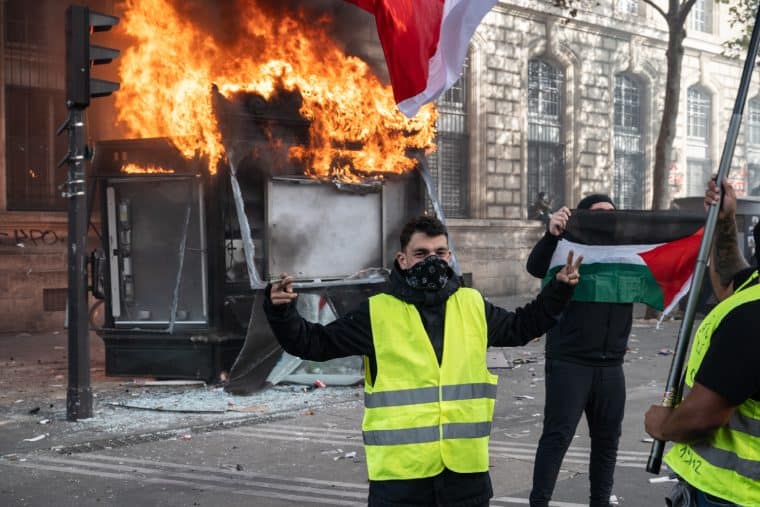
On the streets of Paris on Saturday (Picture: Guy Smallman)
Hundreds of thousands of people raged on the streets of France on Saturday. Around 100,000 turned out in Paris—and 800,000 aross the country.
In Paris, there was broken glass and the remains of barricades all over the city after young people charged through the streets, torching cars and looting shops as they overwhelmed the police.
One homemade placard thanked the school students for starting it. It read, “Merci la jeunesse”—or, “Thank you youth.”
People are revolting against a system that offers them no future and responds with violence when they try to fight back.
In Paris, the overwhelmingly young crowd alternated between setting fire to bins and bus stops and welcoming the firefighters with rounds of applause when they came to put out the flames.
In the Place de la République square, police responded with tear gas and water cannons before people even had a chance to march.
The iconic Statue de la République, a symbol of the French Revolution in the centre of the city, was covered in graffiti.
It was dressed in a giant yellow vest bearing an Extinction Rebellion (XR) logo, a reference to the Yellow Vest movement that exploded across France in 2018.
The crowds erupted in cries of “Siamo tutti antifascisti”—“We are all anti-fascist”. They chanted, “La jeunesse emmerde le Front National”—“The youth tell the Front National to fuck off” in a reference to the previous name of the fascist RN.
Some people joined the march with flags from the Organisation de Solidarité Trans, a group that demands trans+ liberation.
Secondary school students Diana and Julie told Socialist Worker, “Some of the schools are crawling with rats. In summer we are dying in the heat and in the winter we are freezing.
“And we are also against the police. They are tear-gassing and beating us and telling us we can’t protest.”
The pair didn’t think the movement would slow down now that school holidays have started. “There have been protests every day but this is the biggest one because there is everyone,” they said.
Cythère, a supporter of XR, told Socialist Worker, “The young people managed to do something we couldn’t do before—to bring together the fights.
“We have been supporting the movement from the beginning and we offer legal advice. But we are not here to protect them, they know what to do.”
Groups of people in the crowd came dressed in Yellow Vests. Many of them were too young to have been in the movement the last time around.
University student Tess was wearing one of the vests. She explained that there had been calls on social media to bring back the movement as fuel prices are even higher than they were in 2018.
Katya told Socialist Worker, “Our parents used to protest wearing this. It’s mostly against the price of petrol but now there are school students wearing it so it is about other things too. It’s a revival.”
The iconic Statue de la République wirth a Yellow Vest (Picture Guy Smallman)
Some protesters adopted the national flag and national anthem. But many waved flags of Palestine, Congo or Algeria. And some of the placards referenced the massacre of 17 October 1961. That’s when the police carried out a mass killing of Algerian protesters. Many of them drowned in the River Seine.
Student Alesio, with an Algerian flag, told Socialist Worker, “The French Revolution is a scam. The bourgeoisie revolted against the aristocracy for their own gain. We need another revolution for equality.”
Numerous meeting points across France were advertised on social media. And in many cases, hundreds showed up.
Emma went to Gare du Nord station to join a demonstration at 10am. The young artist spoke to Socialist Worker about how there is not enough money for culture and it’s hard to find a job.
She worries about the threat of a fascist winning next year’s presidential elections and about climate collapse.
“Enough with Emmanuel Macron,” she said. “Right now we have a right wing government. There are two possibilities—fascism or something much better. Right now it feels like we already have a foot in fascism.
“In 2050 in Paris it will be 50 degrees celsius. No-one can live with this. The leaves are already dead in summer and there is no water. Something must be done.”
Later in the morning, hospital workers were joined by hundreds of students outside their workplace. The art school students had made a giant Trojan horse that they drove through the streets at high speed, as passing drivers honked their horns in support.
Health worker Ines told Socialist Worker, “There are not enough staff and we can’t care for our patients. The condition of public hospitals is worse each year.”
Ines and her colleague said they had been afraid to come to the protests before but felt that this day was important.
Another health worker, Amel, told Socialist Worker, “They want to cut the budget by billions of euros. It’s a catastrophe. We are already short-staffed in the hospitals and it’s leading to burnout.
“Public services are dying and we are against the way the government responds to us with police violence.
“The media just talks about violence. But I have been on the protests and they are peaceful. It was the police making the tension go up.”
She explained that in her faculty they did protest and it helped improve conditions.
Amel said, “Right now we protest, so that people will understand that at some point they need to strike. But we can’t just abandon our patients by striking. We don’t want people to die.”
Mass numbers on the streets (Picture: Guy Smallman)
Saturday was a day of protest and revolt across France and in other parts of Europe. In Marseille there was a huge demonstration and protesters invaded the city hall. In Lyon they set fire to a branch of the tourist office. In Grenoble, farmers joined the protests.
Elsewhere, 400,000 students protested in Italy against fascist prime minister Giorgia Meloni. They have occupied their schools and said they want to do like the French.
In Germany, school students have started blockading schools to demand funding for education and oppose moves to bring back conscription.
If the movement of mostly young people combines with the power of organised workers, it could be transformative.
France has seen the beginnings of this. For example, school students visited picket lines at the Tiru waste incineration centre earlier in the week and supported striking transport workers in Saint-Denis, north of Paris.
Some of the trade union federations have been slow to join the battle. The gap between strikes is too long. On last Tuesday’s demonstration, thousands of union members in Paris marched separately from the students.
But many ordinary workers recognise the need to unite with the youth and deepen the movement.
Next Saturday, marchers will confront the fascist RN at its conference in Orléans.
There are calls for a day of strike action on 5 November. The challenge is to build it in every workplace.
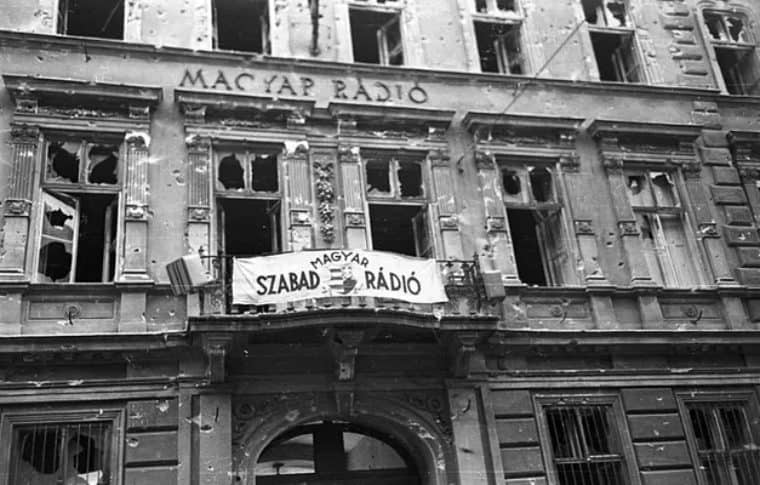
The radio building on Brody Sandor Street in Budapest, Hungary, after 23 October (Picture: Nagy Gyula/Wikimedia Creative Commons)
A stone’s throw from Budapest’s trendy ruin bars where students drink, there is a building like any in your town. Seventy years ago, a clash between Hungarian students and police outside it marked the beginning of one of Europe’s most significant—and forgotten—revolutions.
When they gathered outside the radio building on 23 October 1956, a 17-year old student said “no one thought it would end in revolution”.
By the following morning “an atmosphere of revolution reigned over the city”. Hundreds of thousands of people took to the streets, building barricades and fighting pitched battles against the secret police and tanks.
And workers struck, seized control of their workplaces and set up their own grassroots bodies as alternative organs of political power.
Hungary’s rulers claimed the mantle of Vladimir Lenin and the Russian Revolution of 1917, when workers councils (soviets) had taken power. But the reality was very different. The Russian Revolution, due to international isolation and the devastation of war, had degenerated.
By 1928, the state bureaucracy—with Joseph Stalin at the helm—had developed into a new ruling class with its own set of interests.
The Stalinist regime destroyed the last vestiges of workers’ democracy and unleashed terror. Locked into international military and economic competition with the West, the regime’s goal was to accumulate capital on the backs of workers.
After the Second World War, Russia imposed the “state capitalist” model on its new satellite states in Eastern Europe.
Boom and slump were just as in-built into the Eastern Bloc’s state capitalism as in Western free market capitalism. And, by the time of Stalin’s death in 1953, its ruling classes were facing a crisis.
The brutal methods used for accumulation and building up heavy industry were reaching their limit.
This crisis split the bureaucracy. A “conservative” group feared losing its grip and wanted to maintain Stalin’s methods, while “reformers” wanted to ease repression and shift investment away from heavy industry.
At root, this was a fight between two wings of the ruling class about how best to exploit workers.
In Russia the “reformers”, under Nikita Khrushchev, eventually won the power struggle. The new Russian leadership made clear that Matyas Rakosi’s Hungarian regime had to change course. They installed the “reformer” Imre Nagy as prime minister.
Nagy plotted a “new course”, but his limited reforms were hampered by Rakosi’s supporters and he was ousted in 1955.
Khrushchev then toppled Rakosi, who was replaced by his henchman Erno Gero in 1956. The Russian leader’s “secret speech” to the Twentieth Congress of the Communist Party that year denounced Stalin’s methods and the “cult of personality”.
This caused ideological confusion among Eastern Europe’s rulers, but it also opened up the possibility of people questioning society.
Lenin had written about what made a “revolutionary situation” at the outbreak of the First World War. He said that it had to be “impossible for the ruling classes to maintain their rule without any change”.
This would create splits at the top that would be “a fissure through which the discontent and indignation of the oppressed classes burst forth”.
At the same time, Lenin said that there had to be a determination for “the lower classes not to want to live in the old way”.
Both were true in Hungary in 1956. Discontent first became visible among middle classes—writers and journalists, professionals, junior military officers—who no longer gained material benefits and hoped to reform the system.
The Petofi Circle, an official organisation of the party’s youth organisation, began organising debates. But discontent was brewing in workplaces too.
On 23 October students planned a protest in solidarity with Poland where workers were fighting their own Stalinist regime.
The “fissures” that Lenin wrote about were on full display on that day. Resistance would “burst forth” through them.
At 12.53pm, the music suddenly cut out on Radio Kossuth. The host read out a communique Laszlo Piros, the Minister of the Interior.
“In order to assure public order, the Ministry of the Interior is not permitting any public meetings or demonstrations until further notice,” she said.
Shortly afterwards, Radio Kossuth reported that the deputy interior minister Mihaly Fekete said the ban was lifted to a student meeting at Polytechnic University. “He added that employees and communists in his ministry ‘rallied to the side of honest Hungarians in the interests of change’,” it said.
At 2.23pm, the music stopped abruptly again. “Laszlo Piros, the Minister of the Interior, has withdrawn the ban imposed on public meetings and demonstrations,” the newsreader told listeners.
He added that Communist Party first secretary Erno Gero “will speak tonight at 8pm”.
But thousands of ordinary people had other plans, spurred on by the panic at the top of the regime.
Factories must be directed by workers and technicians and trade unions must truly represent the interests of the Hungarian working class
Shortly before 3pm, university students gathered in front of the statue of Petofi, a Hungarian revolutionary and poet active in the revolution of 1848.
They then marched to join other student at the Bem statue.
Peter Veres, President of the Writers Association, read out the group’s programme . He slammed party leaders for “obstinately organising themselves to restore Stalin’s and Rakosi’s regime of terror”.
The seven-point programme demanded political and economic reforms. “The people must elect their representatives by free, secret ballot,” said one point.
Another declared, “Factories must be directed by workers and technicians,” and, “Trade unions must truly represent the interests of the Hungarian working class”.
It called for Nagy and his allies to be “given the posts they deserve”.
But, after Veres stopped speaking, the protesters did not disperse. The crowd of around 50,000 people—mainly students and writers—crossed over the Danube river and marched on the parliament.
Workers who’d finished their shifts join the march. By 8pm, over 200,000 people were on the streets.
Imre Nagy addresses the crowd outside the parliament building on 23 October
Several flash points that evening radicalised the movement.
The students had issued their own Sixteen Point Manifesto. This went further than the Writers’ Association, for example, demanding “immediate withdrawal of all Soviet troops” rather than a “review of treaties”.
The students cheered Nagy when he appeared, but whistled him down when he started speaking. “Nagy told them that the historical situation was complicated and everyone should go home and wait for developments,” a newspaper reported.
As the “reformer” Nagy spoke, the “conservative” Gero took to the airwaves. His broadcast attacked the students for “barefaced lies” and “hostile slanders” against the Soviet Union.
“Worker-Comrades, workers! We must put it frankly—the question now is whether we want a socialist democracy or a bourgeois democracy,” he said.
In other words, Gero had given demonstrators a choice—either the regime or its overthrow.
The massive crowd outside the parliament split into two demonstrations. Thousands marched on the giant Joseph Stalin monument—and tore down this symbol of their oppression.
“With hammers, iron pipes and other tools, the crowd broke the monument in countless pieces,” one eyewitness told the Manchester Guardian newspaper.
Another crowd marched on the Radio Kossuth building and demanded it broadcast their demands.
At 10.30pm, a delegation went inside to negotiate and was swiftly snatched by the AVH secret police guarding the building. The crowd tried to storm the doors while cops threw back tear gas. Suddenly, the AVH opened fire with machine guns. A murdered protester lay in a pool of blood.
There was no going back now—the revolution had begun. The following day protests and strikes spread across the major towns and cities.
Decapitating the Stalinist regime
The repressive instruments of the state had begun to fracture after the Battle of the Radio Building.
In Budapest, for example, many of the 1,200 police officers came over to the side of the revolution.
The Hungarian military, made up of working class and peasant conscripts, was largely paralysed as soldiers disobeyed orders.
The Third Army Corps, under the command of hardliner General Gyurko, did go into battle. He used Russian MiG fighter jets to attack the crowds in Tiszakecske and Kecskemet, murdering hundreds of protesters. But Gyurko also faced insubordination as he planned a broader airborne campaign.
There was another armed force in Hungary. Gero’s last act was to request Russian tanks roll into Budapest. Within 72 hours there was a mass insurgency across the country.
In Budapest young people, including school children, fought street to street. Soldiers and officers, such as Colonel Pal Maleter, joined the side of the revolution and turned their guns on the Russians.
Nagy was swiftly appointed prime minister on 24 October and Janos Kadar became first secretary of the party.
The Nagy government hoped to restore the bureaucracy’s legitimacy through reforms and bringing the movement under the reformers control.
But it was under political pressure from another force—the workers’ councils.
The first workers’ council was set up on 24 October at the United Electric factory, which employed 10,000 people.
One young worker at the plant told the Observer newspaper, “On Tuesday 23 October we worked, but we talked as we worked.
“We talked about wages, about the results of the writers’ meeting. We had printed copies and knew what they meant when they said it was impossible to go on in this way. We could not live on what we got from our work.
“After work, we saw the students demonstrating and joined in.
“On Wednesday morning the revolt began in our factory. It was unorganised and spontaneous. If it had been organised, the AVH would have known and stopped it before it started.
“The young workers led by the way and everyone followed them.”
By the following day, workers’ councils and factory committees were spreading through Budapest’s workplaces and neighbourhoods.
The major plants were clustered in the Ujpest, Obuda, Angyalfold and Csepel areas of the capital city.
Here, workers set up District Workers’ Councils between 29 and 30 October. And the following day, delegates from 24 plants in the capital held a Parliament of Workers’ Councils of Budapest.
They aimed to bring individual workplaces under democratic control. The delegates resolved, “The supreme controlling body of the factory is the workers’ council democratically elected by the workers.
“The director is employed by the factory. The director and highest employees are to be elected by the workers’ council.
“The director is responsible to the workers’ council in every matter which concerns the factory.”
But workers’ horizons weren’t limited to changes inside workplaces. The workers councils took up political questions and played an important role in fighting the Soviet military.
The second largest centre of workers councils was in Miskolc. On 27 October local radio announced, “For two days the town of Miskolc has been under the leadership of the workers’ council and student parliament.” They linked up with others to form the Borsod County Workers’ Council.
In Gyor, the AVH opened fire on a relatively small demonstration on 24 October, which radicalised the town. Strikes spread. The state’s authority collapsed and was replaced by the National Revolutionary Committee on 26 October.
In Szeged, a smaller town with around 10,000 people, workers’ councils were set up in the factories. They formed a People’s Revolutionary Council on 30 October alongside student groups.
In many places, the councils formed “national guard” militia to defend themselves from the Soviets and security forces.
Hungary was in a situation that Lenin had described as “dual power”—where political power lay with both the Nagy government and the workers’ councils.
The workers’ councils were political bodies and were doing the day-to-day running of society, such as food supply.
But most people did not yet see the potential for the councils to become a new government from below. Many in the workers’ councils supported Nagy and saw their role as pushing him further.
The Nagy government made various concessions in the hope of restoring the bureaucracy’s legitimacy. This included appointing new ministers on 30 October—including Maleter who’d led armed resistance in Budapest.
There were intense political debates inside the workers councils. The most politically-advanced demands came from Miskolc. The president of the city’s national council, argued, “The government must propose the formation of a Revolutionary National Council based upon the workers’ councils of the various regions and Budapest.”
He said it must be “composed of democratically-elected delegates” from the workers’ councils. “At the same time, the old parliament must be dissolved.”
But that was far from the majority view across Hungary. Sandor Bali, a working class militant who had been a Social Democrat and Communist party member, was a leading figure in Budapest.
He argued, “The Hungarian working class developed these workers’ councils quite spontaneously.
“We are well aware that they cannot be political organisations. We know that the workers’ councils will become organs directing our economy.”
This points to a contradiction in all revolutions. Even when people engage in militant and revolutionary acts, they do not abandon all of their “reformist” ideas all at once.
Many still look upwards, hoping for better leaders, even as they are creating a new power from below.
The Hungarian workers’ councils had echoes of the Russian soviets in 1917, which debated those very same questions.
But what was the key difference?
In 1917, revolutionary socialists who wanted workers to take power for themselves were a minority—but they were organised. The Bolshevik party was able to win political positions over a period of time and provide leadership at key points.
In 1956, there was no revolutionary organisation built in advance that could raise the slogan, “All power to the workers’ councils.”
That tradition had been buried under years of Stalinist dictatorship—and the debates were cut short by counter-revolution.
Russian tanks bring counter-revolution
Nagy managed to get a ceasefire and for Russian troops to withdraw from Budapest between 28 to 30 October.
But he soon discovered that Russian troops were massing on the border. The Russian leadership feared that Nagy was going too far—and the far greater threat of the workers’ councils.
So Nagy played his final card. On 1 November, he announced that Hungary would leave the Warsaw Pact military alliance and become a neutral country.
On the same day, Budapest workers’ councils agreed—after sharp debates—that they would call off the strike.
Three days later, Budapest was awoken by the whizz and crash of artillery fire. The counter-revolution had begun.
Russian tanks returned. This time they came with Kadar, whom they’d cut a deal with, to impose a new government.
There was a second period of “dual power”. While Kadar controlled the government buildings, real power lay in the hands of the workers’ councils.
On 12 November, the Ujpest workers’ council called for a Central Workers’ Council in Budapest and it was established.
However, the possibility of a successful insurrection had passed. Over 200,000 Russian troops and 2,000 tanks stood in the way of victory for a working class that had been militarily defeated.
The workers’ councils didn’t want to recognise the legitimacy of the Kadar government. In reality, they were forced to do so in all but name and enter negotiations to extract concessions from it.
Kadar paid lip service to the workers councils having a role in future, but proceeded to pick off leading revolutionaries and wear down the movement. He arrested the entire Central Workers’ Council on 11 December.
Workers continued to fight back into the new year, but the bureaucracy slowly reasserted control.
The Kadar regime never dared to return to the levels of repression that came before 1956—and ploughed money into raising working class living standards.
Despite its defeat, the Hungarian Revolution reasserted the idea that socialism is based on workers liberating themselves.
But it is another reminder that, if you want revolution to win, you need to build a revolutionary organisation now.
Tags: Hungary Posted in In Depth |
Comments Off on Hungary 1956: Europe’s forgotten revolution
Some 86 percent of Scottish women cops reported that they have either been subjected to and/or witnessed sexism and misogyny in the force (Photo credit: rawpixel.com)
Some 45 serving Scottish police officers are currently suspended over allegations of violence against women and girls.
Several former officers have already been convicted for sexual offences.
Some 8,000 police officers are still to be “re-vetted” for their roles despite a change in regulations earlier this year.
Scotland’s top cop, Jo Farrell, acknowledged that the scale of violence against women and girls in Scotland is an “epidemic”. But she refuses to admit that serving police officers are part of that epidemic.
Despite the shocking figures, Farrell claimed women should be confident to come forward and report offending by police officers.
But the police have done nothing to root out the abusers in their ranks.
Scottish cop Cameron Ross was jailed for ten years in July for raping two women and subjecting a third to a campaign of abuse.
Former Scottish cop Campbell Petrie was found guilty of a catalogue of sex crimes, including two counts of rape, over a 17-year period. He was jailed for 12 years this month.
Scottish Cop Alan Greer raped and abused women for 14 years until he took his own life in May this year.
His criminal activities only came to light because a woman he attacked in her home in Glasgow in 2012 reported the attack last year. Greer raped the woman after she called the police to report another crime.
Her courage in stepping forward prompted one of Scotland’s biggest anti-corruption inquiries. It has uncovered a further eight victims, five of whom were sex workers, whom Greer attacked while off duty.
Greer had 17 years of apparently unblemished service when he died in May. Once again, it was the courage of survivors who finally brought his crimes to light—not his colleagues or vetting or safeguarding procedures.
Top cops are still insisting that there were no opportunities to spot his offending sooner and no red flags were missed.
But the Scottish police, like all other police forces, are institutionally sexist—and that’s according to their own boss.
In May 2023 Police Scotland chief constable Sir Iain Livingstone admitted the force “is institutionally racist and discriminatory”.
He was responding to a report which revealed how officers who raise concerns about misogyny and sexism in the force are labelled “a grass” and a “trouble-maker” and feel they have a “target” on their back.
The report also said a “boys’ club culture” exists in parts of the service where “the real team meetings happen on the golf course”.
It said cops often disguise or label sexist behaviour as “banter” and if someone challenges or calls it out, they are seen as not being able to take a take a joke.
Some 86 percent of women cops said they have either been subjected to and/or witnessed sexism and misogyny.
The year before, Police Scotland paid a former female firearms officer almost £1 million after an employment tribunal found she had been victimised for raising concerns about sexism within the force.
And, of course, this is not just unique to Scotland. Alan Greer has been called Police Scotland’s Wayne Couzens. Couzens was the Metropolitan police constable who kidnapped, raped and murdered Sarah Everard in 2021.
Sarah was snatched from the street as she was walking home from a friend’s house towards Brixton in south London. Couzens is serving a whole-life sentence.
His case revealed major vetting failures at the Met. Couzens had exposed himself at a McDonald’s drive-thru days before he murdered Sarah but it was not properly pursued.
Greer could also be compared to David Carrick, a Met police officer who pleaded guilty to multiple counts of rape committed between 2002 and 2021. Carrick is currently serving multiple life sentences.
Police Scotland suggested that Greer was just one “bad apple” and said that he would not pass vetting checks today. But the whole barrel is rotten.
Despite multiple reports and inquiries, the Scottish police, like the Met, will never do anything to uproot sexism. That is because the police force is not there to protect women—it is there to brutalise us in the name of defending law and order.
Tags: Police, Scotland, Sexual violence Posted in News |
Comments Off on Police Scotland suspends 45 cops over allegations of violence against women and girls
Reform UK was plunged deeper into crisis after an investigation exposed its members’ racism and sexism once again.
An ITV Exposed documentary, due to air on Sunday, features undercover recordings of several Reform UK councillors and wannabe councillors.
They have been caught fantasising about sexually assaulting a female candidate, deporting all Asian people from Britain and training up white men to drag Muslims from their homes.
Raymond Dunning is a councillor for Tameside in Greater Manchester. He was recorded saying, “I’d deport every other motherfucker in this country that doesn’t deserve to be here and their children as well.”
He added that “18 to 30 year old young lads” should be trained “up in the army in insurgency tactics”—and then to round people up for deportation.
Dean Miller, a councillor in Bromley, south London, said, “All the ethnic fucking kids, they’re not white, they’re all fucking black, and they’re like fucking animals.” He followed this up by claiming that he’s not racist.
Alan Feeney, councillor for Solihull in the West Midlands, told the undercover reporter about what he calls “Alan’s racist canvassing”. He said he skips every house which is under an Asian name.
He said the area was “infested” with Asian families—and called them “absolute parasites”.
Feeney believes that “no more than 1 percent of the British population can be non-white”. To achieve this, he suggests someone should “literally drag them out their homes, stick them on planes and fuck them off to Pakistan”.
His fellow Solihull councillor Chris Whelan was recorded talking about a female Reform UK candidate. Whelan said he “would have been sniffing that seat as soon as she got up”. “If she’d have given me a hug, I’d have fucking fingered her,” he added.
Miller, Feeney and Whelan have all since resigned from Reform UK, claiming various personal and health reasons.
Reform UK claims it brought in better vetting after the racism of its candidates was exposed before. Farage said this week that “a handful of individuals who do not share our values will initially make it through vetting”.
But the problem isn’t a “few bad apples”—or even a lot of bad apples. Racism against migrants, refugees and Muslims is at the heart of Reform UK, a far right party that blames immigration and multiculturalism for “British decline”.
It should be no wonder that racists want to run for Farage’s party. The racism and the sexism spouted by these councillors and candidates are the values of Reform UK—and have been since day one.
Farage’s party is radicalising as it faces more competition on the far right. Restore Britain, Rupert Lowe’s right wing breakaway from Reform UK, is soaking up votes from Farage by painting itself as “the real deal”.
The revelations show it’s right to target Reform UK for its racism—and label it a far right and racist organisation.
Reform UK is using migrants in small boats as a political card (Pic: Guy Smallman)
Refugees have slammed Reform UK’s plans to tear up the asylum system and deport thousands of people.
Nigel Farage announced plans this week to ban anyone from claiming asylum for up to five years if Reform UK wins the next general election.
In its dystopian proposals, the far right party says that 90,000 asylum seekers with existing outstanding claims would also be immediately deported.
Mohammed is a Syrian refugee who came to Britain two years ago. Farage’s plans would see him sent back to a country torn apart by a bloody civil war.
“To go back to my country is not a small, but a very large risk,” he told Socialist Worker. “I didn’t choose to come to this country, my choices were taken away from me.
“As asylum seekers we don’t have options about where we will go. We travel through jungles, forests and sea—not because we want to but for safety.”
He said the British government, “takes positions that are creating conflicts and then won’t help the people who suffer. Many come from wars that this country has been involved in.”
Aomar sought asylum after fleeing Balochistan province in Pakistan after he was shot twice. He was diagnosed in 2023 with PTSD while living in one of multinational outsourcer Serco’s overcrowded migrant hotels.
He told Socialist Worker that the uncertainty and cruel living conditions he experienced as an asylum seeker took a drastic toll on his physical and mental health.
“The hardest part is the years you wait between arriving and being accepted or not, not knowing how long it will take,” he explained.
Aomar said being banned from working, as all asylum seekers are, made life intolerable.
“Without the right to work you just sit in the hotels,” he said. “For years, I just eat and sleep, eat and sleep.”
“We are expected to live on just £8 a day. Each day I think that I’m exchanging my dignity, my personal freedom for a few portions of rice. I think I could leave the hotel but I don’t have enough money to go anywhere.”
Both Aomar and Mohammed felt that Reform UK’s proposals are an attempt to blame asylum seekers and people on “small boats” for social problems.
“Politicians have created wars around the world. So, when people come to this country to seek sanctuary it is because of them,” said Aomar.
“They are playing with people’s lives, using the ‘small boats’ as a political card that they can play to say it’s our fault there is an NHS issue, a jobs issue.”
Mohammed agreed that “Farage wants to create fear to make a war against us.”
“He wants everyone to be scared of asylum seekers and then make himself the hero by saying he can solve the problem,” he said.
“But what he plans is no solution, it will only make things worse.”
He added, “People don’t have the right information because of the media and the politicians about what life is like for asylum seekers.
“Instead of the Home Office giving money to Mears and Serco to run migrant accommodation, it could be going to pay for case workers to get our claims processed and we could work and contribute. That’s all we want.
“If I could, I would tell people not to believe in politicians that don’t stand by their word. Nigel Farage has taken donations and lied.
“He lies about us, we are not bad people like he says, but we don’t have any power so we’re easy to blame.”
Reform UK is on the back foot after a series of corruption scandals.
But that doesn’t mean the far right party will just melt away. In fact, these proposals show that Reform UK is pulling even further rightwards as it faces competition on the right from Restore Britain.
Taking on the far right’s lies about migrants and refugees is vital to push it back.
Oakley demonstrates to a modern audience that Austen’s work is much more than the romance at its core
This adaptation of Jane Austen’s much-loved novel Sense and Sensibility draws out the cleverness of the writer’s work. It makes a 200 year old novel relatable to today’s viewers.
Oakley gives us an onscreen rendering of two sisters whose hearts are entrapped by the boundaries of society, portraying them with a complexity often denied them by critics.
In many tellings, the two Dashwood sisters are simplified as direct depictions of the book’s title.
Elinor Dashwood, the eldest sister—played by Daisy Edgar-Jones—is said to reflect sense and logic. Marianne Dashwood, the younger sister, portrayed by Esmé Creed-Miles, represents wild sensibility.
There is an element of this in the new adaptation, but here the two sisters better demonstrate the true complexity of Austen’s writing.
The contrast between the sisters’ romances is clear.
Marianne’s passionate and obsessive romance with the charming Mr Willoughby ends in disillusionment when his facade is shattered.
This contrasts with the loving romance of Elinor and Edward Ferrars, played by George MacKay, which has to navigate the bounds of honour and status.
Too often Austen’s novels are dismissed as simple romances where women fall for hard-to-love men who just so happen to be extremely wealthy.
One reviewer famously said Austen’s work is “just a bunch of people going to each other’s houses”.
But Oakley demonstrates to a modern audience that Austen’s work is so much more than the romance often at its core.
The portrayal of London society, where you’re never quite alone, is perfectly depicted in the intimate conversation between Elinor and Edward amongst crowds of strangers in the National Gallery.
And, the contrast is there again when the freedom of the countryside is depicted. Here, love runs free from the refinement and order that constrains London society.
When it comes to the women, the film shows how they must rely on men and their families for stability and status.
Even the coldness of Fanny, the Dashwoods’ sister-in-law, is presented as a reflection of women’s societal insecurity.
Fanny convinces her husband to limit how much of his fortune he shares with his grieving, and now effectively homeless, family.
And so, whilst Austen doesn’t necessarily tear down the barriers of society that restrain her characters, she does hold a mirror up to society and force it to look at itself.
The film observes how society’s rigid rules come up against human desire and passion and create explosions of emotion—even in the most “sensible” of people.
And, despite the period costumes and the language of a story set over 200 years ago, the battle between heart and mind in the context of societal expectations very much echoes the feelings of many today.
We’re told that if we play by the rules, get a “proper” degree and rise up the career ladder, eventually we will reap the benefits.
And yet these rules have never worked in our favour. In fact, they work against us today, just as they did in Jane Austen’s time.
And so, despite the omission of some key favourite scenes from the novel, Oakley beautifully captures the complexities, the wonder and the exhilaration of an Austen novel while making it feel relevant today.
Sense and Sensibility, directed by Georgia Oakley, is in cinemas now
Tags: Film, Reviews Posted in Reviews & Culture |
Comments Off on This tale of two sisters still speaks to us today
Anti-fascism and anti-racism are one side of the coin, and class struggle is the other
I was one of the anti-fascists who confronted the far right Restore Britain party in Camden, north London, during the recent Holborn and St Pancras by-election campaign.
We chased off the fascists at the heart of Restore Britain’s operation for three Saturdays in a row.
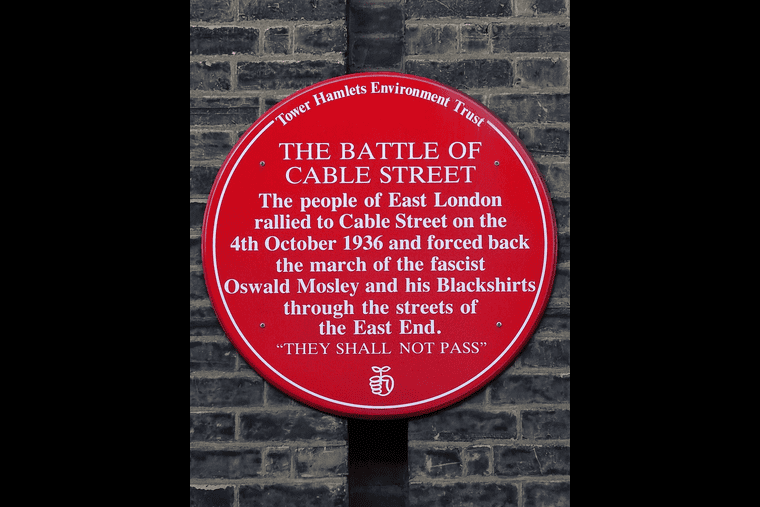
As we did so, we were inspired by the militant anti-fascist tradition and the Battle of Cable Street, which took place in east London 90 years ago.
The tactic of physically confronting fascists in the streets was what stopped Oswald Mosley and his British Union of Fascists (BUF) in London and elsewhere.
It was crucial to defend the mostly Jewish area that Mosley was targeting.
But not everyone accepted this tactic. It was a position that had to be fought for.
The Labour Party, the Board of Deputies of British Jews and several newspapers all urged people to stay away or stay at home. They argued that it should be left to the police and local authorities to “maintain law and order”.
Even the Communist Party (CP) had planned a youth rally in solidarity with the anti-fascist struggle in Spain at Trafalgar Square miles away instead. Until the Friday before the battle, it was still calling on anti-fascists to go to central London.
But, Communists in Stepney mobilised against the BUF, calling on people to mobilise in the East End, not Trafalgar Square.
On the day, huge numbers of people prevented the police from clearing a path through the area for Mosley and the BUF to march through.
Blockades and barricades were set up with trams and lorries, and large numbers of people filling the streets.
The organisers were able to stop the fascists and, a week later, held a mass victory parade through the same streets.
Nevertheless, the CP recognised that some working class people in Stepney were being drawn in by Mosley’s scapegoating of Jewish people.
They faced terrible living conditions and rising unemployment. The fascists exploited the disillusionment people felt, making empty promises but delivering nothing.
The CP saw the necessity of “exposing the fascists to their own supporters” and putting down “roots in the people” of Stepney if it wanted to build a permanent force.
The party involved itself in working class struggles, such as rent strikes and the fight against evictions.
In his memoir, Our Flag Stays Red, Phil Piratin describes how the CP stopped landlords evicting a family in 1937. Communists organised huge numbers of people to stop the eviction using barricades and flour bombs.
After successfully seeing off the bailiffs, whole families of BUF supporters tore up their membership cards because the Communists had proved that they were the real force defending working class interests.
Today, we must look for similar opportunities to embed the anti-racist struggle in the working class.
The conditions we face—soaring rents, collapsing health services and rising unemployment—are eerily similar. The far right builds on disillusionment with mainstream politics but offers nothing to ordinary people.
The only way we can stop the fascists and win gains for our side is through organised working class activity.
Today, there are many on the left who argue that the left should just focus on “community organising” around social issues. But ignoring the cancer of racism in our class does not lessen its devastating effects—it makes our task harder.
That is why anti-fascism and anti-racism are one side of the coin, and class struggle is the other.
We need militant anti-fascism to stop the fascists growing—and working class struggles to give people hope.
“We are going to stay out until we win—we’re determined,” was the message from striking operating theatre workers on a vibrant “mega picket” in Leeds last Friday.
Unison members at Leeds Teaching Hospitals NHS Trust began an indefinite strike on Monday as part of a long-running battle over re-banding.
They are furious at being paid at band 2—the lowest NHS pay band—despite performing vital duties.
These include reducing infection risks, assisting with specialist surgical equipment, supporting clinical teams during operations and helping patients recover afterwards.
One striker based at Leeds General Infirmary (LGI) told Socialist Worker, “It’s a lot of responsibility. We do a lot of training for this and we should be recognised for it.
“People are dealing with death on a daily basis, there’s a psychological and emotional side to our job too.”
The operating theatre workers have already taken 40 days of discontinuous action over more than 18 months. Strikers told Socialist Worker that escalating to an all-out strike was the only way to win.
“It’s costing the Trust massive amounts of money to cover these shifts. So, how long is it going to sustain this without putting the Trust into massive debt?
“It’s paying enhanced rates for other staff to cover the work that we’d normally do. So, it’s in its interest to get back around the table and sort this,” she said.
Strikers are furious that other workers are covering their shifts during the strike.
One worker appealed to other NHS staff employed by the Trust to support them by refusing overtime.
“Our strike opens up the opportunity for overtime, really well-paid overtime, for other members of staff to take easier shifts for more money,” they said.
“I would like to see the union circulate the information around our colleagues and to ask them not to take that overtime for a week or two. That would make a real difference because when they work those shifts it undermines the impact of our strike.”
She is absolutely right. All health unions at the Trust should tell their members not to do the strikers’ work. If the operating theatre workers win, everyone fighting for better pay gets a boost.
Another striker explained how low pay is having catastrophic consequences for the NHS.
“When I started working in the NHS fourteen years ago, band 2 was quite a bit above minimum wage. But that’s been squeezed to nothing.
“We’ve slowly got to the point that now the stalwart, loyal NHS workers, are not just considering leaving the job they’re in, but leaving the NHS completely. I always say the NHS isn’t failing, it’s being failed.
“The hourly rate for an NHS worker at band 2 is just £12.92. It’s really difficult to keep up with basic expenses. Once all your bills have come out there’s barely anything left,” he said.
“I worry when I hear the latest inflation rates because I’m thinking how am I going to keep up? My pay isn’t going up by that much.”
The employer remains unwilling to resolve the dispute or enter meaningful negotiations, despite more than 100 NHS trusts having already agreed re-grading.
Unison should increase the pressure to stop strikebreaking at the Trust and fight for greater solidarity across the trade union movement.
An RMT union member told Socialist Worker at the mega picket said he had come with members of his branch.
They were there to return the favour after other unions supported them in their own battles over the past year.
“That’s what being in a union is about.
“You always have to support other colleagues in other trade unions because you need that joint up approach to win. And you have to get the public on side as well.”