
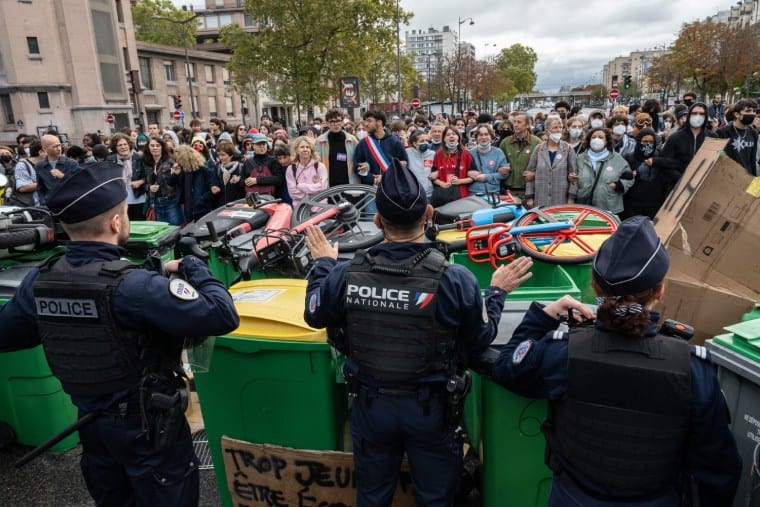
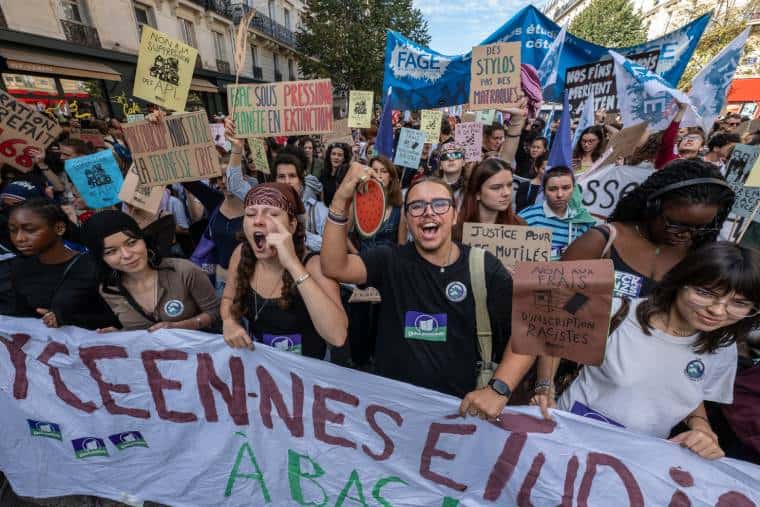
On the streets of Paris ahead of the march on Tuesday (Picture: Guy Smallman)
Young protesters rocked France on Tuesday in another round of militant protests.
The movement of blockades that started in secondary schools in the poorer suburbs of Paris has spread across the country, pulling in university students and workers.
School blockades took place on Tuesday ahead of mass marches across the country that were joined by union members. At Hélène Boucher school in Paris, hundreds gathered at the entrance to the building, blocking it with green plastic wheelie bins.
When the signal was given, they took their barricade into the road to block Cours de Vincennes, one of the main routes through the city. The students outnumbered police, who were forced to direct traffic around the main junction in all four directions as they awaited reinforcements—which eventually arrived in the form of several van loads of CRS riot cops.
“We hope for the resignation of Emmanuel Macron and his government,” one school student in Paris told Socialist Worker, “As well as apologies to the families of the injured children.
“If I am optimistic, I hope for a revolution, and if we are dreaming, Macron to the guillotine.
“Because we are too pacifist and we are waiting for change from a state that does not listen to us, treats us like criminals and is violent towards us.”
Basile, another secondary school student, told Socialist Worker, “The movement was formed around the blockades. That’s our method of action, and we’re going to continue like that. We know we can’t keep this up forever, but we’ll think about what to do next later.
“Right now, at least until the holidays, we have to stay here. Some people are saying that the unions shouldn’t join us because the movement is student-led, and they’re afraid the unions will co-opt it.
“I also understand that we need everyone to win and that we’re also fighting for public services. I don’t know what I think about it. Because it’s true that to have the strength to continue, it would be good if teachers went on strike a lot and we weren’t all alone in carrying the burden.”
The movement has faced fierce repression from the police and some young people have been left with horrific injuries. They include a 15 year old whose hand was blown off and a 14 year old with a fractured jaw after being hit in the head by a tear gas grenade. There have been over 6,000 arrests since the movement began last month, mostly of under 18 year olds.
Late on Thursday last week, the state pledged to send 3,000 more teachers to the schools as an emergency measure to fill staffing gaps. But the government’s measures have done little to quell people’s anger.
They mean little when prime minister Sébastien Lecornu is trying to push a budget through in parliament that promises £46 billion worth of cuts.
“We need all the workers to join the students,” student Hélia told Socialist Worker on the Tuesday morning blockade. “We need everyone to converge in our fights. And we need to go as far as we need to get what we want.
“I want to see all the union federations, the left parties join. We want their help. We desperately need them because we are students and it’s been two and a half weeks already of us blocking everything.”

Students, parents and workers link arms outside the school on Tuesday (Pic: Guy Smallman)
Hélia explained that police have targeted certain neighbourhoods more than others. He said, “We don’t see a lot of police brutality. It’s only when we block the whole road. But in the poorer suburbs they do what they want. They hit everyone, they shoot with flash balls. The police are racist, homophobic, transphobic.”
Emily, a young worker for a not for profit organisation said, “It’s important when you are an adult to come to these things and to support them, because I know it can get a bit rough. Even apart from the physical violence I know a lot of students are getting tired.”
“I’m also part of an anti-fascist group from this neighbourhood. Being here is a way to talk about this with them, talk about the upcoming presidential election with a far right party in the lead. That’s also something we have to fight collectively.”
Danielle Simonnet, a member of the French parliament in the left wing party L’Après, was also at the school to show her support for the students.
She told Socialist Worker that students’ demands go beyond wanting more funding and teachers in schools. “It’s like ‘68. It’s a historic movement. In every country around the world young people are for Palestine. In every country young people are for the climate. And on every demonstration we are against the Rassemblement National, against the extreme right, against racism and against antisemitism. We are for equality.”
CGT general secretary Sophie Binet has raged against the state repression of students whose futures are being stolen.
She said, “Rarely have the living and studying conditions of young people been so degraded. This generation has grown up with the climate crisis, terrorism, Covid, wars, and now the prospect of a world of work disrupted by artificial intelligence.”
Olivier Clément from the CFDT union federation in Paris told Socialist Worker, “It’s important for trade unions to be in solidarity with the high school students’ demands.
“We are there to protect the young people. And, their demands cross ours with some of the same concerns. So, we’ll be in the Parisian streets with young protesters.”
The movement has shown how action by young people can be a lightning rod for wider anger at the system.
Last Thursday huge crowds gathered at the Bastille in Paris where they faced police baton charges.
University students blockaded their campuses and held mass assemblies, including one in Nantes with thousands of people. And some 10,000 people gathered for a rally led by left wing presidential candidate Jean-Luc Mélenchon in the city of Clermont-Ferrand on Sunday.
In Vitrolles, near Marseille in the south of the country, truck drivers have restarted go slow protests bringing traffic to a standstill over rising fuel prices.
This Saturday there are calls for protests over the cost of living, which are drawing comparisons with the Yellow Vest movement that exploded across France in 2018, where tens of thousands of people in high-vis yellow vests took part in road blockades.

Students got to the school to set up blockades from early in the morning on Tuesday (Pic: Guy Smallman)
Some figures on the left have condemned violence from the school students. So Binet says, “We can debate their methods, and we must of course condemn the violence committed against staff or institutions.”
But university students and workers overwhelmingly recognise that the violence comes from the police and want to show their solidarity with the school students.
There are questions about where the movement goes next. After Friday this week, schools will break up for two weeks of holiday. Can the movement of blockades sustain itself?
Will workers join in larger numbers that could really shut down sections of industry and force the government to roll back its budget plans?
And can the movement stop the threat of the fascist RN. School students are chanting against the fascists. But will they march and disrupt their conference on 24 October and stop them from building a base?
All that is possible—but it requires the movement to deepen and develop into a confrontation with the French state and the system it defends.






Alex Callinicos: Zack Polanski must hold not fold over Zionism is racism motion
Zack Polanski speaking at the We Demand Change summit last spring before he became Green Party leader (Picture: Guy Smallman)
Zack Polanski should take it as a compliment that he and the Green Party are getting the Jeremy Corbyn treatment. It means that the British establishment sees them as a threat. He needs not to buckle in the face of this pressure.
The assault takes the same form as the campaign mounted against Corbyn during his leadership of the Labour Party between 2015 and 2020—on the one hand, a frenzied media assault, on the other, attacks from within by the right wing of the party, all centring on the libel that their target is an antisemite.
The moral quality of the media campaign has been beneath contempt. Tony Blair, butcher of Iraq and pensioner of billionaire Donald Trump crony Larry Ellison, is leading the charge. He declaims the Greens “have crossed a line” by having the effrontery to declare that Zionism is racist. The Telegraph newspaper has managed to hit a new low by publishing a revolting anti‑Green cartoon insulting both Jews and Muslims.
Meanwhile, Green ex-leaders, headed by Caroline Lucas— never a reliable friend of the Palestinian cause—have taken advantage of Polanski’s failure to win the Holborn and St Pancras by-election. Uncomfortable with how he has been turning the Greens into a dynamic, mass “eco-populist” party, they want to push him out of the leadership.
It is of course nonsense to deny that, however the Zionist movement started in the 19th century, it now exists to sustain and defend a genocidal racist apartheid state. The fact that the Green Party conference passed a motion to this effect is a result of the gigantic learning process that has hammered this truth home to hundreds of millions of people globally in the three years since 7 October 2023.
Polanski’s achievements are closely bound up with this process. He spotted that the emergence of the huge Palestine solidarity movement and the failure of the Labour government under Keir Starmer to begin to address the cost‑of-living crisis offered an opening for the Greens.
Hannah Spencer’s thumping victory for the Greens in the Gorton and Denton by-election in February and their advances in the local 3elections in May were successes for this strategy. Undoubtedly, they helped to precipitate Starmer’s removal by Andy Burnham, who has tried with a degree of success to rebrand Labour as a more conventional social‑democratic party.
The resulting “Burnham bounce” is the main reason why Polanski lost in Holborn and St Pancras. The Zionism is racism vote was too close to the by-election to have had much effect. But the media campaign that has been running for months to brand Polanski—himself a Jew—as antisemitic probably did.
What he has to do now is keep his nerve and hold firm.
One factor in Corbyn’s demise was the tendency of his leadership team to respond to the attacks with concessions and manoeuvres. These left Corbyn on the defensive and demoralised his supporters.
Polanski must understand that time is on his side. Burnham is very unlikely to deliver on his promises of substantial social change. Moreover, the Palestine movement represents something that didn’t exist when Corbyn led Labour—a vast, sustained and increasingly radicalised effort at solidarity that reaches deep into British society.
That’s a source of strength. Polanski’s biggest weakness is his own party—historically a niche, predominantly middle class electoral project. The Greens’ record in local councils isn’t much better than that of the mainstream parties. And in the rest of Europe, a degree of electoral success has helped to transform Green parties into rotten pro-imperialist parties—witness their denunciation of the Zionism is racism vote.
So far, Polanski has ducked, dived and hedged over what he calls in Monday’s Guardian newspaper “this imperfect motion”. But he hasn’t capitulated, writing that “its substance chimes with my understanding of Zionism as the ideology that underpins the displacement and genocide of Palestinians”.
Nevertheless, he will have to fight to change the Greens so that the party becomes a genuine reflection of the movement that has made their successes possible. And that movement also needs a strong and independent revolutionary left that can fight for the real transformation of society.
Posted in Alex Callinicos, Comment, Palestine & Middle East | Comments Off on Alex Callinicos: Zack Polanski must hold not fold over Zionism is racism motion