Tens of thousands of people from all sorts of backgrounds supported the movement (Photo: WikipediaCommons)
A revived Cockroach youth movement is once again on the charge in India.
The student-led mass movement this summer brought down the country’s education minister following scandals in university entrance exams.
In a few weeks of struggle the movement did more damage to the far right government of Narendra Modi than the official parliamentary opposition has done in years.
Now it is back and targeting Modi’s attacks on democracy.
A mass demonstration is planned for the New Delhi capital this Saturday, and already of police are cordoning-off the Jantar Mantar protest site and preparing for battle.
Protesters’ anger centres on the so-called Special Intensive Review—known as the Sir—which has so far removed over 130 million names from the Indian electoral roll.
That means millions of people have now lost their right to vote, and research suggests that it is overwhelmingly Muslims who are being struck off the list.
The Indian Express newspaper says that in the past 10 months, two out of three Election Commissioners raised a series of formal objections to the process with chief commissioner Gyanesh Kumar.
Leading Cockroach and All-India Student Association activist Aameen Amitoj told the Socialist Worker that the revived movement has “enormous potential.”
“What’s happening right now is a phenomenon where issues around the Sir have become issues of mass struggle,” he said.
“We saw a similar process in the farmers’ movement in 2020-21. The movement started out with farmers, it was sustained by farmers, but it did not remain exclusive to farmers.
“Instead, it became a mass issue where people from all sorts of backgrounds supported the movement.
“For a long time the Sir process was put under scrutiny by intellectuals and commentators but that has changed since the newspaper revelations.”
Aameen says new protests are now drawing lots of new forces, as well as many of the students who participated in the earlier round of struggle.
“This movement has a lot of potential, given that democracy and the integrity of the vote is central to all of the people, to every citizen,” he says.
“That’s why the opposition leaders—led by the Congress party—and student organisations such as ours, are taking up civil questions outside the ambit of education.”
And Ameen says that the stake in this latest fight could not be higher.
“The outcome of the struggle not only calls into question the whole Sir process,” he says. “It also questions the subsequent West Bengal state elections—which Modi’s BJP party won— and the 2024 Lok Sabha general election through which Modi came to power.
“I think we are at a threshold where the fundamental basis of the present regime stands questioned.
“So, we are hopeful and optimistic that through peaceful means we can win our basic demand—that Gyanesh Kumar must resign.”
Aameen Amitoj is part of India’s Cockroach movement in New Delhi and participated in an indefinite hunger strike in support of it. He is a leading member of the All-India Student Association (AISA), which is the student wing of the Communist Party of India (Marxist-Leninist) Liberation
Tags: India Posted in International |
Comments Off on India’s Cockroaches are back for a second bite
Has politics been taken over by demagogs? (Pic: Gage Skidmore on flickr)
Politics are increasingly polarised. Support for the political centre is ebbing away and flowing towards the parties of the far right and, sometimes, the far left.
This is a tendency. Voters can also be won back by mainstream parties.
And those fearful of the rise of the far right, and growing social antagonism, can feel nostalgic for the old two-party system.
But political polarisation is not conjured up by devious politicians—it is rooted in the development of capitalism itself.
Political scientists have identified various kinds of political polarisation. The most damaging is “pernicious polarisation”. This occurs when society is divided and a “them and us” hostility develops around an issue.
Pernicious polarisation involves the demonisation of the “other” and the exploitation of people’s anger. In particular, it creates the potential for violence to erupt against a religious, national or ethnic group.
Some argue that polarisation is occurring because mainstream parties have been captured by political extremists.
But in Polarised—Making Sense of a Divided America, James E Campbell argues that such extremists have always contested for power and influence at moments of conflict and social crisis.
Manipulative political elites do exploit and intensify divisive ideas and demonising rhetoric—but such figures always hover on the margins. We have to explain why politics is becoming more polarised now.
The European political centre established dominance over the electoral process after the Second World War.
The economy was expanding. The welfare state was established. Trade unions fought for, and sometimes won, higher wages.
This economic boom created some political stability. It led to a growth in technical, managerial and civil service jobs. More young people were allowed to access higher education.
The growth of the managerial classes appeared to be a refutation of Marxism.
In the Communist Manifesto, Karl Marx and Frederick Engels had argued that capitalism would progressively simplify social relations into a conflict between two antagonistic classes—the bourgeoisie and the proletariat.
But capitalist societies generated more complex social structures. The middle classes grew and the managerial social layer expanded.
Many working class people hoped and expected their children would get an education and aspire to a better standard of living.
Marx was also criticised for suggesting the working class would become increasingly immiserated and impoverished. But the growth of public services like health and education, and of pensions and unemployment benefits created a safety net that protected people from destitution.
The post-war boom and the relative political stability that rested on it are the exceptions in the history of capitalism.
Marx’s analysis provides the only approach capable of unearthing the economic roots of political polarisation.
Marx argues that competition propels companies to drive others out of business. Power and wealth become concentrated in fewer hands.
Today, large multinational corporations dominate global markets. Wealth inequality has increased in advanced economies.
Those children of working class families who went to university and got professional jobs as university lecturers or health workers, face “proletarianisation”. They have insecure contracts, low pay and managerial scrutiny. They are often at the sharp edge of trade union struggle.
The safety net of the welfare state has been eroded.
Political polarisation is not caused by demagogic politicians.
It is rooted in the rise of inequality, the erosion of the security and well-being of many who saw themselves as middle class and the destruction of the welfare state.
So, don’t mourn for the old order. Polarisation is inevitable—but the victory of the right is not.
Armed Israeli settlers attempted to steal sheep from the villagers
Israeli settlers attacked the village of Umm al-Khair in the West Bank once again this week as they try to steal more Palestinian land.
“Settlers keep attacking our community. They attacked the house in the early hours of the morning,” Eid, a resident of the village, told Socialist Worker.
Settlers have attacked the Bedouin village near Hebron many times before. They have shut the gates to Masafer Yatta, the collection of villages it is a part of. Three villages in Masafer Yatta have been destroyed by settlers in the past month.
The settlers are backed by Israeli forces and the Israeli government.
“In the early morning on Thursday, the Israeli military detained one lady for five hours in a military base,” Eid told Socialist Worker. Videos show a significant military presence standing guard over the settlers breaking international law in front of them.
“Settlers attacked another lady and beat her and pushed her to the ground. They also sprayed two guys with pepper spray in their eyes. They tried to steal our sheep and put barbed wire around them.
“The Israeli military just stood there, doing nothing to stop them. Mainly they helped them and stood to the side.”
Mahmoud, another resident, told Socialist Worker, “The settlers are armed and protected by the Israeli military. They are armed with modern automatic weapons, tear gas, and often operate under the direct protection and backing of the Israeli military.”
The settlers attacked again on Friday. This time, no one was hurt. But the Israeli forces confiscated Palestinians’ cameras in order to examine the footage they had of the settlers.
Around 750,000 settlers live across the 500 illegal Israeli settlements in the West Bank. Andy Burnham’s Labour government has recently banned trade in goods with these settlements due to the immense pressure of the Palestine movement.
The Israeli government threatened to close the British consulate in East Jerusalem in response. But Britain and Israel have brokered a compromise that allows a diplomatic mission to continue.
Palestine activists in Britain are keeping up the pressure for the Labour government to go further. Labour now acknowledges that settlers are carrying out ethnic cleansing. But they are backed by the whole state.
Pushing for an arms and trade embargo is vital to mount pressure.
Eid told Socialist Worker, “Later on, they declared our village is a closed military zone.”
“We are feeling alone, we can’t stand against armed settlers and the Israeli military. They’re trying to expel us from our lands using brutal methods,” Mahmoud told Socialist Worker.
“We keep steadfast until we are free. But the situation on the ground is difficult. The people here face risk every moment.”
30 October: International day of action in support of dock and port workers. See Stop The War for more info. What can you do in your union branch, workplace or campus?
Activists outside Woolwich Crown Court support the Filton 25
Trade unionists gathered at Woolwich Crown Court in south London on Friday to support members of the Filton 25 who are on trial.
The defendants in Trial 3 have been on trial since 21 September for their alleged role in taking action to destroy drones made in Britain by Israeli firm Elbit Systems two years ago.
They are Qesser Zuhrah, Heba Muraisi, Zahra Farooque, Kamran Ahmed, Moiz Ibrahim and Liam Mullany. All of the group were imprisoned on remand, in some cases for up to 458 days. And several of them were on hunger strike.
Outside the court, protesters chanted, “Direct action saves lives, free the Filton 25.”
UCU union London region chair Mandy Brown said, “Solidarity is the main thing that trade unions can do.
“We cannot sit by and let the state pick off, isolate, punish, imprison beyond the legal limit without trial and then brand as terrorists, people who are standing up against genocide and our government’s complicity in that genocide.”
Phil Rowan, the political officer of the RMT union’s London region, spoke about how his union had invited Filton 25 defendants to come to their meetings and speak to the workers.
He said, “In the last couple of weeks we’ve seen massive protests in France and in Spain. We’ve seen thousands of people blocking the Garvaghy Road to stop a sectarian march going down it.
“You’ll see on all these demos the Palestine flag flying and Palestine has helped politicise the young people.
“Students and young people have gone out, demonstrated, fought the police and it’s the young people who have dragged the trade unions behind them.”
RMT general secretary Eddie Dempsey addressed the way the state’s authoritarian turn impacts trade unionists in the workplace.
“The right to protest, the right to dissent is being criminalised in this country. And that is a concern for every citizen, every trade unionist and anyone who believes in freedom,” he said.
The protest itself faced restrictions as they were pushed to the other side of a dual carriageway by police and not allowed to use megaphones for part of the rally.
The rally also heard solidarity messages from Jo Grady, the general secretary of the UCU and Ian Hodson, the president of the Bfawu union.
Hundreds of thousands of people across the trade union movement oppose the state ban on Palestine Action and it is the policy of the TUC union federation.
Trade unionists can raise the question of state repression of Palestine activists and invite Filton defendants into their workplaces and union meetings.
As Mandy argued, “This also gives us a space to talk about the bigger issues that we don’t get a chance to talk about. About imperialism, about what could be a solution for the Palestine people and about the global march towards war.”
Palestine activists outside the arms factory in Leicestershire
Palestine activists slam Leicestershire police repression
Leicestershire police ran riot at a peaceful vigil against Israel’s genocide at Elbit’s UAV-Tactical Systems weapons factory on Thursday.
The police arrested at least 30 people under the Terrorism Act. Only 16 of those arrested were holding signs that read, “I oppose genocide. I support Palestine Action”.
The others arrested were observers. Three of them were accredited journalists and four were photographers and videographers.
Cops arrested them under section 12 of the Terrorism Act 2000, punishable with 14 years’ imprisonment.
A spokesperson for Defend Our Juries (DOJ) said, “Leicestershire Police should be ashamed of this sickening assault on free speech.
“Ed Miliband has acknowledged that Israel is committing ethnic cleansing and war crimes, and that the British government will uphold international law.
“So why does the government allow Elbit Systems to profit from genocide, while cracking down on those shining a light on its crimes?
“If the government has any integrity, it will put a stop to these embarrassing scenes right now.
“If it defends the proscription in the Supreme Court, it’s Andy Burnham who will own this national disgrace.”
Campaigners in Leicester have protested regularly outside the factory gates, calling for it to be shut down.
The DOJ campaign has been forced to continue its Lift the Ban on Palestine Action under the new prime minister.
Colleen Molloy, a 70 year-old retired educator and charity worker from Leicester said, “I’m here today because I wish to expose government hypocrisy.
“I agree with Ed Miliband when he said Palestine protesters were right. Young people from the group Palestine Action acting with love to stop a genocide are not terrorists.
“The real terrorists are the Israeli leadership who have destroyed Gaza, targeted vital infrastructure and killed and maimed children, medical workers, journalists, farmers, teachers and poets.
“Britain’s support for Israel and its arms factories must stop.”
Tags: Palestine Posted in News, Palestine & Middle East |
Comments Off on Trade unions rally in support of Filton 25 Palestine activists on trial
And the combined vote is 2 points higher than Reform UK’s vote in the 2024 general election.
Restore Britain’s campaign in Holborn and St Pancras has been getting lots of coverage – or rather, their humiliation has.
For the three weekends in a row leading up to the election, Stand Up To Racism (SUTR) activists confronted and chased Restore Britain off the streets.
SUTR exposed the Nazis and antisemites—including former members of the fascist BNP—running Restore Britain’s campaign.
Candidate Tyler Johnstone was nominated by vicious antisemite Patrick McGinnis, and associated with former BNP official Michael Newland.
Richard Donnelly, a senior researcher for SUTR, told Socialist Worker, “Restore has not been able simply to campaign unchallenged and normalise itself.
“That has made it much harder for Restore to present itself simply as another respectable electoral party.
“Restore supporter Gregory Moffitt, known as ‘Young Bob’, was arrested after assaulting anti-racists when we opposed his presence in the Holborn campaign.”
But Richard warned against writing off Restore Britain—the fact that it won so many votes in multicultural inner city London is a warning.
“Nobody should conclude that Restore has disappeared just because they came sixth,” he said.
“Our investigation showed former BNP and Homeland figures taking practical roles in the campaign, including nominating the candidate and distributing material.
“The danger is in the attempt to bring those networks together into a durable political organisation. That is why continuing to organise against Restore after the by-election matters.
“We are encouraging anti-racist across Britain to disrupt Restore’s campaign stalls, branch meetings and activities. We should not wait for Restore to become a fully-fledged fascist party. It already has a serious fascist core, including national campaigns director Charlie Downes. We must break it while it is still beatable.”
Owen is an SUTR supporter in the constituency who was part of confronting Restore Britain.
“We were absolutely right to disrupt them to send the message that we don’t debate with fascists,” he told Socialist Worker.
“I would encourage everyone to get involved in building a local SUTR group. We need to ensure that there is a large network of anti-racists capable of responding to fascists trying to operate in their neighbourhoods.
“If we didn’t have the numbers we had, things could’ve gone very differently.”
Don’t wait for Restore Britain to become a fully-fledged fascist party—confront it now.
Tags: Anti-fascism Posted in Anti-racism, News |
Comments Off on ‘We confronted Restore Britain in Holborn & St Pancras—now you should too’
The Holborn and St Pancras by-election was one of the first major tests of Andy Burnham’s Labour government (Picture: Number 10/Flickr)
The Labour Party has held Holborn and St Pancras in a boost for Andy Burnham’s leadership—and a blow for Zack Polanski and the Greens.
The by-election result on Friday shows that Burnham has boosted Labour’s polling and arrested the loss of voters to the Greens.
But it still has a way to go after the depths of unpopularity under Keir Starmer.
Labour candidate Sagal Abdi-Wali won with 12,292 votes on 45.1 percent while Green leader and candidate Polanski came second with 8,928, on 32.8 percent.
The Tories trailed behind on 5.9 percent with 1,922 votes, Reform UK on 5.9 percent with 1,612 votes and the Lib Dems on 3.4 percent with 924 votes.
Rupert Lowe’s Restore Britain—which had known fascists at the heart of its campaign—scraped in sixth on 2.5 percent with 692 votes.
The vote shows Labour was up compared to the drubbing it received in the local elections in England on 7 May. These triggered the ousting of Keir Starmer, the former Holborn and St Pancras MP, as party leader.
But it is still down compared to the general election in 2024.
Elections expert professor John Curtice says, “If we look at what happened in this constituency in the 7 May local elections, the Greens were just 4 percent behind. Now, in contrast, Labour are 12 points ahead.
“This essentially mirrors the national opinion polls. Labour is about 7 points above where it was when Burnham was elected leader, but it is still 7 or 8 points down where they were in the 2024 general election.”
In the by-election, Labour is “4 points down where it was in the general election, but 7 points above where it was in the local elections” in the area.
Curtice summed up what’s behind Labour’s changing fortunes—“The short answer to that question is Andy Burnham.”
Burnham has pitched leftwards, albeit mainly rhetorically, and now announced the flagship policy of a National Care Service. When he promises “the biggest changes in 40 years” and slams Margaret Thatcher’s legacy, it chimes with working class voters.
In Camden, the borough that includes the constituency, Socialist Worker has reported on two strikes of traffic wardens and teaching assistants.
When Socialist Worker went to the picket lines, strikers were furious with the Labour-run council that is led by Abdi-Wali. But many said they still planned to vote for Labour because of its promises nationally.
Palestine was a key flashpoint in Holborn and St Pancras in the general election where Starmer was the candidate. Here, the picture is more complicated for Labour to win back voters.
The Labour government has significantly shifted its tone on Palestine. Foreign secretary Ed Miliband has declared, “You were right,” to the “millions of people who have been moved and outraged by the plight of the Palestinian people”.
Labour announced sanctions on trade with settlements in the occupied territory. Miliband said that there is “ethnic cleansing of Palestinians in areas of the West Bank perpetrated by settler terrorists”.
But it appears night and day compared to Keir Starmer who said Israel had the right to cut of water, power and food to Gaza at the beginning of the genocide.
That will help Labour win back some voters who jumped ship to the Greens and halt new defections. This will have been true for some in Holborn and St Pancras—even though the Labour candidate, who was a loyal Starmer supporter, has stayed silent on Palestine.
But the Greens have managed to retain a core of voters who broke with Labour over Palestine in the general election. Polling for the Palestine Solidarity Campaign (PSC) in June showed that many of these voters want the British government to go much further—for example, an arms embargo on Israel.
In 2024 in Holborn and St Pancras, the left vote was split between independent candidate Andrew Feinstein, who made a dramatic breakthrough, and the Green Party. Feinstein backed the Greens this time round.
Polanski’s vote was up 3 points on the combined vote of Feinstein and the Greens. Although it was down 3 points compared to what the Greens got in the area in the local elections in the area on 7 May.
There are groups of voters that aren’t going back to Labour very easily—18 to 24 year olds and many Muslims.
As Curtice comments, “If Labour was demonstrating that it had started to reconnect with the Muslim community, they would have done better than simply lose 4 percent
“This is a constituency where 20 percent of the vote is Muslim, where Labour’s vote fell very heavily in 2024. There is very little sign of that being recovered.”
He added, “Bear in mind that 45 percent compares to 70 percent Labour got when Jeremy Corbyn was leader.
“However controversial that motion was, the Greens stance on Gaza has enabled them to win a significant share.”
Delegates at the Green Party conference last weekend passed a “Zionism is racism” motion in a victory for the Palestine solidarity movement.
It called for “the establishment of a single democratic, Palestinian state in all of historic Palestine” with “Jerusalem as its capital” and “equal rights for all”. And “Palestinians and their descendants” must have “the right of return” to the home they were ethnically cleansed from, it says.
The Greens were right to pass it—Zionism is racism.
The political centre and mainstream media are spearheading an assault on the Green Party over the motion.
They have used Polanski’s loss in Holborn and St Pancras as an opportunity to ramp up the pressure and demand his resignation. “Defeated, yes, but—more significantly—confronting a wall of questions about his party, his leadership, his judgement, his future,” smeared the BBC.
Figures inside the Green Party, such as former leader Caroline Lucas, attacked the motion on the night of the election.
They partly fear that the motion will lose the Green Party votes just as it’s being squeezed by Burnham. The underlying pressure to moderate is rooted in the nature of electoralism, which sees change as coming primarily through winning votes.
Polanski was already pitching the Greens as a ginger group to Burnham’s Labour—and equivocated over the motion in interviews on Friday morning.
The key thing is building the struggle outside of electoral politics. Wouldn’t it be powerful if Polanski now called on his 9,000 voters to join the Palestine demonstration in London on Saturday as a next step?
Burnham has promised change, but he isn’t willing to defy big business and the bond markets to deliver it. This means that, after the bounce, there will be a Burnham betrayal.
That will help feed the far right, as will Labour’s failure to break with the war on migrants.
Restore Britain was chased off the streets of Camden by Stand Up To Racism (SUTR). But the combined vote of Reform UK and Restore Britain was up 2 points on what the far right got in 2024. The threat of the far right across Britain is still vast.
The need for building the anti-racist movement across Britain, with roots in workplaces and communities, is a key task for the left.
And we have to build the widest possible solidarity for workers’ struggles that have the potential to deliver the change millions desperately need.
Tags: Greens, Labour Posted in Labour, News |
Comments Off on Labour holds back Greens in Holborn & St Pancras—but no landslide
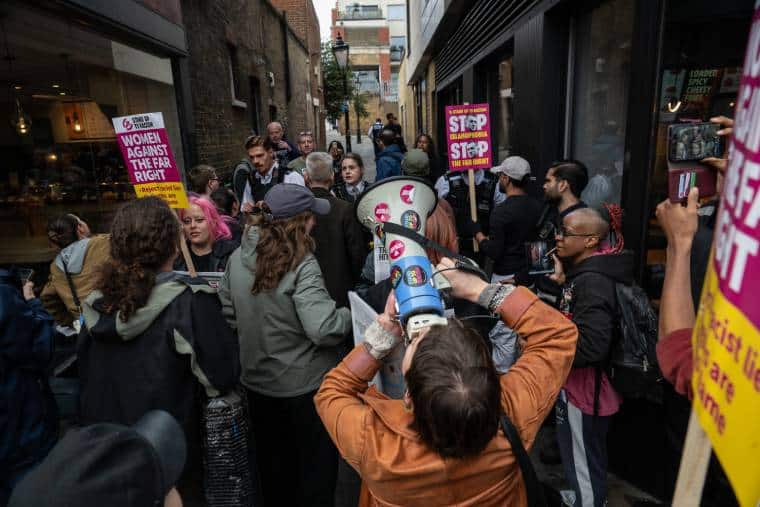
Women Against the Far Right joined protests against the burka ban
Anti-racists have slammed far right Reform UK for proposing a “burqa ban” at the Scottish parliament.
Members of the Scottish parliament (MSPs) debated a motion put forward by Reform UK MSP Thomas Kerr on Thursday, as anti-racists protested outside.
Kerr said, “We want a full ban—no exemptions, no double standards, just pure common sense.”
Mariam Ahmed is the CEO of Amina—the Muslim Women’s Resource Centre. She told Socialist Worker, “Thomas Kerr is hijacking violence against women and weaponising it so he can push this narrative, his anti-migrant, anti-Muslim agenda.
“Firstly, women who do wear the niqab or the burqa are a very small minority. But that’s their personal choice. If we are a country that is meant to support women’s rights then we have to give them the freedom to wear what they want.
“I would like to live in a society where women are empowered to make their own decisions about how they want to dress and live.”
Around 60 people from across Scotland protested outside the parliament in Edinburgh, as the debate on the motion began.
The protest was called by Amina, Women Against the Far Right (WAFR) Scotland, Stand Up To Racism Scotland and Sisters Against Cuts.
Talat Yaqoob is co-convenor of WAFRS and founder of Pass the Mic.
“We often see the burqa ban come up as a debate when there is another attempt to divide communities,” she told Socialist Worker.
She described it as an attempt “to paint Muslim communities, migrant communities, communities of colour as other”.
“There is an attempt to try and use the burqa and clothing of Muslim women as a dividing line,” she said.
“It’s no surprise that a party like Reform UK has put forward this debate, because they have consistently tried to pursue division and endorsed disinformation. It’s not a surprise that they’ve done it. But it is completely unacceptable.”
Thomas Kerr is an ex-Tory, having defected to Reform UK in January 2025 when he sat on Glasgow City Council. Kerr said earlier this year he would “really welcome” the opportunity to join fascist street patrol group Scots Active.
They fantasise about shooting Muslims and have been seen making Nazi salutes at anti-immigration protests in Glasgow.
The burqa ban motion was supported by 15 of the other 16 Reform MSPs—and Tory Stephen Kerr.
Muslim women are at the sharp end of racism and sexism.
Tory leader Kemi Badenoch declared last summer that she does not speak to women in her surgery if they are wearing a burqa. She argued that bosses should be able to ban their workers from wearing such face coverings.
When politicians demonise Muslim women, it fuels the far right and racist attacks.
Talat said, “We’ve seen in recent years an increase in the number of racist hate crimes. We’ve seen an increase in Islamophobia and an increase in misogyny.
“Muslim women experience all three of those. And hijab wearing or burqa wearing Muslim women disproportionately so.”
Miriam agreed, “Kerr is contributing to a real increase in racially motivated attacks by singling Muslim women out and making them visible targets for discrimination and Islamophobia.”
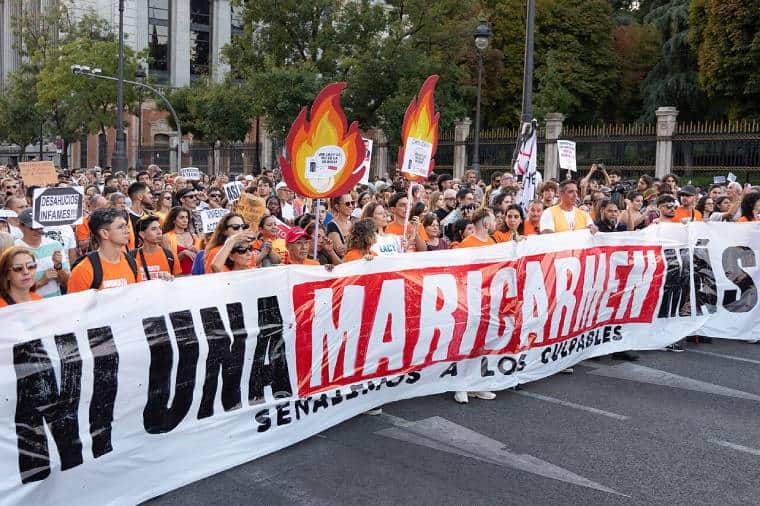
Madrid protesters so ‘no more Maricarmens’ (Pic: Wikimedia commons)
“This was not a death—this was a murder” chanted thousands of protesters who took to the streets of Madrid on Wednesday night.
They were brought out onto the streets by the news that María del Carmen Abascal, known as Maricarmen, had died.
Maricarmen spent most of her life living quietly in the apartment she had rented for decades in Madrid—until she was forcibly evicted from her home and became a symbol for millions of people who are struggling to pay their rent.
A shrine was set up in Madrid’s Puerta del Sol, where around 1,000 people are involved in an encampment protesting against housing costs.
And two major union federations, the UGT and CCOO, have called for a general strike over low wages and high housing costs to take place on 11 November.
Spanish socialist Jesús told Socialist Worker, “Just one day after all trade unions together called for a general strike for rising salaries and the right to have a home, Maricarmen died.
“Maricarmen was an 87 year-old woman who was forcibly evicted from her home by a financial fund, and became the symbol of the protests.
“We working class people know that she was killed by speculators who play with our lives and treat us as numbers.
“Demonstrations are taking the streets and the squares are occupied by the movement. And altars with pictures of Maricarmen together with flowers and candles are appearing.
“We want life at the centre of society, not the capitalist system and its sacrifice of life.
“The movement after Maricarmen’s eviction and murder is a political earthquake—a general strike on 11 November and the general election will be held on 29 November.
“Maricarmen will be with us as we fight.”
Prime minister Pedro Sánchez was forced to call a general election after half a million people joined protests across the Spanish state and after his proposals to appease the movement were defeated in Congress.
He wants to corral the movement on the streets into an election campaign that returns him to power.
But the mood among many campaigners is to demand more fundamental change. They want an end to evictions of vulnerable people and rent freezes. And they want an end to vulture capitalists profiting from their homes.
Among many messages left by the door of Maricarmen’s old home was one that read, “Your death won’t be in vain. We will continue the struggle.”
“She was the flame that led us to start this encampment and protest,” 28 year-old receptionist María Holgado said outside her tent at the Puerta del Sol.
“Her death shocked us and left us all incredibly sad, but I believe it will give us more energy and conviction to keep protesting and demanding our rights so that there is not one more murder.
“The blame falls on the property owners and vulture funds that are taking advantage of a basic right and making loads of money from it.”
Tags: Housing, Spain Posted in International, News |
Comments Off on ‘Maricarmen will be with us as we fight,’ say Spanish housing protesters after pensioner’s death