Israeli soldiers search homes in Umm al-Khair last month
Israeli forces withdrew from the city of Hebron in the West Bank on Monday morning after a ten-day siege.
But they left a trail of death and destruction behind—and are planning new assaults.
The Israeli military launched the siege after it murdered two Palestinian freedom fighters, who had shot dead two soldiers.
Israelis had already begun demolition of Palestinian neighbourhoods near the site of the shooting.
Reem, a head teacher in Hebron, told Socialist Worker, “The whole city was affected by the siege.
“The seven gates of the city were closed. We were under siege. We were not allowed to leave the city.
“Some people were more affected than others. But throughout the whole city, not many people could go out and buy things and traffic was less than usual.
“Schools were closed because it was difficult for teachers to reach them and because it was not safe.
“Settlers made use of the closure of the city. They attacked the farmers who were harvesting olives and kicked them out of their lands and stole the olive harvest.”
Israeli settlers attacked Palestinian olive groves at least 401 times last month.
Nisreen, who lives in Hebron, told Socialist Worker, “The army carried out forced displacement and closed off neighborhoods and the city.”
The Israeli withdrawal from Hebron does not mean much for villagers under constant attack from settlers.
Mahmoud is from the village of Umm al-Khair in the West Bank. “I think they will put more and more obstacles in the lives of the Palestinian people until it becomes impossible,” he told Socialist Worker.
“Umm al-Khair is now surrounded by three gates and the first one was closed for five days last week.
“The new ones are open, but the settlers will close them in time.
“Settlers attacked ten teachers in Masafer Yatta, our collection of villages, on Sunday.”
The Israeli settlers have the full support of the state to ethnically cleanse Palestinians and steal their land.
Mahmoud said, “It’s forbidden to speak to settlers, photograph them or treat them poorly.
“The settlers are a red line and there will be harsh punishment if you break these rules.
“They will put you in detention in terrible conditions—a small dark room where they brutally assault you.”
As well as in the West Bank, Israel is keeping up its attacks in Gaza. An Israeli drone murdered five Palestinians in al-Mawasi near Khan Younis on Sunday.
Another three were killed in drone strikes on the Rimal neighbourhood in Gaza city, including a four year old boy.
Reform UK councillors’ disgusting sexist attitudes are the values of the far right party—and have been since day one (Picture: Reform UK)
Reform UK councillor George Madgwick has been charged with 12 counts of rape, the Crown Prosecution Service has announced.
The CPS confirmed it “has decided to prosecute George Madgwick for serious sexual offences, including multiple counts of rape”.
“He has also been charged with making a threat to kill, false imprisonment and stalking,” it said.
Madgwick was the leader of the Reform UK on Hampshire county council. He has been charged with a total of 35 offences, including two counts of sexual assault, two counts of assault by penetration, two counts of making and one count of distributing indecent images of a child.
He will appear at Portsmouth magistrates court on 25 November. Hampshire police launched their investigation on 24 July last year after receiving a report of a sexual offence.
In September Daniel “Tommo” Thomas and the fascist Patriot Platform mobilised against refugees in Portsmouth.
Madgwick was at the scene—and defended the protests as “normal local families” reacting to government policy.
Stand Up To Racism condemned his actions as “disgraceful behaviour” fuelling fascist movements.
In March, Madgwick boasted of the “fantastic day” he had spent with Nigel Farage in Portsmouth. They went for a pint together.
When Madgwick was elected last May, Reform MP Suella Braverman, said, “I have known of George’s record and political success for years.
“He is a fearless campaigner who speaks for ordinary people and is never afraid to challenge the political establishment.”
Madgwick accused ITV of “election interference” after two journalists infiltrated the party and did an expose. He was caught out by the journalist praising the far right Portsmouth Patriots.
The far right pose as defenders of women’s rights.
In June 2025, Madgwick recorded a video about a sexual assault allegedly carried out by a car with Wolverhampton number plates. He demanded that abuse by “cross border” private hire drivers must stop.
The same month, Madgwick accused city officials of ordering councillors to stay silent about the housing status of a man charged with rape in Southsea. The accused was housed at a refugee hotel in the area.
Madgwick claimed he had been silenced to prevent the inflaming of “community tensions”.
Sophia Beach from Women Against the Far Right told Socialist Worker, “The news about Madgwick is shocking, but not surprising.
“Reform UK’s disgusting sexist attitudes were exposed in the ITV documentary, but Farage has defended these men to the hilt.
“The far right thugs who attacked refugee hotels are more likely to have been reported for domestic violence than the rest of the population.
“Women are sick of the far right racists weaponising violence against women and girls.”
Tags: Reform UK, Sexual violence Posted in News |
Comments Off on Reform UK councillor charged with 12 counts of rape
Some 1.6 million joined protests across France (Pic: Guy Smallman)
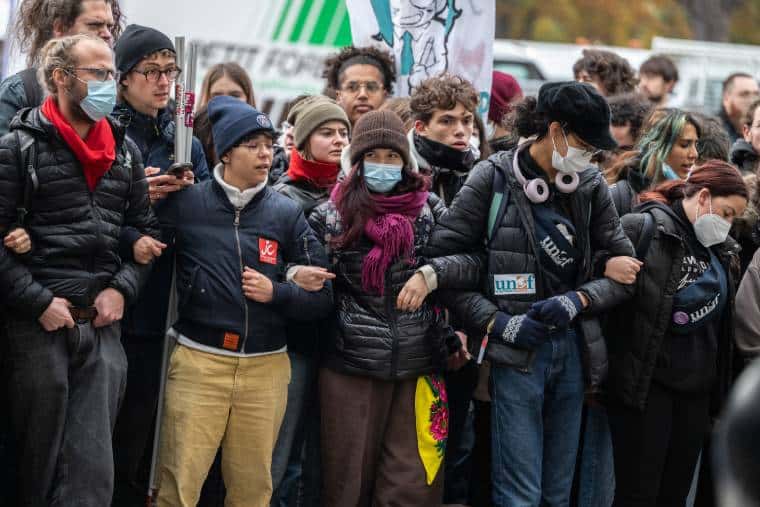
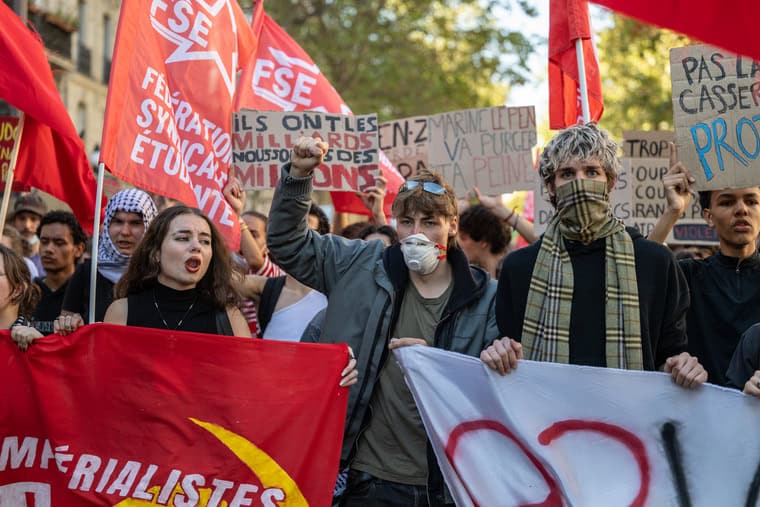
Striking workers and students flooded the streets of Paris on Thursday. Organisers said that 1.6 million marched, including some 350,000 in the capital.
At Le Havre, huge numbers of dock workers joined the march. Some 50,000 marched in Lyon and there were mass protests in at least 70 towns and cities including Marseille, Toulouse, Bordeaux, Grenoble and elsewhere.
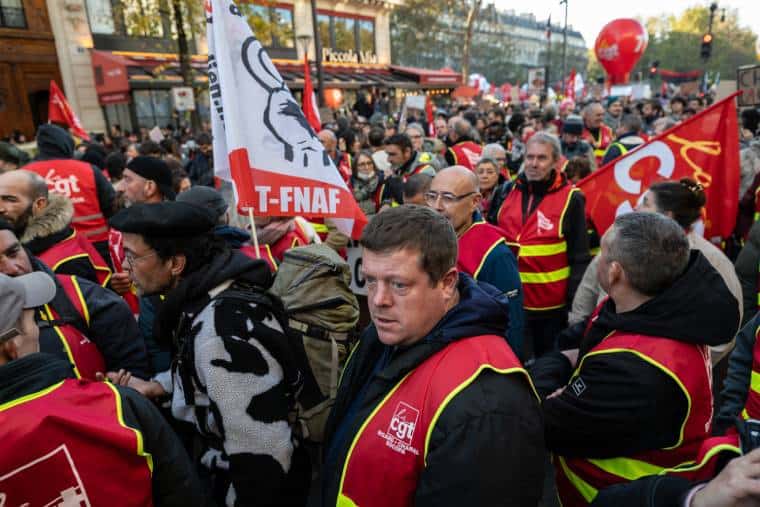
The general strike was supported by all the major union federations. And in Paris their supporters formed huge blocs that packed the streets.
The march brought together the unions’ sounds systems with floats created by art college students including a giant papier-mâché sculpture of president Emmanuel Macron looming over a burning school building.
A bloc of lawyers dressed in their black robes carried a banner reading “Colère noire”, a reference to the “black rage” they feel about the repression handed out to young people.
Protesters brought huge Palestine flags and anti-fascist chants regularly spread through the crowd.
Arnaud, a striking firefighter, told Socialist Worker that as a firefighter he is demanding better conditions because the state doesn’t reward workers and the public will pay the price if the fire service is eroded.
As a father, he demands a better future for the next generation. And as a son he stands with the retired people who get less and less each year.
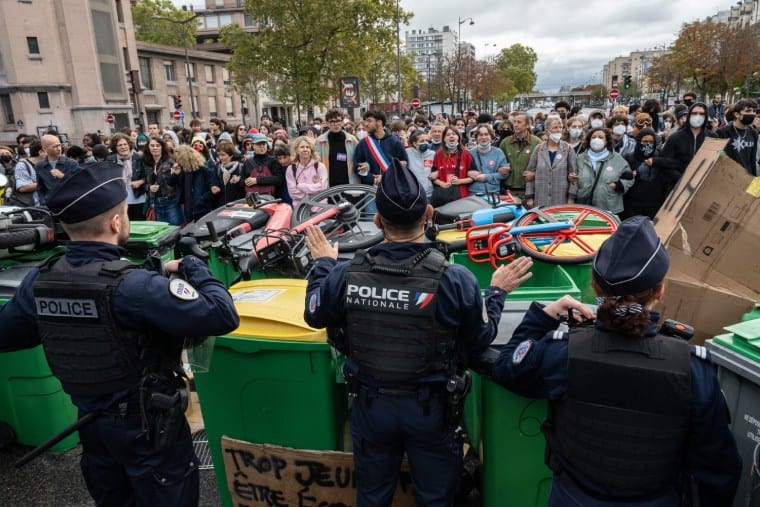
The day began with school students blockading their secondary schools. At the Hélène Boucher school in central Paris, police removed the blockades and aggressively forced the students to move, knocking some of them to the ground as they surrounded them and subjected them to bag checks.
But later that morning school students had regrouped and were using plastic wheelie bins to blockade the Rue de Rivoli and facing riot police in the centre of the city.
The movement was started by school students blockading their schools (Pic: Guy Smallman)
Students and workers from the suburb of Saint-Denis spontaneously marched through the Gare du Nord rail station before forming a feeder march to join the main demonstration.
They were led by rail and hospital workers and students and workers from the Paul Éluard school.
When they arrived they were briefly stopped by the police. But the cops were forced to give way.
Guillaume, a striking rail worker, said that the strike was strong, especially among train drivers. He told Socialist Worker that wages had not kept up with inflation and that energy prices had doubled in 15 years.
“There is a lot of money for shareholders and nothing for salaries,” he said. “We don’t have a political party for the workers here. The only movement for labour is here on the streets.
“After today, I think this movement will continue. The government doesn’t listen to the people and the police are very tough with young people. When they hit young people I think it’s time to strike.”
Paul Éluard was one of the first schools to be blockaded as school students refused to tolerate the conditions. Schoolworkers have been on strike there since 24 September for more resources and against police violence. It’s a renewable strike—workers decide each day whether to continue.
School student Monica told Socialist Worker, “We have been part of it since day one at our school. People around the world look at the news and think that we are always angry in France. But we have reason to be. We have had 10 years of Macron.
“We had the Gilets Jaunes protest over fuel prices. They told us things would change but nothing has changed. A lot of people are cold during the winter with no money for heating.”
At the Voltaire school, workers have also walked out on strike this week. They started picketing early in the morning, held a meeting in a local cafe and joined the main demonstration alongside students.
Strikers across the city had a choice about whether to join the protests as individuals or whether to organise and picket their workplace as a group.
Workers at the natural history museum formed a picket line in the morning. Marie from the CGT union federation explained that they have been in dispute for six months with the library closed by strikes every Saturday.
“At first it was about salaries,” she told Socialist Worker. “But we talked to each other during the strikes and we have other demands around the arrangement of the work and the management practices. When we all talked we realised it was something we all faced.
“Today is a national day. What is different today is that we are joining forces with students, university workers and workers from other museums.”
Members of the CGT union federation form a huge bloc as part of the Paris demonstration (Pic: Guy Smallman)
Marie added that it’s important to join the demonstration in a group from the same workplace as some people feel nervous about joining the marches alone.
Kaïna, also a striking museum worker, said that workers themselves had voted to hold a picket line after a general assembly of 150 people.
She told Socialist Worker, “The picket line is an occasion to meet with other colleagues. And it’s important to be visible to the visitors to the museum. Most of them don’t even realise there are so many workers here.”
Other strikers were less confident. A worker from a consulting firm said he had not managed to get other colleagues to join the strike so far although he had tried to talk to them.
NGO worker Sam said that workers face low wages and lots of work pressure, “because it’s for a good cause”.
Sam said union members had organised at her workplace by holding general assemblies every week and going from door to door to speak to people about the strike.
The movement in France was started by teenage school students. Some argue that the school students’ demands should be more prominent—and that workers should be careful not to “take over” with their own issues.
But many workers say that their own demands are the same as those in the schools.
Sam told Socialist Worker, “We need to move on from talking about ‘helping’ and ‘protecting’ the students to talking about solidarity with our own strikes. The best way to protect them is to join them in the struggle and build our own power.”
But workers will have to organise against the trade union bureaucracy, which seeks to contain the movement’s potential. This means pushing for organisation and action at the base that goes beyond the union leaders’ vision.
Thursday’s general strike was a spectacular show of strength against Macron’s government and against the attempts by the police to contain it. CGT union federation leader Sophie Binet has promised to escalate the movement “to the next level”. To make this a reality and defeat Macron’s budget, workers will need to organise and spread the roots of the strike movement into every workplace.
Consultants on the picket line at UCH hospital in central London in 2023 (Picture: Guy Smallman)
Hospital consultants and specialist doctors in England are preparing to strike later this month in a long-running fight over pay.
The government has earmarked a rise of just 2.4 percent for them—and all other health workers—next year, despite having earlier promised doctors “pay restoration.”
The doctors’ BMA union says time is running out for health secretary Yvette Cooper to take “meaningful steps” to avoid the 48-hour walkout set to begin on Wednesday 25 November.
Matt, an anaesthetist in Liverpool, said the mood among his colleagues was “disappointment” with the government.
“We’re annoyed that we’re in the same situation we were a few years ago, even after ministers promised something completely different,” he said.
“Just a modicum of fairness is all people want really.”
Matt says the Department of Health has “forced” doctors into preparing for strikes.
“There’s a strong feeling that there’s a profession to defend here,” he says.
“We feel a bit embarrassed about our lack of industrial action in the previous 20 years, to be honest, and the state we’ve left the profession in.
“And I think there is a view that says, if we don’t stand up and make a fight at some point, there’ll be nothing left for future generations.”
The decline of the NHS, and staff pay, can be traced back to the years following the 2008 financial crisis”, says Matt.
“Our pay has been cut in real terms by a third during the past 20 years of austerity,” he says.
“At the negotiation at the end of our last dispute in 2024, we were told we’d see a gradual restoration of our pay over several years, and in the future, an independent review body would look at our pay.
“But they, basically, just lied to us.
“So a 2.4 percent rise is another real terms pay cut. I don’t see how anyone in the NHS takes another real terms pay cut again.”
“Maybe we were fooled 20 years ago, at the end of the banking crisis. Back then, people said you’ve got to take a tough cut. And now 20 years later, it’s the same story. They are still saying they can’t afford to pay us.
“How come they can’t afford to pay us, but the bankers are still back on big money? I don’t see how that washes. Why can’t we tax billionaires? Why do we even have to have bankers?”
Matt says the impact of decades of doctors’ pay erosion can be seen easily across the profession.
“It’s a well-trodden path, starting at medical school and doing your training, and you can see the people on the ladder ahead of you, and those behind you.
“The people who are doing the same work as I did when I was a junior, now haven’t got the same prospects as I had. And it’s the same for me, looking at the people above me.”
In the past, employers have tried to use divide-and-rule tactics to separate consultants and doctors from the rest of the NHS workforce. Matt says the unions must stand firm and united against this.
“We need decent pay rises across the board, if we want a health service to function. A victory for one set of workers is also a victory for the next set.”
Farewell to Trump? (Photo: Flickr / Official White House Photo by Tia Dufour)
Donald Trump is a lame duck president—and the far right is reeling—after humiliating defeats in the US mid term elections.
The Republicans were preparing for a “blue wave” of Democratic victories on Wednesday. When it came, it was a tsunami.
The Democrats now hold a majority in both chambers of the US Congress. This is only the third time in 50 years that a party has lost control of the House of Representatives and the Senate at once.
The Republicans didn’t hold on to congressional seats that they had gerrymandered. They redrew the boundaries of districts in Florida, North Carolina, Alabama and Texas to stop Democrats gaining majorities—and failed.
Key wins include Texas where James Talarico, who leaned leftwards in the campaign, has won the Senate seat by over one million votes. He is the first Democrat to win a Texas Senate seat since 1988.
The Democrats also flipped previous Republican strongholds of Kansas, North and South Carolina, Ohio, Iowa and Maine.
Tech billionaires tried to buy the election—but they failed. A record $11.9 billion has been spent on campaigning and advertising, the majority by Republicans.
Much of this money has come from “dark money” sources, such as cryptocurrency and rule-bending non-profits. Elon Musk alone gave nearly half a billion dollars to the Republican campaign.
The midterms were a devastating verdict on Trump’s second term.
His presidency has been plagued with war, violent deportations and a spiralling cost of living crisis.
The US war on Iran has driven up inflation, in particular food and fuel prices. And the tariffs introduced by Trump at the start of his second term had already made many goods more expensive to buy in the US.
Prices for petrol increased 34.2 percent over the 12-month period ending September.
US oil corporations have raked in more than $130 billion in profits during the war—up from $47 billion last year.
But all Trump did was boast about the rich getting richer and laugh in voters faces. At a rally at the end of last month, the president said, “The United States oil and gas business is making hundreds of billions of dollars.
“I don’t give a damn, I’m going to say it—we’re making a freaking fortune.”
A Washington Post-ABC News-Ipsos poll in October put his economic approval rating at just 28 percent.
Trump pitched himself as an “anti-establishment” outsider who would restore the “American Dream”. But the Republicans pushed more of the same policies that hammered working class people while lining the pockets of the super-rich.
Trump’s failures fuelled a right wing radicalisation of the regime, particularly around mass deportations.
The violent abductions and deportations carried out by Ice were another key factor in the mid-terms.
Black, brown and Latino people face harassment and danger regardless of their citizenship status.
Latinos, who in 2024 voted evenly for Trump and Democratic candidate Kamala Harris, turned away from the Republican Party.
This includes people who buy into the right wing lie that immigration is a problem. Javier Villalobos is the Republican mayor of McAllen in Texas. “Inflation, the economy, everything is important,” he says.
“But what hits you immediately, what hits personally is the crackdown, when you see the ICE agents, masked, and pulling people out of vehicles.”
He says Republican voters who support “border security” have been driven away by “a crackdown on the Hispanic community”.
A recent CBS News poll found nearly 60 percent of Latinos believe the Trump administration has deported more people than they expected.
The scale of Trump’s deportation programme has caused tensions between some bosses, who rely on racist divide and rule and migrant labour.
Benny Melendez, a Latino citizen who owns a small construction company, voted for Joe Biden in 2020 and Trump in 2024.
He has built a fence around his company to stop Ice agents rounding up his workers. “Now I regret my vote for Trump,” he says.
In several of the swing states, progressive and left-leaning Democratic candidates have swept up huge victories.
Talarico ran on a campaign of better public funding, repealing tax cuts for the 1 percent. He has called for an end to the Iran war and arms sales to Benjamin Netanyahu’s government, albeit not Israel.
Michigan was another key race. The state has had a Democratic senator for 12 years, but voted for Trump in 2016 and 2024.
Democratic candidate Abdul El Sayed ran a simple campaign—“Get money out of politics, put money in your pocket, and pass Medicare for All.”
Mike, a trade unionist in Michigan, told Socialist Worker, “Palestine has galvanised people.
“For the first time in history a pro-Palestinian position is popular in the US and among Democratic voters it is overwhelmingly popular.
“Abdul El-Sayed’s campaign focused on the cost of living, but he didn’t dodge questions about Palestine or trans rights issues.”
El Sayed has been the target of attacks from both sides. Israel supporter Haley Stevens, who he defeated in the race to be the Democratic candidate, endorsed Republican Mike Rogers just days before the election.
Despite this, El Sayed won with over 6 points between him and Rogers.
Mike added, “The conventional wisdom from the Democratic leadership is that you have to appeal to the centre.
“But people who vote Republican from an anti-establishment feeling are more easily won by progressive candidates than moderates.
“I think the Haley Stevens thing was bigger than just Israel. It was a section of the Democratic right wing who are really scared of the rise of the Democratic Socialists of America (DSA) and progressives.”
In Florida, Democrat Angie Nixon came just shy of victory against Ashley Moody. Nixon is a progressive, aligned with Bernie Sanders and a member of the DSA.
Anti-choice bigots threw $80 million the campaigns challenging the likes of Talarico, Nixon and Sherrod Brown in Ohio. But they too failed.
The DSA is the largest socialist organisation in US history, hitting 130,000 members in 2026. It generally acts as a campaign group, endorsing progressive candidates running as Democrats.
New York mayor Zohran Mamdani is a well-known DSA-endorsed success.
The recent victories, and near-victories, of DSA and progressive candidates should be a boost for all those who want fundamental change.
But history shows that the Democratic Party is no solution. The Democrats have started wars in the Middle East, failed to fund health care and locked up and deported migrants. Ice operations were expanded under Biden.
Far more “moderate” than progressive Democrats—let alone DSA members—were elected in the blue wave. They will be the ones setting the agenda.
Some sections of the Democratic establishment see that they have to adapt to survive. Former president Barack Obama, for example, endorsed El Sayed. They hope to contain the mood he reflects into the dead end of the Democrats.
One of the most rattling defeats for Trump was nothing to do with an election. In Minneapolis, Minnesota, in January statewide demonstrations against Ice violence rocked the country.
Mass resistance to violent deportation raids, and a day-long work-stoppage succeed in kicking out most of the 3,000 Ice agents Trump deployed to the city.
But Victor Fernandez, a socialist and migrants’ rights activist in LA, says the deportations have surged again. “I think Trump is trying to purposely gear up his base,” he told Socialist Worker.
“People are organising against it and are involved in the movement, but there’s this emphasis by some on elections, on voting and that the Democrats will save them.
“After a while it starts to ring hollow,” he continued.
“The liberal left is focused on the elections, but the ongoing movements on the ground are where people are starting to question things.
“My biggest fear right now is a level of demobilisation.”
Trump is down, but the far right is not out. He has already said he will veto Democratic legislation and can resort to terror on the streets.
Hope lies with revolt in the streets, campuses and workplaces, not channelling it into the Democrats.
Students defied the cops at the Hélène Boucher school in central Paris (Guy Smallman)
School students in France have returned to the blockades this week as a general strike approaches on Thursday. And the movement won’t be subdued by president Emmanuel Macron’s attempts to wind it down.
At the Hélène Boucher school in central Paris, at least a dozen van loads of CRS riot police arrived early in the morning. They removed school students’ blockades to try to keep the school open.
Police started checking bags and allowing the students into the school. But instead of going to lessons, the students defied the cops. Unfurling a banner reading, “Gen Z—generation revolution”, they blockaded the front entrance from the inside.
Student Aëlle told Socialist Worker, “We are blockading firstly because we support the school students in the poorer suburbs.
“And because we have a lot of students in every class and there are not enough teachers there. We have the final exams coming up and we need teachers. We can’t study in these conditions.”
Macron’s government promised to replace the hated Parcoursup university admissions system and to provide more teachers.
But Aëlle said, “It’s only to calm the movement. The government ignores us. They only send us police officers to restrain the movement. The police injured a lot of students really badly.
“We have been asking for more for a long time. It’s only since we started blocking everything that he hears what we say. But he won’t really do anything. He never keeps his promises.
“Macron doesn’t care because he will leave soon at the next election,” she said, adding that Marine Le Pen of the Rassemblement National doesn’t care about the students either.
Student Hilda said, “The extra teachers that were deployed by the government were not the right ones. They were sending maths teachers to teach French.
“But even if we got what we want—more teachers and money—it will not be enough. They will still send money to the military and the elites and starve public services.
“We will still protest because of the police violence. I have friends who have had broken bones.
“They all say that we are violent. But we think that it is legitimate. When the state is violent towards us, violence is the last thing that we have to be heard.”
“It’s like Victor Hugo said in Les Misérables, ‘A cloud has been collecting for fifteen hundred years. After fifteen hundred years it has burst. You are condemning the thunderclap.’”
Teacher Raphaelle explained that some of the teachers had refused to go into the building and teach as normal the day before. “We didn’t want to teach in these conditions, so it’s a strike,” she told Socialist Worker.
On Wednesday the teachers were deciding what to do next as school students continued their sit-in.
Raphaelle said, “Some students have a nine-hour day. It’s terrible for them and for us too. We have demands over our salary which hasn’t risen above inflation for decades. We used to have smaller classes because they split the classes in two for some lessons but we lost that.
“Tomorrow there will be a lot of people on strike. But after that we will see.”
A contingent of parents and locals were there to observe. Some parents worried about the disruption to young people’s education. But many were supportive of their demands.
At the Voltaire school, teachers have also refused to teach with police outside and have walked out on strike all week. Every morning they hold an assembly and decide whether to continue the action.
Police arrived early on Wednesday and prevented a student blockade. Teachers outside the school said they assaulted one teenager with a baton.
“Macron says he wants schools to open smoothly, but do you call this smooth?” asked one teacher, pointing at the line of cops. She said teachers are absolutely against teaching in those conditions.
PE teacher Cedric told Socialist Worker he had decided to stay outside that day because of the police presence.
“The teachers are just here to protect the kids. We put our banner between the police and them and said to the police that they are just teenagers,” he said.
The general strike on Thursday could be a boost to the movement. The teachers at Voltaire said they will picket in bigger numbers and try to convince more of their colleagues to join. Then they will decide whether to continue the following day.
Teachers added that the students consider themselves not just to be blockading but to be striking too.
Students in France want to know whether the movement will spread to Britain.
Hilda said, “We are with you in Britain. Everywhere should just try to start something. Maybe it’s not the revolution. But we should just try some new things.
“We need people to stand for their rights. We need our voices to be heard.”
Workers are getting organised as France prepares to strike
On the day before general strikes across France, trade unionists are discussing how to organise in their workplaces.
School student Lex in the Paris suburb of Vitry-sur-Seine told Socialist Worker, “We are still fighting. The government gave us a response to our demands but it was not enough.”
She said that about 40 teachers at her school were set to join Thursday’s general strike and go with the students to protests in the centre of the city.
Philippe is a school teacher and member of the Force Ouvrière union federation. “We are fighting for the same things as the students,” he told Socialist Worker. “It’s for decent conditions for education, decent schools and equality for every student, whether they come from Paris or the poorer suburbs on the outskirts.”
He didn’t think France lives up to the principles of liberty, equality and fraternity when students in the suburbs are denied a future.
Philippe said he thinks he will be on strike on Thursday as well.
Vincent, the secretary of the CGT union federation for the Villejuif area, was also unsure whether workers would walk out.
“We hope lots of people are on strike. We don’t have a button we can push to put people on strike but we hope they hear the call,” he told Socialist Worker.
“French society has many issues that need to be addressed now, not just in the next election.
“Our salaries have not been raised in 20 years, the cost of living has risen. I certainly want the government to stop the budget.”
Henri from the militant Solidaires union federation was trying to organise precariously employed university workers in solidarity with school and university students.
“Their demands echo our own working conditions,” he said. “And it’s to oppose the state’s repression which has been really brutal. Young people have been mutilated. Thousands of children have been sent to detention. They are just young people demanding a better future.”
Philippe added that he had heard about plans for international walkouts on 20 November. He said, “I think that’s a good idea. We are suffering from the same issues.”
At least seven union federations—all the major ones—support the call for strikes on Thursday. But whether workers will answer that call is another matter. Trade unionists will need to fight for as many of their colleagues to walk out as possible and call for pickets, assemblies and occupations in their workplaces if they can.
Lula celebrating his historic win last month (Photo: WikipediaCommons)
On Sunday 25 October, Brazilians achieved a historic result at the ballot box, re-electing president Luiz Inácio Lula da Silva as president after a near-defeat on the first round of votes.
While this letter doesn’t seek to glorify Lula or to ignore his many political and economical mistakes during his time in power, I would like to disagree with the analysis on the “Celebrate Lula’s win over far right in Brazil—but the movement is key” article in Socialist Worker when it says this was a “surprise victory” over far-right Flávio Bolsonaro.
As a Brazilian comrade who was very involved in the campaign, I affirm it was not a surprise—the left wing movement we saw on Brazil’s streets as well as on social media was extremely organised, focused and tactical.
It defied Big Tech and recovered previously lost ground on social media. It built hundreds of student-led demonstrations. It brought millions more people to vote and/or change their candidates in just three weeks.
Finally, it was a mass workers movement composed of an ample united front between far left, left, centre and even centre right in defence of democracy and workers’ rights.
I will list some points that help explain how Lula went from a 2.5 million votes disadvantage on October 4 to a 4.5 million votes advantage three weeks later.
Hidden behind the scary “Flavio Bolsonaro wins first round of elections” headline, there were true political gains for the left in the first round. Many young leftist MPs with great social media reach were elected, including an openly communist MP, Jones Manoel. These politicians, activists at their core, were at the heart of some of the biggest pro-left wing demonstrations.
During the electoral period, it was revealed that Meta was openly favouring the reach of Flavio Bolsonaro and his supporters. Lula’s campaign conceded to radically change its communication strategy.
They accepted the support of centre-left MP André Janones, who created an organised WhatsApp channel that got to 11 million people, all focused on gaining the fight against far right misinformation on Meta, Instagram, X and WhatsApp. Thanks to this group, revelations about Flavio’s criminal history reached people way beyond the left bubble.
A big campaign was organised between the progressive working class to convince people who didn’t vote in the first round to vote in the second.
The main strategy was to avoid confrontation with hard-right Bolsonaro voters and focus on people who annulled their vote, older generations or people who were openly undecided.
Guides on “how to convince someone with empathy” were widely shared among chat groups and millions of people were given the “mission” to convince at least one person in their vicinity to vote.
An united front was formed “Left & right against Bolsonaro” and spread like wildfire to dozens of millions of people online and on the streets.
This was not started by Lula’s team but as an online campaign by centrist voters who didn’t like Lula or the Workers’ Party, but that recognised them as the only solution to protect democracy, sovereignty and the Amazon against fascist forces and Trump. This united front included high-profile artists, scientists, professors and even former Lula adversaries from the right.
Finally, but most importantly, student-led demonstrations in many cities broke records, some having over a million attendees. These were not focused solely on the image of the president, but specially rooted in class struggle. The importance of class consciousness spread among young and older people through these marches.
All of this happened in 21 days, and as a result Lula won the votes of 7 extra million people. But, more important than that, millions of people became aware of the class struggle, the dangers of Bolsonaro’s family, of fascism and of Trump’s plans for interfering in Brazil.
Lula has said in his winning speech that he has also learned from this organised campaign, and that he will change how he governs so that the people’s demands have a bigger role. As the SW article said, Brazilians will have to stay on the streets to make sure this promise is kept.
Finally, I hope that the organised left in Britain and the world can learn from this win. It IS possible to defeat the overt influence of the US, Big Techs and the Far Right in our democracies. The people can take over online and physical spaces simultaneously.
We can pressure MPs to action and elect socialists while still believing, as revolutionaries, that the answer is not in elections. We can make big gains in a small time, and we should not ever despair while we have time to change.
Débora O, Waltham Forest
Fascists won’t silence us
I was attending a Socialist Workers Party meeting in Glasgow on 22 October when around 20 fascists attempted to storm the building.
Our comrades stood firm, kept those of us inside safe and the allowed the meeting to continue.
The meeting brought together university strikers fighting to defend their jobs, a striker from the Institute of Cancer Research and a revolutionary from Paris discussing the revolt in France.
The fascists wanted to intimidate people organising resistance to exploitation and oppression. But the attack failed to silence us. Instead, it exposed their violence.
The far right have portrayed the attack as a victory. This is a cynical attempt to rewrite what happened. The attackers did not achieve their aim.
But we should not underestimate the danger they pose. Opposing fascism cannot stop at condemning its ideas.
The answer is solidarity organised in workplaces and communities. We must transform solidarity into mass resistance. Fascists won’t drive us out of our meetings or our streets.
Emma Edwards, Glasgow
Who is paying for Trump’s tariff wars?
Donald Trump’s so-called “tariff war” has made life in Canada more difficult.
The cost of living has gone up considerably due to product and service limitations or simply because of corporate greed.
Please remember that our Canadian government knew the US was going to invoke a policy using tariffs to get what it wanted.
Trump spoke about using tariffs as a political‑diplomatic tool over a year before he was re-elected. All our Canadian corporate heads and politicians let this information pass over their heads.
From the corporate world, to our Liberal Party government to the opposition parties, all failed to see what he proclaimed clearly.
In my sector, working with metals, thousands of workers may lose their jobs in layoffs.
Tariffs are being utilised as a weapon. For shame.
Now the average consumer and worker is suffering for this lack of foresight.
Steven Kaszab, Bradford, Ontario, Canada
Fight arms spending
Defence secretary Wes Streeting said that British factories making tank parts will provide “the firepower that will make us warfighting ready by 2030”.
Will someone ask him how likely it is that we will be fighting in tanks on British soil?
People are suffering and dying now because of lack of money in health services, from food insecurity and homelessness.
There needs to be a debate about further increasing what is already one of the world’s biggest military budgets.
Brendan O’Brien, north London
Tags: Brazil Posted in International, Letters |
Comments Off on Letters: The historic win in Brazil brings lessons for the left
NEU union members picketing Forest Fields primary school in Leicester this week. Picture: Richard Buckwell
Unison union members at a special educational needs school in Leicester are set to strike in support of one of their union reps who has been unfairly dismissed. Workers at Ash Field Academy, a school operated by Discovery Schools Academies Trust, have called on trade unionists and supporters from across the country to attend a strike rally outside the school this Wednesday—the 16th day of their strike.
The strikers’ one demand is that their union rep, Tom Barker, is reinstated. He was suspended in October 2025 after workers voted for strikes over unsafe staffing levels and workloads. Unison maintains that Tom’s suspension was in retaliation for his union activity and that bosses are trying to cut staff off from their union rep.
Unison Leicester City branch secretary, Sam Randfield, said, “We consider the allegations against Tom to have been made in bad faith and we don’t believe the evidence supports the Trust’s decision. Rather, we consider these acts to be vindictive attempts to punish Unison members at Ash Field for pushing back against dangerously deep cuts to the workforce.”
Workers at six nurseries in Barnsley, south Yorkshire, held a rally in the town centre last week to protest against private company Limetree taking over their service. The new firm has refused to honour existing pension agreements.
The Reform UK local council leader claims the outsourcing decision was taken to “protect jobs” and “retain services”. But one nursery in Grimethorpe has already closed leaving vulnerable children and parents without support. Workers who were based there now have to travel across Barnsley to other nurseries with no travel expenses paid.
One of the workers said, “Our work is vital and we expect to be treated properly by the new employer. If we are good enough to look after Barnsley’s future, we are good enough to have a decent future ourselves.”
Workers at the private Forest School in Snaresbrook, east London, began two weeks of strikes over pay cuts on Monday. The Unite union members are contracted by Compass to work as catering and cleaning staff at the school. Compass reported £1.5 billion in profit last year. Yet it is cutting contract hours for its Forest School workers by 13.5 percent.
Luisa, a catering assistant at the school, told Socialist Worker that this means £400less for her each month. “The kitchen staff and cleaners, they’re working longer hours and they’re expected to do more work,” she said. Their current strike is set to last for two weeks. Workers had already walked out for a week at the start of October.
“For me, the idea is to stay out. I don’t care how long it takes,” said Luisa.
The school has been trying to intimidate the strikers. They have accused them of scaring the students and banging on car windows. “But that’s not true,” said Luisa. “They’re intimidating us. There’s some people who didn’t come out today because they feel intimidated.”
The strikers have been getting support from the students and many parents. The students have given Luisa and other staff cards, thanking them for all their hard work—which the school have taken away from them.
As well as attacking their lowest paid workers, the school has also cut the quality of the food the children receive. Forest School charges £10,898 per term, and its headteacher takes home £300,000 a year. It reported an income of over £39 million last year.
Rebecca Long
Tags: NEU, Schools, strikes Posted in News |
Comments Off on Schools action round-up