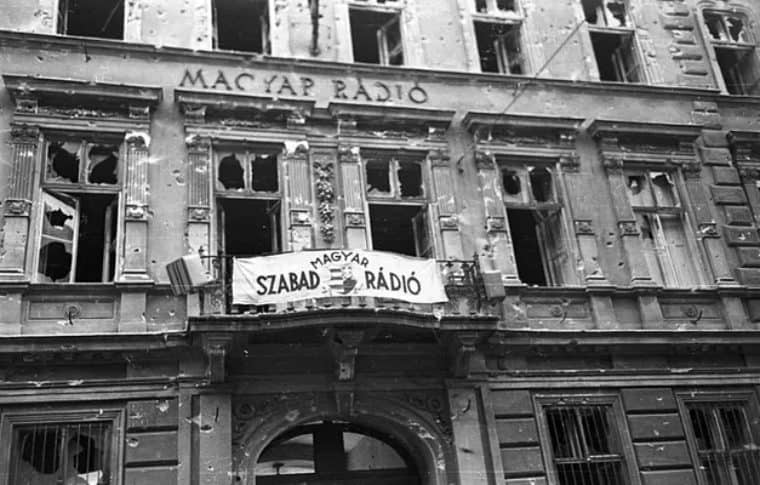
The radio building on Brody Sandor Street in Budapest, Hungary, after 23 October (Picture: Nagy Gyula/Wikimedia Creative Commons)
A stone’s throw from Budapest’s trendy ruin bars where students drink, there is a building like any in your town. Seventy years ago, a clash between Hungarian students and police outside it marked the beginning of one of Europe’s most significant—and forgotten—revolutions.
When they gathered outside the radio building on 23 October 1956, a 17-year old student said “no one thought it would end in revolution”.
By the following morning “an atmosphere of revolution reigned over the city”. Hundreds of thousands of people took to the streets, building barricades and fighting pitched battles against the secret police and tanks.
And workers struck, seized control of their workplaces and set up their own grassroots bodies as alternative organs of political power.
Hungary’s rulers claimed the mantle of Vladimir Lenin and the Russian Revolution of 1917, when workers councils (soviets) had taken power. But the reality was very different. The Russian Revolution, due to international isolation and the devastation of war, had degenerated.
By 1928, the state bureaucracy—with Joseph Stalin at the helm—had developed into a new ruling class with its own set of interests.
The Stalinist regime destroyed the last vestiges of workers’ democracy and unleashed terror. Locked into international military and economic competition with the West, the regime’s goal was to accumulate capital on the backs of workers.
After the Second World War, Russia imposed the “state capitalist” model on its new satellite states in Eastern Europe.
Boom and slump were just as in-built into the Eastern Bloc’s state capitalism as in Western free market capitalism. And, by the time of Stalin’s death in 1953, its ruling classes were facing a crisis.
The brutal methods used for accumulation and building up heavy industry were reaching their limit.
This crisis split the bureaucracy. A “conservative” group feared losing its grip and wanted to maintain Stalin’s methods, while “reformers” wanted to ease repression and shift investment away from heavy industry.

At root, this was a fight between two wings of the ruling class about how best to exploit workers.
In Russia the “reformers”, under Nikita Khrushchev, eventually won the power struggle. The new Russian leadership made clear that Matyas Rakosi’s Hungarian regime had to change course. They installed the “reformer” Imre Nagy as prime minister.
Nagy plotted a “new course”, but his limited reforms were hampered by Rakosi’s supporters and he was ousted in 1955.
Khrushchev then toppled Rakosi, who was replaced by his henchman Erno Gero in 1956. The Russian leader’s “secret speech” to the Twentieth Congress of the Communist Party that year denounced Stalin’s methods and the “cult of personality”.
This caused ideological confusion among Eastern Europe’s rulers, but it also opened up the possibility of people questioning society.
Lenin had written about what made a “revolutionary situation” at the outbreak of the First World War. He said that it had to be “impossible for the ruling classes to maintain their rule without any change”.
This would create splits at the top that would be “a fissure through which the discontent and indignation of the oppressed classes burst forth”.
At the same time, Lenin said that there had to be a determination for “the lower classes not to want to live in the old way”.
Both were true in Hungary in 1956. Discontent first became visible among middle classes—writers and journalists, professionals, junior military officers—who no longer gained material benefits and hoped to reform the system.
The Petofi Circle, an official organisation of the party’s youth organisation, began organising debates. But discontent was brewing in workplaces too.

On 23 October students planned a protest in solidarity with Poland where workers were fighting their own Stalinist regime.
The “fissures” that Lenin wrote about were on full display on that day. Resistance would “burst forth” through them.
At 12.53pm, the music suddenly cut out on Radio Kossuth. The host read out a communique Laszlo Piros, the Minister of the Interior.
“In order to assure public order, the Ministry of the Interior is not permitting any public meetings or demonstrations until further notice,” she said.
Shortly afterwards, Radio Kossuth reported that the deputy interior minister Mihaly Fekete said the ban was lifted to a student meeting at Polytechnic University. “He added that employees and communists in his ministry ‘rallied to the side of honest Hungarians in the interests of change’,” it said.
At 2.23pm, the music stopped abruptly again. “Laszlo Piros, the Minister of the Interior, has withdrawn the ban imposed on public meetings and demonstrations,” the newsreader told listeners.
He added that Communist Party first secretary Erno Gero “will speak tonight at 8pm”.
But thousands of ordinary people had other plans, spurred on by the panic at the top of the regime.
Factories must be directed by workers and technicians and trade unions must truly represent the interests of the Hungarian working class
Shortly before 3pm, university students gathered in front of the statue of Petofi, a Hungarian revolutionary and poet active in the revolution of 1848.
They then marched to join other student at the Bem statue.
Peter Veres, President of the Writers Association, read out the group’s programme . He slammed party leaders for “obstinately organising themselves to restore Stalin’s and Rakosi’s regime of terror”.
The seven-point programme demanded political and economic reforms. “The people must elect their representatives by free, secret ballot,” said one point.
Another declared, “Factories must be directed by workers and technicians,” and, “Trade unions must truly represent the interests of the Hungarian working class”.
It called for Nagy and his allies to be “given the posts they deserve”.
But, after Veres stopped speaking, the protesters did not disperse. The crowd of around 50,000 people—mainly students and writers—crossed over the Danube river and marched on the parliament.
Workers who’d finished their shifts join the march. By 8pm, over 200,000 people were on the streets.

Imre Nagy addresses the crowd outside the parliament building on 23 October
Several flash points that evening radicalised the movement.
The students had issued their own Sixteen Point Manifesto. This went further than the Writers’ Association, for example, demanding “immediate withdrawal of all Soviet troops” rather than a “review of treaties”.
The students cheered Nagy when he appeared, but whistled him down when he started speaking. “Nagy told them that the historical situation was complicated and everyone should go home and wait for developments,” a newspaper reported.
As the “reformer” Nagy spoke, the “conservative” Gero took to the airwaves. His broadcast attacked the students for “barefaced lies” and “hostile slanders” against the Soviet Union.
“Worker-Comrades, workers! We must put it frankly—the question now is whether we want a socialist democracy or a bourgeois democracy,” he said.
In other words, Gero had given demonstrators a choice—either the regime or its overthrow.
The massive crowd outside the parliament split into two demonstrations. Thousands marched on the giant Joseph Stalin monument—and tore down this symbol of their oppression.
“With hammers, iron pipes and other tools, the crowd broke the monument in countless pieces,” one eyewitness told the Manchester Guardian newspaper.
Another crowd marched on the Radio Kossuth building and demanded it broadcast their demands.
At 10.30pm, a delegation went inside to negotiate and was swiftly snatched by the AVH secret police guarding the building. The crowd tried to storm the doors while cops threw back tear gas. Suddenly, the AVH opened fire with machine guns. A murdered protester lay in a pool of blood.
There was no going back now—the revolution had begun. The following day protests and strikes spread across the major towns and cities.

Decapitating the Stalinist regime
The repressive instruments of the state had begun to fracture after the Battle of the Radio Building.
In Budapest, for example, many of the 1,200 police officers came over to the side of the revolution.
The Hungarian military, made up of working class and peasant conscripts, was largely paralysed as soldiers disobeyed orders.
The Third Army Corps, under the command of hardliner General Gyurko, did go into battle. He used Russian MiG fighter jets to attack the crowds in Tiszakecske and Kecskemet, murdering hundreds of protesters. But Gyurko also faced insubordination as he planned a broader airborne campaign.
There was another armed force in Hungary. Gero’s last act was to request Russian tanks roll into Budapest. Within 72 hours there was a mass insurgency across the country.
In Budapest young people, including school children, fought street to street. Soldiers and officers, such as Colonel Pal Maleter, joined the side of the revolution and turned their guns on the Russians.
Nagy was swiftly appointed prime minister on 24 October and Janos Kadar became first secretary of the party.
The Nagy government hoped to restore the bureaucracy’s legitimacy through reforms and bringing the movement under the reformers control.
But it was under political pressure from another force—the workers’ councils.
The first workers’ council was set up on 24 October at the United Electric factory, which employed 10,000 people.
One young worker at the plant told the Observer newspaper, “On Tuesday 23 October we worked, but we talked as we worked.
“We talked about wages, about the results of the writers’ meeting. We had printed copies and knew what they meant when they said it was impossible to go on in this way. We could not live on what we got from our work.
“After work, we saw the students demonstrating and joined in.

“On Wednesday morning the revolt began in our factory. It was unorganised and spontaneous. If it had been organised, the AVH would have known and stopped it before it started.
“The young workers led by the way and everyone followed them.”
By the following day, workers’ councils and factory committees were spreading through Budapest’s workplaces and neighbourhoods.
The major plants were clustered in the Ujpest, Obuda, Angyalfold and Csepel areas of the capital city.
Here, workers set up District Workers’ Councils between 29 and 30 October. And the following day, delegates from 24 plants in the capital held a Parliament of Workers’ Councils of Budapest.
They aimed to bring individual workplaces under democratic control. The delegates resolved, “The supreme controlling body of the factory is the workers’ council democratically elected by the workers.
“The director is employed by the factory. The director and highest employees are to be elected by the workers’ council.
“The director is responsible to the workers’ council in every matter which concerns the factory.”
But workers’ horizons weren’t limited to changes inside workplaces. The workers councils took up political questions and played an important role in fighting the Soviet military.
The second largest centre of workers councils was in Miskolc. On 27 October local radio announced, “For two days the town of Miskolc has been under the leadership of the workers’ council and student parliament.” They linked up with others to form the Borsod County Workers’ Council.
In Gyor, the AVH opened fire on a relatively small demonstration on 24 October, which radicalised the town. Strikes spread. The state’s authority collapsed and was replaced by the National Revolutionary Committee on 26 October.
In Szeged, a smaller town with around 10,000 people, workers’ councils were set up in the factories. They formed a People’s Revolutionary Council on 30 October alongside student groups.
In many places, the councils formed “national guard” militia to defend themselves from the Soviets and security forces.
Hungary was in a situation that Lenin had described as “dual power”—where political power lay with both the Nagy government and the workers’ councils.
The workers’ councils were political bodies and were doing the day-to-day running of society, such as food supply.
But most people did not yet see the potential for the councils to become a new government from below. Many in the workers’ councils supported Nagy and saw their role as pushing him further.
The Nagy government made various concessions in the hope of restoring the bureaucracy’s legitimacy. This included appointing new ministers on 30 October—including Maleter who’d led armed resistance in Budapest.

There were intense political debates inside the workers councils. The most politically-advanced demands came from Miskolc. The president of the city’s national council, argued, “The government must propose the formation of a Revolutionary National Council based upon the workers’ councils of the various regions and Budapest.”
He said it must be “composed of democratically-elected delegates” from the workers’ councils. “At the same time, the old parliament must be dissolved.”
But that was far from the majority view across Hungary. Sandor Bali, a working class militant who had been a Social Democrat and Communist party member, was a leading figure in Budapest.
He argued, “The Hungarian working class developed these workers’ councils quite spontaneously.
“We are well aware that they cannot be political organisations. We know that the workers’ councils will become organs directing our economy.”
This points to a contradiction in all revolutions. Even when people engage in militant and revolutionary acts, they do not abandon all of their “reformist” ideas all at once.
Many still look upwards, hoping for better leaders, even as they are creating a new power from below.
The Hungarian workers’ councils had echoes of the Russian soviets in 1917, which debated those very same questions.
But what was the key difference?
In 1917, revolutionary socialists who wanted workers to take power for themselves were a minority—but they were organised. The Bolshevik party was able to win political positions over a period of time and provide leadership at key points.
In 1956, there was no revolutionary organisation built in advance that could raise the slogan, “All power to the workers’ councils.”
That tradition had been buried under years of Stalinist dictatorship—and the debates were cut short by counter-revolution.

Russian tanks bring counter-revolution
Nagy managed to get a ceasefire and for Russian troops to withdraw from Budapest between 28 to 30 October.
But he soon discovered that Russian troops were massing on the border. The Russian leadership feared that Nagy was going too far—and the far greater threat of the workers’ councils.
So Nagy played his final card. On 1 November, he announced that Hungary would leave the Warsaw Pact military alliance and become a neutral country.
On the same day, Budapest workers’ councils agreed—after sharp debates—that they would call off the strike.
Three days later, Budapest was awoken by the whizz and crash of artillery fire. The counter-revolution had begun.
Russian tanks returned. This time they came with Kadar, whom they’d cut a deal with, to impose a new government.
There was a second period of “dual power”. While Kadar controlled the government buildings, real power lay in the hands of the workers’ councils.
On 12 November, the Ujpest workers’ council called for a Central Workers’ Council in Budapest and it was established.
However, the possibility of a successful insurrection had passed. Over 200,000 Russian troops and 2,000 tanks stood in the way of victory for a working class that had been militarily defeated.
The workers’ councils didn’t want to recognise the legitimacy of the Kadar government. In reality, they were forced to do so in all but name and enter negotiations to extract concessions from it.
Kadar paid lip service to the workers councils having a role in future, but proceeded to pick off leading revolutionaries and wear down the movement. He arrested the entire Central Workers’ Council on 11 December.
Workers continued to fight back into the new year, but the bureaucracy slowly reasserted control.
The Kadar regime never dared to return to the levels of repression that came before 1956—and ploughed money into raising working class living standards.
Despite its defeat, the Hungarian Revolution reasserted the idea that socialism is based on workers liberating themselves.
But it is another reminder that, if you want revolution to win, you need to build a revolutionary organisation now.