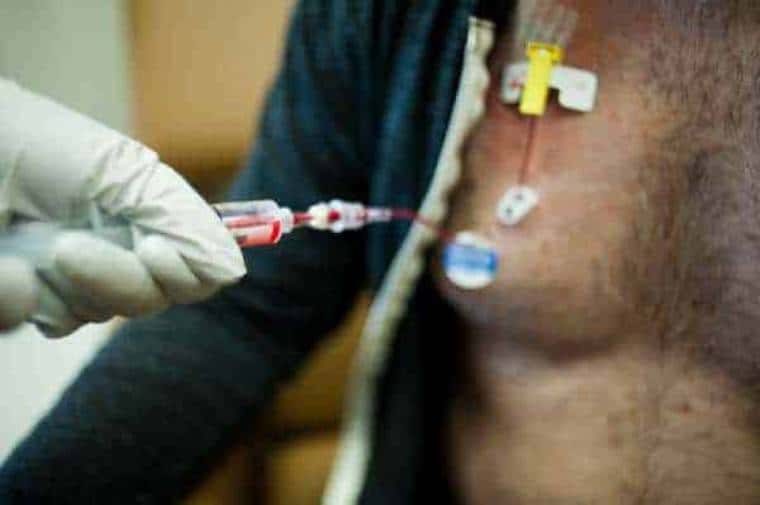
The NHS says 85 percent of people with cancer should start treatment within 62 days of an urgent referral. This target has not been met since 2015. (Pic: Stephen Dickter/Flickr)
The NHS is diagnosing a record number of new cancers, according to figures released this week. But experts say the health service is failing to meet its own targets for treatment.
According to the latest cancer registration statistics from NHS Digital, more than 373,000 were diagnosed with cancer in 2024, the highest figure on record.
Prostate, breast, lung and bowel cancers accounted for half of all new diagnoses.
Cancer that is diagnosed and treated at an early stage, when it isn’t too large and hasn’t spread, is more likely to be treated successfully.
According to Cancer Research UK, for every month a cancer patient waits before starting treatment, their chance of survival falls by around 10 percent, on average.
However, the charity says the NHS is repeatedly missing key targets designed to improve outcomes.
For example, some 78.6 percent of people were diagnosed or had cancer ruled out within 28 days of an urgent referral in August 2026. Had the 80 percent target been met, around 3,900 more patients could have benefitted.
The NHS says 85 percent of people with cancer should start treatment within 62 days of an urgent referral. This target has not been met since 2015.
And the effect of delays to treatment can be appalling.
Alan was diagnosed with lung cancer after a nodule was found in June last year. The 70-year old was meant to have an operation within weeks but ended up waiting for five months, by which time the cancer had spread.
“I was so frustrated and angry and couldn’t understand why they would leave me like that,” Alan told the BBC. On two occasions, Alan’s scans were cancelled because machines had broken.
By the time Alan had his operation, the cancer had spread to his lymph nodes and the nodule “had grown at an alarming rate”, according to his lung specialist.
The Radiotherapy UK group says more than 2,800 extra patients would need to start treatment every month to achieve the 62-day target.
That number is likely to grow as the number of diagnoses continues to rise.
NHS trusts that show the sharpest declines in treatment times say they are facing massive pressures from rising demand combined with shortages of skilled staff. Some also point to delays caused by private providers of diagnostic services.
Low pay and understaffing drive thousands of valuable staff out of the health service every month, and many trusts have frozen unfilled posts in an effort to save money.
But the effect of such managed decline is that thousands of people are waiting and pain and fear for urgent treatment, not knowing when it may come.
Tags: Health Posted in Labour, News, Trade Unions |
Comments Off on Cancer cases hit record high as NHS misses treatment targets
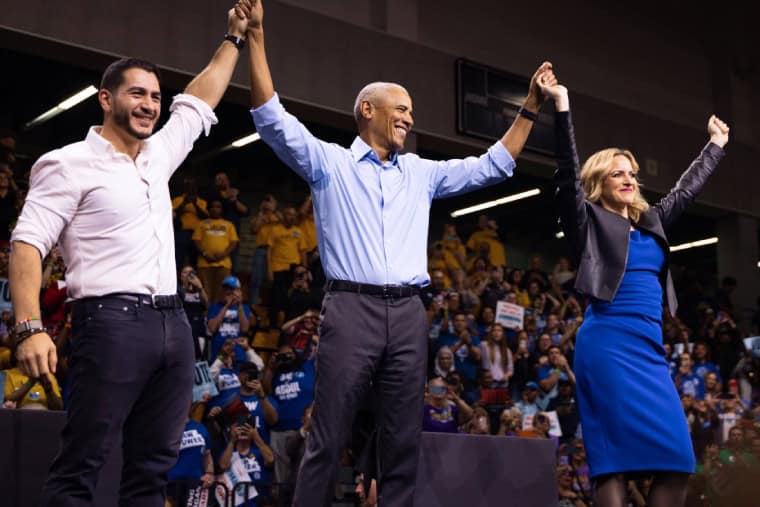
Democratic candidate in Michigan, Abdul El Sayed, leaned leftwards and ran a simple campaign—“Get money out of politics, put money in your pocket, and pass Medicare for All.” (Photo: X / @theDemocrats)
Millions of people are rejoicing at Donald Trump’s and the Republican Party’s humiliation in the midterm elections this week.
But the “blue wave” has raised sharp questions about what comes next for the Democrats—and the left.
Members of the Democratic Socialists of America (DSA), which runs candidates in the Democrats, spoke to Socialist Worker.
Saya, a volunteer with the DSA in north Texas, said the blue wave “felt amazing”. “Many of our members will not have seen a blue Texas for as long as they’ve been alive,” she said.
“We are all experiencing a sense of renewed hope and confidence.”
She added, ”Republican abuse of power. Deadly overseas wars that kill innocents. Attacks on marginalised groups and the threat of Ice in our communities.
“The Epstein-billionaire class wielding too much power and the rise of Christian nationalism and fascism.
“These were all top of the mind.”
The Democrats are not a social democratic party, such as Labour, let alone a left wing one. They are a liberal capitalist one—and those interests are still in the driving seat after the midterm elections.
The centrist New Democrat Coalition has at least 140 members, making it the single biggest bloc in the caucus.
The Blue Dog Coalition, which is even more right wing, has grown to over 20 members.
The Congressional Progressive Caucus, which includes a wide spectrum of liberals, now has over 100 members.
Only eight members of that grouping are card-carrying members of the DSA, including AOC.
Saya said, “We would like to see moderate Democrats grow a spine and do everything in their power to block Trump’s agenda at every turn. They should not concede an inch to him on anything for any reason.
“Let’s see a refocus away from billionaire interests and back towards the people who keep the gears of society turning.
“To the people who go to work every day, who are currently unable to buy a house, afford healthcare, raise a family or live meaningful lives.”
The Democratic Party is doing its best to contain progressive policies.
A flurry of centrist politicians, strategists and pundits have been downplaying the popularity of left wing policies. If DSA or progressive candidates did well, they argue, it was only because they were part of the Democratic “blue wave”.
“Our wins are so big tonight that there’s no one part or wing of the Democratic Party that’s going to dictate anything,” says former Virginia governor Terry McAuliffe.
Centrists are pushing this narrative because their main argument—that left wing policies cannot win elections—rings hollow
Democrats who leaned leftwards did well in former “red” and “swing” states, such as Texas and Michigan.
And, policies championed by the left have a broader appeal. One poll shows that at least 66 percent of US adults support what’s known as “Medicare For All”, a single, public health insurance plan for everyone.
That rises to up to 94 percent of Democratic voters and 72 percent of Independents.
Second, sections of the Democratic leadership know that the best way to discipline people is to promote them.
Hakeem Jeffries, the Democratic leader in the House of Representatives, began work on bedding in a right wing agenda before the election. He is the typical corporate Democrat—heavily backed by the American Israel Public Affairs Committee (AIPAC).
Jeffries set up a series of working groups this autumn to develop the Democrats’ agenda. He appointed centrist congresspeople Terri Sewell and DSA member Alexandria Ocasio-Cortez (AOC) to head the health care working group.
When the group reported back, AOC said, “There’s a large diversity of opinions in the Democratic caucus.
“A lot of what we do is just compile all the different proposals among the caucus. Medicare for All is of course included.”
Jeffries has no intention of supporting public healthcare—and nor do most Democrats in the House of Representatives or Senate. “We’ll have a family conversation,” he said, dodging the question when asked about Medicare For All.
The pressure will be on DSA supporters and left liberals, such as Abdul El-Sayed, to compromise for the sake of party unity ahead of the presidential election in 2028.
AOC was once a rising star of the left, but lined up behind the Democratic Party over key issues. She, for instance, did not vote against US funding for Israel’s “iron dome” air defence system—switching her vote to an abstention.
Jeffries went on a charm offensive with progressive candidates ahead of the election to tie in their support for him to become Speaker of the House.
Zohran Mamdani, Democratic mayor of New York who is a DSA member, has repeatedly reaffirmed his support for Jeffries’s bid.
Liz, a DSA member in Oregon, said the mid terms were “an anti-Trump vote, 100 percent”.
But she was less optimistic about what the Democrats would deliver. “It was a big splash for Democrats across the country, but when you look at the details you get some stuff that’s not looking good,” she said.
“I think this is probably more similar to when Labour won the 2024 election in Britain.
“Labour won by a landslide and everyone thought it would change things. But we know that, for example, it just stepped up the transphobia.”
She added, ”I don’t expect the Democrats to do very much. Maybe they’ll make some conciliatory gesture, but I don’t think they’re going to end the war.
“Even though they tend to not be as hawkish, it was not Joe Biden who finally pulled out of Afghanistan.
“The Democrats are probably going to slide right on trans+ issues and not going to move much on the labour front.”
There are different ideas in the DSA about what next.
Saya said, “We will keep organising to elect more progressive DSA candidates and continue building education and class consciousness in our communities.
“We will keep campaigning locally for economic and social justice and building membership of our socialist organisation.”
Liz added that there are limitations to the DSA’s current strategy. She argued, ”The DSA needs a better labour strategy. It tends to be, ‘Join the union and vote for our candidate in your union elections.’
“Instead, we should be meeting workers where they are in workplaces and pushing actual resources and organisers into them.
“When me and a comrade were organising our workplace, it basically turned into a recruitment ground for the DSA.
“We were able to bring in so many people who were dissatisfied, who had socialist leanings but weren’t organised.
“It’s a long chain that needs to be thought through before we can start asserting real power.
“It’s going to be an uphill battle. But when you fight you win—and when you win, you get to fight some more.”
The “blue wave” in the US has boosted everyone who hates the far right—but it shows the limits of a purely electoral response.
Hope for change lies with the sort of action we’re seeing on the streets of France, Italy, Spain, Portugal and elsewhere.
In the US, the challenge is to use the renewed sense of hope and confidence to build movements and working class organisation outside the Democrats.
Israeli soldiers search homes in Umm al-Khair last month
Israeli forces withdrew from the city of Hebron in the West Bank on Monday morning after a ten-day siege.
But they left a trail of death and destruction behind—and are planning new assaults.
The Israeli military launched the siege after it murdered two Palestinian freedom fighters, who had shot dead two soldiers.
Israelis had already begun demolition of Palestinian neighbourhoods near the site of the shooting.
Reem, a head teacher in Hebron, told Socialist Worker, “The whole city was affected by the siege.
“The seven gates of the city were closed. We were under siege. We were not allowed to leave the city.
“Some people were more affected than others. But throughout the whole city, not many people could go out and buy things and traffic was less than usual.
“Schools were closed because it was difficult for teachers to reach them and because it was not safe.
“Settlers made use of the closure of the city. They attacked the farmers who were harvesting olives and kicked them out of their lands and stole the olive harvest.”
Israeli settlers attacked Palestinian olive groves at least 401 times last month.
Nisreen, who lives in Hebron, told Socialist Worker, “The army carried out forced displacement and closed off neighborhoods and the city.”
The Israeli withdrawal from Hebron does not mean much for villagers under constant attack from settlers.
Mahmoud is from the village of Umm al-Khair in the West Bank. “I think they will put more and more obstacles in the lives of the Palestinian people until it becomes impossible,” he told Socialist Worker.
“Umm al-Khair is now surrounded by three gates and the first one was closed for five days last week.
“The new ones are open, but the settlers will close them in time.
“Settlers attacked ten teachers in Masafer Yatta, our collection of villages, on Sunday.”
The Israeli settlers have the full support of the state to ethnically cleanse Palestinians and steal their land.
Mahmoud said, “It’s forbidden to speak to settlers, photograph them or treat them poorly.
“The settlers are a red line and there will be harsh punishment if you break these rules.
“They will put you in detention in terrible conditions—a small dark room where they brutally assault you.”
As well as in the West Bank, Israel is keeping up its attacks in Gaza. An Israeli drone murdered five Palestinians in al-Mawasi near Khan Younis on Sunday.
Another three were killed in drone strikes on the Rimal neighbourhood in Gaza city, including a four year old boy.
Reform UK councillors’ disgusting sexist attitudes are the values of the far right party—and have been since day one (Picture: Reform UK)
Reform UK councillor George Madgwick has been charged with 12 counts of rape, the Crown Prosecution Service has announced.
The CPS confirmed it “has decided to prosecute George Madgwick for serious sexual offences, including multiple counts of rape”.
“He has also been charged with making a threat to kill, false imprisonment and stalking,” it said.
Madgwick was the leader of the Reform UK on Hampshire county council. He has been charged with a total of 35 offences, including two counts of sexual assault, two counts of assault by penetration, two counts of making and one count of distributing indecent images of a child.
He will appear at Portsmouth magistrates court on 25 November. Hampshire police launched their investigation on 24 July last year after receiving a report of a sexual offence.
In September Daniel “Tommo” Thomas and the fascist Patriot Platform mobilised against refugees in Portsmouth.
Madgwick was at the scene—and defended the protests as “normal local families” reacting to government policy.
Stand Up To Racism condemned his actions as “disgraceful behaviour” fuelling fascist movements.
In March, Madgwick boasted of the “fantastic day” he had spent with Nigel Farage in Portsmouth. They went for a pint together.
When Madgwick was elected last May, Reform MP Suella Braverman, said, “I have known of George’s record and political success for years.
“He is a fearless campaigner who speaks for ordinary people and is never afraid to challenge the political establishment.”
Madgwick accused ITV of “election interference” after two journalists infiltrated the party and did an expose. He was caught out by the journalist praising the far right Portsmouth Patriots.
The far right pose as defenders of women’s rights.
In June 2025, Madgwick recorded a video about a sexual assault allegedly carried out by a car with Wolverhampton number plates. He demanded that abuse by “cross border” private hire drivers must stop.
The same month, Madgwick accused city officials of ordering councillors to stay silent about the housing status of a man charged with rape in Southsea. The accused was housed at a refugee hotel in the area.
Madgwick claimed he had been silenced to prevent the inflaming of “community tensions”.
Sophia Beach from Women Against the Far Right told Socialist Worker, “The news about Madgwick is shocking, but not surprising.
“Reform UK’s disgusting sexist attitudes were exposed in the ITV documentary, but Farage has defended these men to the hilt.
“The far right thugs who attacked refugee hotels are more likely to have been reported for domestic violence than the rest of the population.
“Women are sick of the far right racists weaponising violence against women and girls.”
Tags: Reform UK, Sexual violence Posted in News |
Comments Off on Reform UK councillor charged with 12 counts of rape
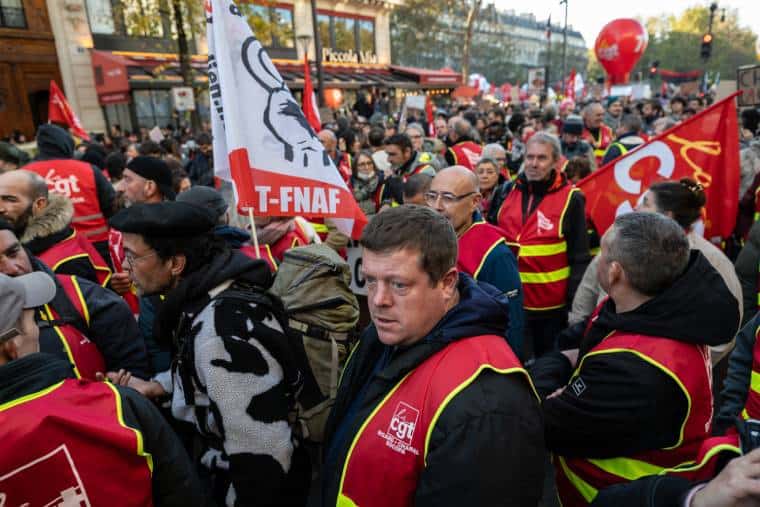
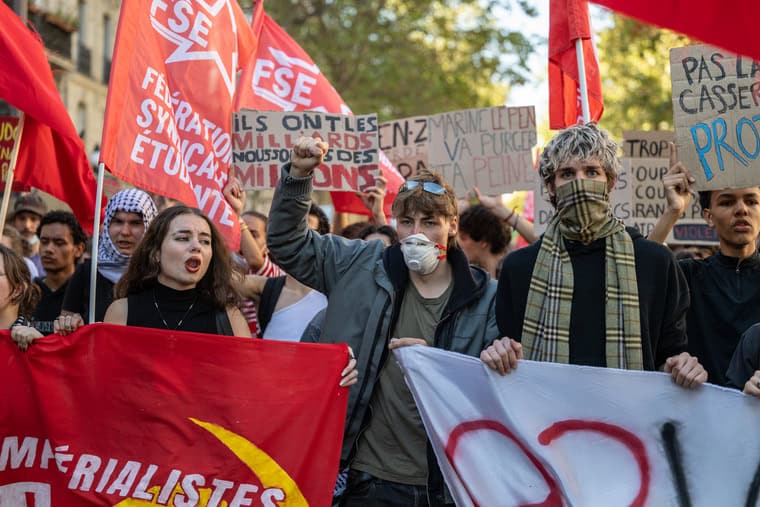
Some 1.6 million joined protests across France (Pic: Guy Smallman)
Striking workers and students flooded the streets of Paris on Thursday. Organisers said that 1.6 million marched, including some 350,000 in the capital.
At Le Havre, huge numbers of dock workers joined the march. Some 50,000 marched in Lyon and there were mass protests in at least 70 towns and cities including Marseille, Toulouse, Bordeaux, Grenoble and elsewhere.
The general strike was supported by all the major union federations. And in Paris their supporters formed huge blocs that packed the streets.
The march brought together the unions’ sounds systems with floats created by art college students including a giant papier-mâché sculpture of president Emmanuel Macron looming over a burning school building.
A bloc of lawyers dressed in their black robes carried a banner reading “Colère noire”, a reference to the “black rage” they feel about the repression handed out to young people.
Protesters brought huge Palestine flags and anti-fascist chants regularly spread through the crowd.
Arnaud, a striking firefighter, told Socialist Worker that as a firefighter he is demanding better conditions because the state doesn’t reward workers and the public will pay the price if the fire service is eroded.
As a father, he demands a better future for the next generation. And as a son he stands with the retired people who get less and less each year.
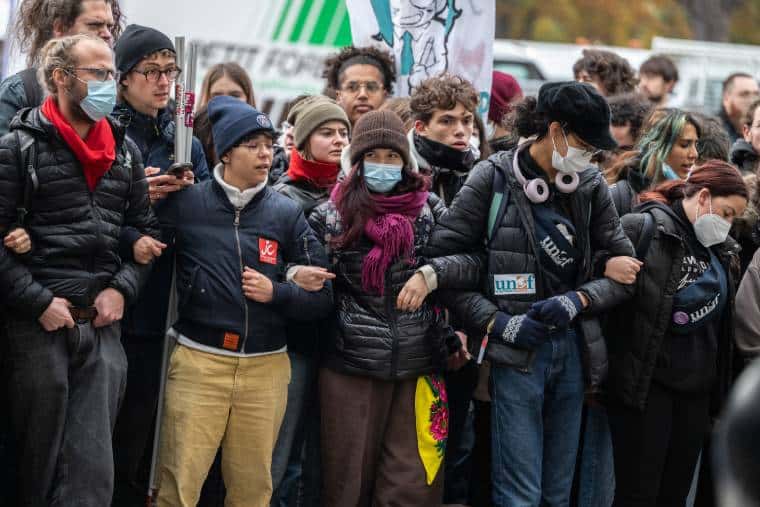
The day began with school students blockading their secondary schools. At the Hélène Boucher school in central Paris, police removed the blockades and aggressively forced the students to move, knocking some of them to the ground as they surrounded them and subjected them to bag checks.
But later that morning school students had regrouped and were using plastic wheelie bins to blockade the Rue de Rivoli and facing riot police in the centre of the city.
The movement was started by school students blockading their schools (Pic: Guy Smallman)
Students and workers from the suburb of Saint-Denis spontaneously marched through the Gare du Nord rail station before forming a feeder march to join the main demonstration.
They were led by rail and hospital workers and students and workers from the Paul Éluard school.
When they arrived they were briefly stopped by the police. But the cops were forced to give way.
Guillaume, a striking rail worker, said that the strike was strong, especially among train drivers. He told Socialist Worker that wages had not kept up with inflation and that energy prices had doubled in 15 years.
“There is a lot of money for shareholders and nothing for salaries,” he said. “We don’t have a political party for the workers here. The only movement for labour is here on the streets.
“After today, I think this movement will continue. The government doesn’t listen to the people and the police are very tough with young people. When they hit young people I think it’s time to strike.”
Paul Éluard was one of the first schools to be blockaded as school students refused to tolerate the conditions. Schoolworkers have been on strike there since 24 September for more resources and against police violence. It’s a renewable strike—workers decide each day whether to continue.
School student Monica told Socialist Worker, “We have been part of it since day one at our school. People around the world look at the news and think that we are always angry in France. But we have reason to be. We have had 10 years of Macron.
“We had the Gilets Jaunes protest over fuel prices. They told us things would change but nothing has changed. A lot of people are cold during the winter with no money for heating.”
At the Voltaire school, workers have also walked out on strike this week. They started picketing early in the morning, held a meeting in a local cafe and joined the main demonstration alongside students.
Strikers across the city had a choice about whether to join the protests as individuals or whether to organise and picket their workplace as a group.
Workers at the natural history museum formed a picket line in the morning. Marie from the CGT union federation explained that they have been in dispute for six months with the library closed by strikes every Saturday.
“At first it was about salaries,” she told Socialist Worker. “But we talked to each other during the strikes and we have other demands around the arrangement of the work and the management practices. When we all talked we realised it was something we all faced.
“Today is a national day. What is different today is that we are joining forces with students, university workers and workers from other museums.”
Members of the CGT union federation form a huge bloc as part of the Paris demonstration (Pic: Guy Smallman)
Marie added that it’s important to join the demonstration in a group from the same workplace as some people feel nervous about joining the marches alone.
Kaïna, also a striking museum worker, said that workers themselves had voted to hold a picket line after a general assembly of 150 people.
She told Socialist Worker, “The picket line is an occasion to meet with other colleagues. And it’s important to be visible to the visitors to the museum. Most of them don’t even realise there are so many workers here.”
Other strikers were less confident. A worker from a consulting firm said he had not managed to get other colleagues to join the strike so far although he had tried to talk to them.
NGO worker Sam said that workers face low wages and lots of work pressure, “because it’s for a good cause”.
Sam said union members had organised at her workplace by holding general assemblies every week and going from door to door to speak to people about the strike.
The movement in France was started by teenage school students. Some argue that the school students’ demands should be more prominent—and that workers should be careful not to “take over” with their own issues.
But many workers say that their own demands are the same as those in the schools.
Sam told Socialist Worker, “We need to move on from talking about ‘helping’ and ‘protecting’ the students to talking about solidarity with our own strikes. The best way to protect them is to join them in the struggle and build our own power.”
But workers will have to organise against the trade union bureaucracy, which seeks to contain the movement’s potential. This means pushing for organisation and action at the base that goes beyond the union leaders’ vision.
Thursday’s general strike was a spectacular show of strength against Macron’s government and against the attempts by the police to contain it. CGT union federation leader Sophie Binet has promised to escalate the movement “to the next level”. To make this a reality and defeat Macron’s budget, workers will need to organise and spread the roots of the strike movement into every workplace.
Consultants on the picket line at UCH hospital in central London in 2023 (Picture: Guy Smallman)
Hospital consultants and specialist doctors in England are preparing to strike later this month in a long-running fight over pay.
The government has earmarked a rise of just 2.4 percent for them—and all other health workers—next year, despite having earlier promised doctors “pay restoration.”
The doctors’ BMA union says time is running out for health secretary Yvette Cooper to take “meaningful steps” to avoid the 48-hour walkout set to begin on Wednesday 25 November.
Matt, an anaesthetist in Liverpool, said the mood among his colleagues was “disappointment” with the government.
“We’re annoyed that we’re in the same situation we were a few years ago, even after ministers promised something completely different,” he said.
“Just a modicum of fairness is all people want really.”
Matt says the Department of Health has “forced” doctors into preparing for strikes.
“There’s a strong feeling that there’s a profession to defend here,” he says.
“We feel a bit embarrassed about our lack of industrial action in the previous 20 years, to be honest, and the state we’ve left the profession in.
“And I think there is a view that says, if we don’t stand up and make a fight at some point, there’ll be nothing left for future generations.”
The decline of the NHS, and staff pay, can be traced back to the years following the 2008 financial crisis”, says Matt.
“Our pay has been cut in real terms by a third during the past 20 years of austerity,” he says.
“At the negotiation at the end of our last dispute in 2024, we were told we’d see a gradual restoration of our pay over several years, and in the future, an independent review body would look at our pay.
“But they, basically, just lied to us.
“So a 2.4 percent rise is another real terms pay cut. I don’t see how anyone in the NHS takes another real terms pay cut again.”
“Maybe we were fooled 20 years ago, at the end of the banking crisis. Back then, people said you’ve got to take a tough cut. And now 20 years later, it’s the same story. They are still saying they can’t afford to pay us.
“How come they can’t afford to pay us, but the bankers are still back on big money? I don’t see how that washes. Why can’t we tax billionaires? Why do we even have to have bankers?”
Matt says the impact of decades of doctors’ pay erosion can be seen easily across the profession.
“It’s a well-trodden path, starting at medical school and doing your training, and you can see the people on the ladder ahead of you, and those behind you.
“The people who are doing the same work as I did when I was a junior, now haven’t got the same prospects as I had. And it’s the same for me, looking at the people above me.”
In the past, employers have tried to use divide-and-rule tactics to separate consultants and doctors from the rest of the NHS workforce. Matt says the unions must stand firm and united against this.
“We need decent pay rises across the board, if we want a health service to function. A victory for one set of workers is also a victory for the next set.”
Farewell to Trump? (Photo: Flickr / Official White House Photo by Tia Dufour)
Donald Trump is a lame duck president—and the far right is reeling—after humiliating defeats in the US mid term elections.
The Republicans were preparing for a “blue wave” of Democratic victories on Wednesday. When it came, it was a tsunami.
The Democrats now hold a majority in both chambers of the US Congress. This is only the third time in 50 years that a party has lost control of the House of Representatives and the Senate at once.
The Republicans didn’t hold on to congressional seats that they had gerrymandered. They redrew the boundaries of districts in Florida, North Carolina, Alabama and Texas to stop Democrats gaining majorities—and failed.
Key wins include Texas where James Talarico, who leaned leftwards in the campaign, has won the Senate seat by over one million votes. He is the first Democrat to win a Texas Senate seat since 1988.
The Democrats also flipped previous Republican strongholds of Kansas, North and South Carolina, Ohio, Iowa and Maine.
Tech billionaires tried to buy the election—but they failed. A record $11.9 billion has been spent on campaigning and advertising, the majority by Republicans.
Much of this money has come from “dark money” sources, such as cryptocurrency and rule-bending non-profits. Elon Musk alone gave nearly half a billion dollars to the Republican campaign.
The midterms were a devastating verdict on Trump’s second term.
His presidency has been plagued with war, violent deportations and a spiralling cost of living crisis.
The US war on Iran has driven up inflation, in particular food and fuel prices. And the tariffs introduced by Trump at the start of his second term had already made many goods more expensive to buy in the US.
Prices for petrol increased 34.2 percent over the 12-month period ending September.
US oil corporations have raked in more than $130 billion in profits during the war—up from $47 billion last year.
But all Trump did was boast about the rich getting richer and laugh in voters faces. At a rally at the end of last month, the president said, “The United States oil and gas business is making hundreds of billions of dollars.
“I don’t give a damn, I’m going to say it—we’re making a freaking fortune.”
A Washington Post-ABC News-Ipsos poll in October put his economic approval rating at just 28 percent.
Trump pitched himself as an “anti-establishment” outsider who would restore the “American Dream”. But the Republicans pushed more of the same policies that hammered working class people while lining the pockets of the super-rich.
Trump’s failures fuelled a right wing radicalisation of the regime, particularly around mass deportations.
The violent abductions and deportations carried out by Ice were another key factor in the mid-terms.
Black, brown and Latino people face harassment and danger regardless of their citizenship status.
Latinos, who in 2024 voted evenly for Trump and Democratic candidate Kamala Harris, turned away from the Republican Party.
This includes people who buy into the right wing lie that immigration is a problem. Javier Villalobos is the Republican mayor of McAllen in Texas. “Inflation, the economy, everything is important,” he says.
“But what hits you immediately, what hits personally is the crackdown, when you see the ICE agents, masked, and pulling people out of vehicles.”
He says Republican voters who support “border security” have been driven away by “a crackdown on the Hispanic community”.
A recent CBS News poll found nearly 60 percent of Latinos believe the Trump administration has deported more people than they expected.
The scale of Trump’s deportation programme has caused tensions between some bosses, who rely on racist divide and rule and migrant labour.
Benny Melendez, a Latino citizen who owns a small construction company, voted for Joe Biden in 2020 and Trump in 2024.
He has built a fence around his company to stop Ice agents rounding up his workers. “Now I regret my vote for Trump,” he says.
In several of the swing states, progressive and left-leaning Democratic candidates have swept up huge victories.
Talarico ran on a campaign of better public funding, repealing tax cuts for the 1 percent. He has called for an end to the Iran war and arms sales to Benjamin Netanyahu’s government, albeit not Israel.
Michigan was another key race. The state has had a Democratic senator for 12 years, but voted for Trump in 2016 and 2024.
Democratic candidate Abdul El Sayed ran a simple campaign—“Get money out of politics, put money in your pocket, and pass Medicare for All.”
Mike, a trade unionist in Michigan, told Socialist Worker, “Palestine has galvanised people.
“For the first time in history a pro-Palestinian position is popular in the US and among Democratic voters it is overwhelmingly popular.
“Abdul El-Sayed’s campaign focused on the cost of living, but he didn’t dodge questions about Palestine or trans rights issues.”
El Sayed has been the target of attacks from both sides. Israel supporter Haley Stevens, who he defeated in the race to be the Democratic candidate, endorsed Republican Mike Rogers just days before the election.
Despite this, El Sayed won with over 6 points between him and Rogers.
Mike added, “The conventional wisdom from the Democratic leadership is that you have to appeal to the centre.
“But people who vote Republican from an anti-establishment feeling are more easily won by progressive candidates than moderates.
“I think the Haley Stevens thing was bigger than just Israel. It was a section of the Democratic right wing who are really scared of the rise of the Democratic Socialists of America (DSA) and progressives.”
In Florida, Democrat Angie Nixon came just shy of victory against Ashley Moody. Nixon is a progressive, aligned with Bernie Sanders and a member of the DSA.
Anti-choice bigots threw $80 million the campaigns challenging the likes of Talarico, Nixon and Sherrod Brown in Ohio. But they too failed.
The DSA is the largest socialist organisation in US history, hitting 130,000 members in 2026. It generally acts as a campaign group, endorsing progressive candidates running as Democrats.
New York mayor Zohran Mamdani is a well-known DSA-endorsed success.
The recent victories, and near-victories, of DSA and progressive candidates should be a boost for all those who want fundamental change.
But history shows that the Democratic Party is no solution. The Democrats have started wars in the Middle East, failed to fund health care and locked up and deported migrants. Ice operations were expanded under Biden.
Far more “moderate” than progressive Democrats—let alone DSA members—were elected in the blue wave. They will be the ones setting the agenda.
Some sections of the Democratic establishment see that they have to adapt to survive. Former president Barack Obama, for example, endorsed El Sayed. They hope to contain the mood he reflects into the dead end of the Democrats.
One of the most rattling defeats for Trump was nothing to do with an election. In Minneapolis, Minnesota, in January statewide demonstrations against Ice violence rocked the country.
Mass resistance to violent deportation raids, and a day-long work-stoppage succeed in kicking out most of the 3,000 Ice agents Trump deployed to the city.
But Victor Fernandez, a socialist and migrants’ rights activist in LA, says the deportations have surged again. “I think Trump is trying to purposely gear up his base,” he told Socialist Worker.
“People are organising against it and are involved in the movement, but there’s this emphasis by some on elections, on voting and that the Democrats will save them.
“After a while it starts to ring hollow,” he continued.
“The liberal left is focused on the elections, but the ongoing movements on the ground are where people are starting to question things.
“My biggest fear right now is a level of demobilisation.”
Trump is down, but the far right is not out. He has already said he will veto Democratic legislation and can resort to terror on the streets.
Hope lies with revolt in the streets, campuses and workplaces, not channelling it into the Democrats.
Students defied the cops at the Hélène Boucher school in central Paris (Guy Smallman)
School students in France have returned to the blockades this week as a general strike approaches on Thursday. And the movement won’t be subdued by president Emmanuel Macron’s attempts to wind it down.
At the Hélène Boucher school in central Paris, at least a dozen van loads of CRS riot police arrived early in the morning. They removed school students’ blockades to try to keep the school open.
Police started checking bags and allowing the students into the school. But instead of going to lessons, the students defied the cops. Unfurling a banner reading, “Gen Z—generation revolution”, they blockaded the front entrance from the inside.
Student Aëlle told Socialist Worker, “We are blockading firstly because we support the school students in the poorer suburbs.
“And because we have a lot of students in every class and there are not enough teachers there. We have the final exams coming up and we need teachers. We can’t study in these conditions.”
Macron’s government promised to replace the hated Parcoursup university admissions system and to provide more teachers.
But Aëlle said, “It’s only to calm the movement. The government ignores us. They only send us police officers to restrain the movement. The police injured a lot of students really badly.
“We have been asking for more for a long time. It’s only since we started blocking everything that he hears what we say. But he won’t really do anything. He never keeps his promises.
“Macron doesn’t care because he will leave soon at the next election,” she said, adding that Marine Le Pen of the Rassemblement National doesn’t care about the students either.
Student Hilda said, “The extra teachers that were deployed by the government were not the right ones. They were sending maths teachers to teach French.
“But even if we got what we want—more teachers and money—it will not be enough. They will still send money to the military and the elites and starve public services.
“We will still protest because of the police violence. I have friends who have had broken bones.
“They all say that we are violent. But we think that it is legitimate. When the state is violent towards us, violence is the last thing that we have to be heard.”
“It’s like Victor Hugo said in Les Misérables, ‘A cloud has been collecting for fifteen hundred years. After fifteen hundred years it has burst. You are condemning the thunderclap.’”
Teacher Raphaelle explained that some of the teachers had refused to go into the building and teach as normal the day before. “We didn’t want to teach in these conditions, so it’s a strike,” she told Socialist Worker.
On Wednesday the teachers were deciding what to do next as school students continued their sit-in.
Raphaelle said, “Some students have a nine-hour day. It’s terrible for them and for us too. We have demands over our salary which hasn’t risen above inflation for decades. We used to have smaller classes because they split the classes in two for some lessons but we lost that.
“Tomorrow there will be a lot of people on strike. But after that we will see.”
A contingent of parents and locals were there to observe. Some parents worried about the disruption to young people’s education. But many were supportive of their demands.
At the Voltaire school, teachers have also refused to teach with police outside and have walked out on strike all week. Every morning they hold an assembly and decide whether to continue the action.
Police arrived early on Wednesday and prevented a student blockade. Teachers outside the school said they assaulted one teenager with a baton.
“Macron says he wants schools to open smoothly, but do you call this smooth?” asked one teacher, pointing at the line of cops. She said teachers are absolutely against teaching in those conditions.
PE teacher Cedric told Socialist Worker he had decided to stay outside that day because of the police presence.
“The teachers are just here to protect the kids. We put our banner between the police and them and said to the police that they are just teenagers,” he said.
The general strike on Thursday could be a boost to the movement. The teachers at Voltaire said they will picket in bigger numbers and try to convince more of their colleagues to join. Then they will decide whether to continue the following day.
Teachers added that the students consider themselves not just to be blockading but to be striking too.
Students in France want to know whether the movement will spread to Britain.
Hilda said, “We are with you in Britain. Everywhere should just try to start something. Maybe it’s not the revolution. But we should just try some new things.
“We need people to stand for their rights. We need our voices to be heard.”
Workers are getting organised as France prepares to strike
On the day before general strikes across France, trade unionists are discussing how to organise in their workplaces.
School student Lex in the Paris suburb of Vitry-sur-Seine told Socialist Worker, “We are still fighting. The government gave us a response to our demands but it was not enough.”
She said that about 40 teachers at her school were set to join Thursday’s general strike and go with the students to protests in the centre of the city.
Philippe is a school teacher and member of the Force Ouvrière union federation. “We are fighting for the same things as the students,” he told Socialist Worker. “It’s for decent conditions for education, decent schools and equality for every student, whether they come from Paris or the poorer suburbs on the outskirts.”
He didn’t think France lives up to the principles of liberty, equality and fraternity when students in the suburbs are denied a future.
Philippe said he thinks he will be on strike on Thursday as well.
Vincent, the secretary of the CGT union federation for the Villejuif area, was also unsure whether workers would walk out.
“We hope lots of people are on strike. We don’t have a button we can push to put people on strike but we hope they hear the call,” he told Socialist Worker.
“French society has many issues that need to be addressed now, not just in the next election.
“Our salaries have not been raised in 20 years, the cost of living has risen. I certainly want the government to stop the budget.”
Henri from the militant Solidaires union federation was trying to organise precariously employed university workers in solidarity with school and university students.
“Their demands echo our own working conditions,” he said. “And it’s to oppose the state’s repression which has been really brutal. Young people have been mutilated. Thousands of children have been sent to detention. They are just young people demanding a better future.”
Philippe added that he had heard about plans for international walkouts on 20 November. He said, “I think that’s a good idea. We are suffering from the same issues.”
At least seven union federations—all the major ones—support the call for strikes on Thursday. But whether workers will answer that call is another matter. Trade unionists will need to fight for as many of their colleagues to walk out as possible and call for pickets, assemblies and occupations in their workplaces if they can.