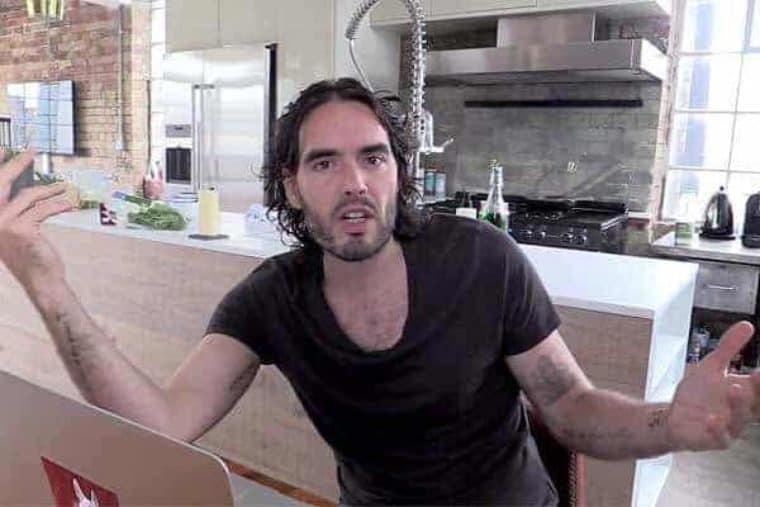
Síomha promoting her five star comedy show at the 2024 Fringe Festival (Photo: SiomhaH/X)
The revelations about Russel Brand and David Walliams are shocking. But they weren’t at all surprising for comedian Síomha Hennessy.
“It goes way beyond Brand,” she told Socialist Worker.
“It’s a whole culture. His crimes are on the extreme end of what we let powerful men do.
“That’s what it comes down to,” she continued. “Because they were making money. And I think that’s one reason it’s coming out now—it’s been a long time since Brand was making money or has been relevant.
“I hope the verdict on Brand is a turning point, or a landmark. But the system remains intact and the toxicity is still here.
“Sexism in comedy and entertainment isn’t just down to a few powerful celebrities. Comedy is a total boys’ club,” she said. “There’s a massive culture of sexism, it’s one of the most backwards industries and it’s very male dominated.”
She explained how there are societal barriers for women in comedy. “Being funny is still considered male, there’s still a taboo around funny women.
“Socially, women are expected to fit into gender roles and that’s a barrier for women getting into comedy. Historically there’s been incentives for women not to pursue comedy. Those are not characteristics society has encouraged women to have.
“Nowadays men must accept there are women comedians. But some men really struggle to respect women comedians as equals.”
More women are entering comedy and entertainment, partly because social media has allowed them to reach people outside the traditional comedy circuits. But most comedy clubs will only ever have one woman in a line-up, meaning they are all disconnected from each other.
Sexism in the industry goes beyond disdain for women comedians. “Comedians reflect the ideas of society,” Síomha continued. “Sexist jokes get big laughs, jokes about how annoying your wife is are so common.”
Síomha described how extreme misogyny is entering the mainstream once again, brought in by comedians and podcasters who circle around the online “manosphere”.
“Male comedians think they are above woke politics,” she said.
“There’s been a movement in comedy away from ‘woke’, on the issue of gender in particular. There’s this reaction against what they think are the ‘overreaches of the #MeToo movement.
“It’s so blatant and they’re not at all embarrassed to have no women anywhere near their podcast or line up.”
The bread and butter content of male comedians often kicks down against women. The consequences of such casual sexism in an industry that systematically excludes women is that men like Brand and Walliams can abuse the power and influence they accrue to exploit vulnerable women. Everyone keeps their “open secrets”.
Síomha added, “The victims were so brave. I think there is possibly a legacy of raised consciousness from #MeToo. It’s nice to see it hasn’t all been washed away, it did influence society.
“There’s the big characters like Harvey Weinstein who were brought to justice. But it’s a way for the system to pretend it’s reformed and changed, when really all the structures are left in place.
“The grassroots, people power movements from below, are the only way to force change.”
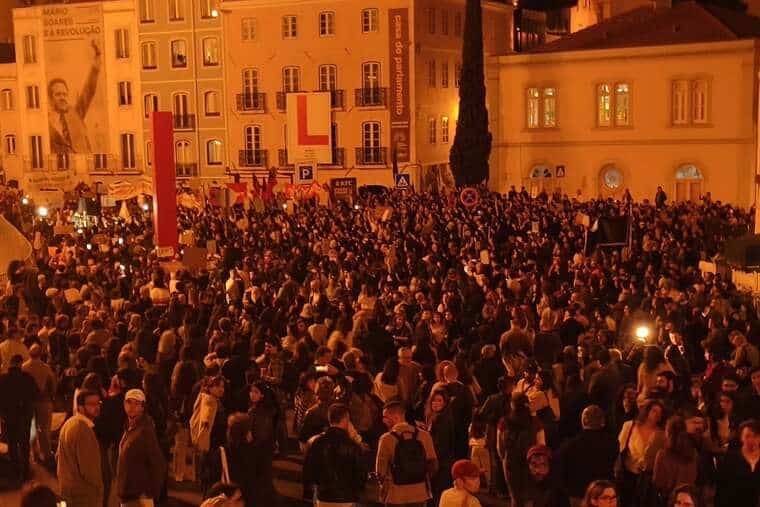
Protesters flooding the streets (Blocodeesquerdaoficial/Facebook)
Protests over Portugal’s housing crisis have been ongoing for over 30 days.
The protesters have forced prime minister Luís Montenegro, of the right wing PSD party, to meet with their representatives this Friday.
They have faced police violence with encampments and occupations being attacked and dismantled night after night.
An encampment remains in Porto, while in Lisbon activists have shifted to mobile protests.
Over 100 people were injured in Lisbon and Porto on 1 November, with 10 protestors sent to hospital after being hit with batons and chased by attack dogs.
In Porto, two undercover cops hid in the crowd with the sole purpose of instigating violence in an attempt to justify a repressive response.
When the housing protestors understood that these men were undercover instigators, they tried to isolate them from the rest of the crowd to avoid escalation. At this point, one of the cops pulled a loaded gun from behind his back and proceeded to aim it at protesters.
But the response of the armed forces of the state has only intensified working class anger and brought more people out.
After the brutal attacks that weekend, thousands poured into the squares in solidarity with the encampments.
The demonstration culminated with an orchestra playing the Internationale, the revolutionary socialist anthem.
The week before, students blockaded three high schools in Lisbon and Porto in solidarity with those in France.
The demonstrations have been incredibly broad. Protesters range from teachers, pensioners, high school students and rank and file trade union members to anarchist collectives and small revolutionary groups.
The protests began over a proposed change to renting legislation by the PSD, the right wing party in government.
This new legislation will allow landlords to evict tenants and raise rent prices more easily. Most working class people in Portugal are unable to afford rent altogether. In Lisbon, for example, the average rent for a one bedroom flat is worth 116 percent of the average salary.
Over the last decade, the Portuguese state has sold existing and speculative property to multinationals. It offered “golden visas” to foreign investors who were interested in investing in property in Portugal.
Montenegro, who owns 55 properties around the country, has called demonstrators “selfish” for their fight over housing and dignity.
The protests have a deep anti-fascist undercurrent.
The memory of the Portuguese Revolution of 1974 is present on the streets of Lisbon. Protestors are comparing the repressive tactics of the state to those of the political police under the dictatorship of António de Oliveira Salazar.
On top of that, the PSD has counted on votes from the far right party Chega to pass the pro-landlord legislation through parliament.
Chega scapegoats migrants and Roma people for lack of housing. But people know that the real-estate magnates and landlords in their party are trying to implement legislation that makes the housing crisis worse.
For this movement to deepen, those on the street have to put pressure on the left and on the trade union leadership.
Pressure from below pushed the CGTP, the Communist Party (PCP) aligned trade union federation, to call a general strike for 21 November.
But it refused to call it for Wednesday of this week, the same day as the general strike in the Spanish state.
An Iberian general strike could paralyse the economy of the peninsula. This could deepen the movement and provide it with a path forward into more radical action that places immense pressure on both ruling classes.
But the reformist reluctance of PCP and the CGTP was on show.
The CGTP has called supportive demonstrations. But the trade union bureaucracy want to show themselves to be the “respectable” face of the movement.
The PCP pursues a reformist strategy, defends the structures of the Portuguese state and seeks to contain radicalism. One PCP writer denounced calls for an Iberian general strike as “external pressure” that wanted to “break the vital link between workers and their class-based unions”.
But the mood on the ground shows that people want to link this struggle with what is taking place all over Europe.
Rank and file trade unionists alongside the street movement could apply pressure from below on the CGTP and go beyond one-day strikes.
Arguing for mobilisation in workplaces, schools, and campuses that shuts down the flow of profits is key.
The scandals around Russell Brand and David Walliams have once again shone a light on the sexism that runs through society.
The mainstream media presents Brand and Walliams as despicable individuals and admits that there is an industry-wide “problem”.
But it doesn’t interrogate why such predators thrived and were protected for so long.
Brand was enabled to operate in plain sight by institutions that allowed his crimes. A sexist society treated his views about women as a “joke” or “banter” and normalised sexual violence.
The revelations come less than a year after the latest Epstein scandal—and less than two months after the Cornell 7.
Violence against women flows from an oppression that is ingrained at every level of society. Women’s bodies are sexualised and men are encouraged to see women as objects that exist solely for their gratification.
Brand and Walliams were standard-bearers of the “lad culture” of the 1990s and 2000s. It celebrated hypermasculinity, lewd behaviour and objectification of women and girls in “lads mags”, TV shows and films.
This “lad culture” was part of a right wing backlash against the Women’s Liberation Movement and thrived under neoliberalism.
The new sexism reflected a contradiction—progress for women’s rights alongside the persistence of oppression.
The women’s and gay liberation movements of the 1960s and 70s made important gains.
The changes transformed many of the expectations women had around their lives. The employment rate for women of working age rose from 57 percent in 1975 to reach 78 percent by 2017.
Women settled down with a husband or partner later in life, had fewer children and had them later.
People’s disposable income rose throughout the 1990s and into the 2000s until the financial crisis hit at the end of the decade.
Many people still struggled financially. But for a layer of younger women, the possibilities of living independently from parents and of going out and meeting new people opened up in a way they hadn’t for their mothers and grandmothers.
Social attitudes towards women and LGBT+ people were revolutionised.
Some of these changes were reflected in changes in the law. Marital rape was criminalised in 1991. The homophobic section 28 legislation was finally repealed in 2003. Equal marriage was finally introduced in England, Wales and Scotland in 2014.
There was more openness about discussing sex and sexuality and when women and LGBT+ people were becoming more visible in the media.
However, women were still seen as sex objects— and misogyny was repackaged as liberation. The political gains of the movements were faced by a right wing backlash and “lad culture” was a key part of it.
This counter-revolution did not simply reverse the gains and bring back the past.
Instead, feminism was dismissed as no longer necessary in a liberal society of legal equality. “Women, you can have it all—a loving man, devoted husband, loving children, a fabulous career,” we were told.
But it wasn’t just the right that pushed or bought into these sorts of ideas.
Capitalism can turn almost anything into a commodity—and it took the language of liberation and used it to sell sexism.
Ariel Levy’s Female Chauvinist Pigs was one of the first books to analyse what she called “raunch culture”. “Only 30 years (my lifetime) ago, our mothers were ‘burning their bras’ and picketing Playboy,” she wrote in 2005.
“And suddenly we were getting implants and wearing the bunny logo as supposed symbols of our liberation.
“How had the culture shifted so drastically in such a short period of time?”
Levy argued that women’s struggle for liberation had been distorted. She identified a trend of women being encouraged to go to lap dancing clubs and learn to pole dance.
Women were being pressured to join in with this, she described. Their objections were dismissed and they were told that sexist behaviour was “just banter”.
What Levy calls “raunch culture” was seen as liberating. But it forced women to conform to a narrow ideal of what is considered sexy.
There was another contradiction in the changes of the 1960s. Some right wingers, such as the Daily Telegraph newspaper, argue that Brand is the product of the “permissive” society where there was more openness around sex.
But there is a vast difference between a hyper sexualised society and genuine openness about sex, let alone sexual freedom. There was more openness. But sex is still presented as something done to women who are treated as objects.
Lads’ mags and social media helped perpetuate sexist ideas—and they helped predators gain access to young women.
Brand was an associate of sexist “pick up artists” such as Julien Blanc and Neil Strauss. In 2007, he endorsed Strauss’ book—“Neil Strauss’s writing turned me from a desperate wallflower into a wallflower who can talk women into sex.” “Okay Neil, teach us more,” he said on a BBC Radio 6 show.
And Strauss said Brand “does extremely well as a pick-up artist…when I met him he was intuitively using the principles in the book.”
The “lad culture” was reinforced by how neoliberalism reshaped the lives of women and men. The hyperindividualistic ideology used to justify it claimed that anyone could make it.
Ruling class ideology holds up the family as an ideal, but neoliberalism undermines people’s ability to have fulfilling ones. Working class men are taught that they should still be the “bread winner” and “provider”, but the reality is very different because of neoliberal economics.
The likes of Brand were presented as the men who’d “made it”—and a role model to follow.
The poisonous ideas of masculinity in “lad culture” didn’t always conform to the traditional vision of the breadwinner. Sometimes, it was presented as a “male rebellion” against being tied down by shared responsibilities in a family.
But the magazines glorified sexism and sold a “male” lifestyle with adverts for cars and flash watches most of their readers could never afford.
It bred a similar sort of entitlement—where men were told they could grab whatever they wanted.
The persistence of sexism can’t be explained purely by blaming the toxic mass media.
It is overwhelmingly men who attack women, but violence isn’t rooted in a “male psyche” or biology. Rather, it is shaped and reinforced by the unequal and oppressive world we all still live in.
Marxists argue that women’s oppression is rooted in capitalism and class society—and that the family as an institution plays a key role.
The nuclear family structure—the women at home, the man as “breadwinner”—was only dominant from the late 19th century to the mid 20th century.
Even during this period, it was challenged by changes within capitalism. For example, thousands of women joined the workforce, as well as military service, during the First World War of 1914-18 and Second World War of 1939-45.
However, the idea of the nuclear family remained the dominant “ideal” pushed by the ruling class—and the right wing in particular.
The family plays an enormously important economic and ideological role in class society. And women continue to carry more of the burden of looking after the home and raising the next generation of workers than men.
For young women who don’t live in a nuclear family, the drudgery of housework and childcare may seem very distant from their experience. But the family still shapes women’s and men’s expectations.
Society has never fully shaken off the idea that men are the leaders and the breadwinners and that women’s role is to be available for the men in their lives.
The unpaid labour that women do in the home saves the state trillions every year, from cooking and cleaning to child rearing and looking after elderly or sick family members.
The roles that women take up in the family are assumed to be natural, and occupations such as caring, nursing or cleaning are mainly done by women.
But the family is not simply about an economic benefit to the ruling class, it also plays a deeply ideological role. The family is where socialisation takes place, it’s where the norms of society are taught to children.
Even if women don’t have children or live in a traditional family, the ideological view of women’s role in the family shape’s all women’s experiences. It shapes the way women’s primary role is still to have and care for children no matter what else they may achieve.
And it shapes the way women are seen in society—nurturing, caring, willing to please, always available for everyone, to make everyone feel better and provide for their needs.
The deep-rooted oppression means that men such as Brand are enabled to “pursue women sexually, regardless of what they wanted”.
For women and men to have truly liberated relationships we need to create a more equal world. Unless we smash the sexist system, it will create more monsters. And the only way to get rid of that system is for working class men and women to fight together to smash it.
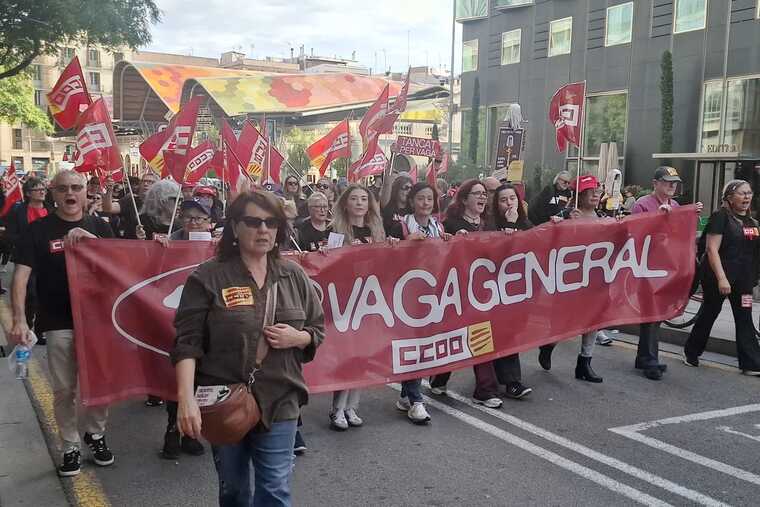
Socialist Worker spoke to striking workers on the streets of Barcelona
A massive general strike has gripped the Spanish state. The strike began at midnight on Wednesday night with workers blockading roads with burning tyres, occupying building and picketing major workplaces.
In many areas, the police attacked strikers, charging them to break the picket lines and blockades of roads in cities including Valencia and Castellón.
The entire rail network has been shut down in a strike that began on Tuesday. The striking railworkers are demanding better health and safety after the horrific crash on the high speed line two weeks ago.
The entire industrial zone of Barcelona was shut down. And every motorway into both Madrid and Barcelona was shut down by huge pickets.
The government imposed “minimum service” orders on the unions, requiring some workers to turn up to keep transport moving. But in many cases pickets stopped the services running.
Workers from the UGT and CCOO unions came together in the centre of Barcelona at 10.30am to march through the city’s historic streets. The started at the headquarters of the bosses’ association and ended at the Barcelona stock exchange. They marched past the encampment set up by housing activists in Placa de Catalunya.
Workers shut down big shops, including Benetton, Adidas, El Corte Ingles and Zara as they marched, using whistles, flares and fireworks.
Every shop that was open was forced to close by the strikers. There was a real sense of collective power which the police were powerless to stop.
Striking hotel workers told Socialist Worker that they are demanding action on housing, the cost of living, wages and public services.
Victor said, “We work in hotels. You see the luxury hotels are booming, but the hotels for ordinary people are in difficulty.
“They are making big profits—but they don’t want to share them with us.
“Things have got worse for the last 30 years—not just here, but everywhere.
“When I was young, I had a government sponsored flat. I could save up to buy a flat for €180,000. Now, there is no cheap housing and the same flat would cost €450,000.”
Striker Gwendolene said, “We are fighting for housing and for public services. My son is training to be a lawyer, but he is still living at home.
“The government invested in the high speed railways, but they do not spend to keep it safe. And they never invested the short distance trains that people use to go to work and school.
“Spain has more kilometres of high speed train track than anywhere outside China. But they don’t invest in it.”
Miguel added, “Food has gone up by 45 percent. But our wages haven’t gone up. They gave us 2 percent in 2022, 2 percent in 2023, 2 percent in 2024, 2 percent in 2025. Now it’s 4 percent, but that isn’t enough. We have fallen behind.”
Cleaners Yolanda and Sylvia used their mops as placard sticks. Yolanda told Socialist Worker, “We are striking because we cannot afford to feed our children. We cannot afford to keep a roof over our heads. We work so hard, but we get nothing.”
The vice president of the CDT union in Morocco, Younes Firachine, was with a delegation of Moroccan workers who came to Barcelona to show their solidarity.
Younes told Socialist Worker, “The unions must stand together and support each other.
“We face the same issues everywhere. Some get richer, but life is harder for us and for our children.
“We must be together and show solidarity.”
The strike was called by the UGT and CCOO unions along with the renters’ union, the Confederación de Sindicatos de Inquilinos.
A mass campaign over housing erupted after the eviction of 87 year old María del Carmen “Maricarmen” Abascal in Madrid in September. Housing activists have set up encampments in major cities.
Prime minister Pedro Sánchez called a general election for 28 November. Sánchez’s Labour-type PSOE is trailing in the polls to a potential coalition of the right wing PP party and the far right Vox.
Striker Jordi works in financial services. He explained to Socialist Worker that the general election does not offer workers a real choice.
Jordi said, “I will not vote for the PP or Vox. They are of the right. They pretend to care about us, but they just want to win the race, to be elected.
“I cannot vote for Sánchez. He is centre left, but they have been in power for eight years and things have got worse.
“I will go to vote, but I will do a white vote—a protest vote. I won’t vote for any of them. We need to keep striking—we have to give our young people a future”.
Tags: Spain Posted in International, News |
Comments Off on General strike grips Spanish state: ‘We have to give young people a future’
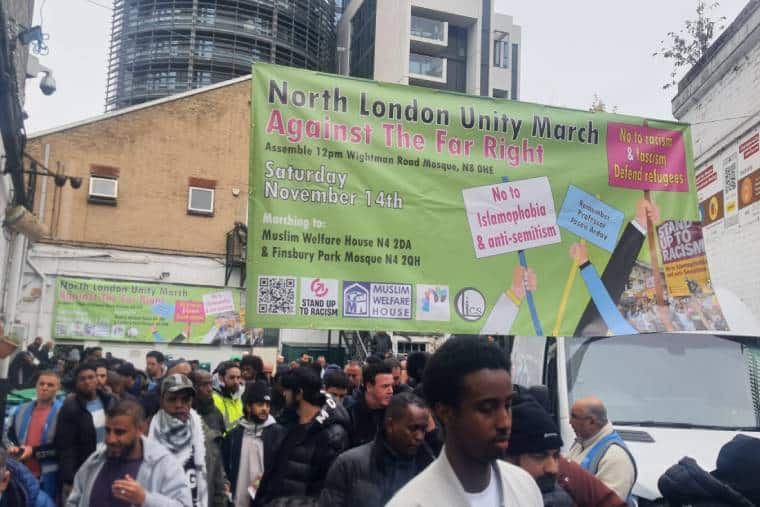
Banner outside Muslim Welfare House in Finsbury Park, north London, calling on people to join the unity march
Anti-racists will take to the streets of London on Saturday with unity marches in the north, west and south of the capital.
Called by Stand Up To Racism (SUTR), they are backed by trade unions, Palestine organisations, councillors and Muslim groups.
A banner urging people to join the north London march flies outside Muslim Welfare House in Finsbury Park.
Toufik, a member of the Muslim Welfare House, told Socialist Worker, “We live in a climate where everything is going towards the far right.
“You see what’s going on in France with Marine Le Pen and here with Nigel Farage, Restore Britain and the rhetoric against Islam and Muslim and migrants.
“You go on social media and see the way they are talking about migrants and Muslims, it’s disgusting.
“On top of that some people want us to be quiet.
“We can’t be quiet—we have to attend marches like this.
“Muslims must understand that unless you complain, unless you participate, then nothing is going to change.”
Hate crimes against Muslims have risen by 15 percent since last year, according to Home Office statistics.
Toufik said, “Muslims are so frightened of what’s going on, we hear complaints all the time, especially from women wearing headscarves. They’re attacked every day.
“When people experience racism, they don’t report it. They don’t trust the system and think the police will do nothing about it.”
The far right has suffered setbacks in recent weeks with defeats in the Brazilian presidential and US midterm elections.
Revolts in France, Spain, Portugal and Italy show millions of people want an alternative to the centre and the far right.
But resistance against austerity doesn’t automatically defeat the far right—it has to go hand in hand with a fight against racism.
“In France, you see millions of people on the streets every week,” said Toufik. “People are frustrated with the regime.
“The people are talking about the cost of living crisis, how expensive everything is, the lack of education funding and problems with healthcare.
“But then look who is gaining momentum day by day–the far right. It is completely contradictory.
“The far right is saying their first priority is to ban the headscarf. As if the scarf is the problem.
“As if all the health and employment problems, and the education system failing will be sorted when women no longer wear a scarf.
“All the polls say Marine Le Pen is going to win the presidential election in France.
“In Germany, Portugal, Italy and everywhere it looks like the far right are gaining momentum.
“There’s some people saying not to speak up about these problems—but you can’t keep quiet.”
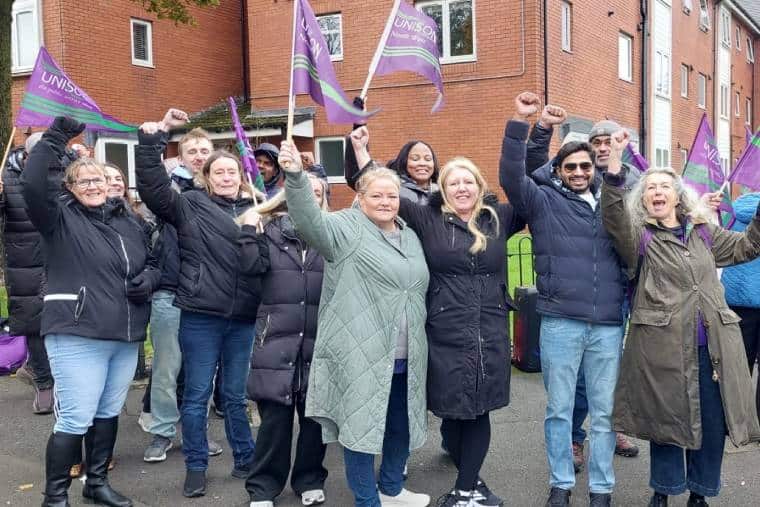
Oldham Theatre workers striking for overtime pay last month (Pic: unisonnca on facebook)
NHS theatre workers in Greater Manchester are set to return to picket lines next week as part of their long-running dispute over overtime pay.
The more than 400 striking theatre staff at the Northern Care Alliance (NCA)—including nurses, clinical support workers and housekeepers—work at the Salford Royal, Royal Oldham, Rochdale Infirmary and at Fairfield General Hospital in Bury.
NCA bosses have been using an NHS-owned agency, NHS Professionals, to pay workers less than the nationally agreed rates stipulated in the Agenda for Change agreement.
As a result, some workers stand to lose up to £80 per overtime shift.
Unison union members at the NCA last week voted by 99 percent on an 83 percent turnout to reject the trust’s latest offer.
Bosses had sought to end the dispute on their terms.
The new offer would have given workers enhanced overtime pay rates—but only for 12 months—before returning to management’s new, lower-paid system.
Unison said that bosses used “scare tactics” to try to win the vote, but to no avail.
As the latest deal was rejected, Unison organiser Kevin Dolan said, “Staff are sending a resounding message to NCA bosses.
“They’re standing together and won’t be deterred in their fight for what’s right.
“It’s disappointing the trust has resorted to scare tactics, by telling staff this was the final offer. But that’s not the trust’s decision to make.”
Unison is planning a 24-hour strike on Wednesday 18 November, a 48-hour strike starting on 23 November and a further 24-hour strike on 27 November.
Strikers know that the issue of undercutting normal overtime rates affects health workers across Britain.
That’s why they have decided to lobby a meeting of the Greater Manchester Health Board on their next strike day.
The NCA Unison branch is inviting all Unison branches in the north west of England to join the protest.
Lobby health bosses on Wednesday 18 November. Meet at 12.45pm at the Emmeline Pankhurst statue, St Peter’s Square, Manchester M2 5PD.
Health workers slam plan to slash NHS jobs and services in Scotland
Scottish government plans to slash the number of health boards from 14 to just two have sent a wave of anger through some health trade unions.
The two remaining bodies would cover the whole of the east and west of Scotland.
First minister and Scottish National Party leader John Swinney unveiled the plan in September, saying it would streamline management and free up resources for frontline care.
But health workers say the reorganisation could see the loss of up to 20,000 jobs in NHS Scotland and Scottish local authorities.
Dr Nóra Murray-Cavanagh, the new head of the doctors’ BMA union in Scotland, said the moves would be “costly and time consuming”.
She called on Swinney to withdraw the plans and think again.
The BMA is not alone in raising concerns that consolidation could widen health inequalities if people are forced to travel further for treatment.
The patient safety commissioner, as well as some rural campaign groups, have echoed these fears.
Despite that, a health worker in Edinburgh told Socialist Worker that Unison, the biggest general health union, is doing little to oppose the plans.
“The union has strongly condemned aspects of the government’s moves, but it hasn’t opposed it outright,” he said.
“That’s why most people don’t understand what it exactly entails.”
He said that around 60 percent of the cuts will fall on the NHS, with services including IT and diagnostics being cut in the name of “reducing duplication”.
But many people also expect local authority-run social care and health provision to take a “big hit” too.
The Unison union member also thought that some leading activists were “sitting on their thumbs” over the reorganisation issue.
“Unison Scotland’s Health Committee, which is the senior governing body, has failed to wake up and realise what’s going on, and basically directed local branches to fight things on an individual case-by-case basis. That’s a recipe for disaster,” he said.
The Unison activist says that at a “minimum” the union needs to be ready to fight—instead of “fighting like rats in a sack for their own union positions.”
“Every affected branch should immediately convene an open meeting on the subject of the reorganisation, so that members can be alerted.
“We need bulletins and emails and posters.
“And we need to start talking up the possibility of strikes over the issue.
“This could be the biggest change to the NHS in Scotland since its formation.
“All health and local government unions should say directly that we will oppose any cuts to our services.”
Indefinite strike demands action on rebanding
Low-paid strikers in Leeds remain solid in their fight to win over pay bands.
The Unison union members work as operating theatre assistants in the Leeds Teaching Hospitals NHS trust. They began an indefinite strike on 5 October demanding their jobs are rebanded as band 3, to reflect the clinical work they do.
This includes reducing infection risks, assisting with specialist surgical equipment, supporting clinical teams during operations and helping patients recover afterwards.
All health unions at the trust should tell their members not to do the strikers’ work.
If the operating theatre workers win, everyone fighting for better pay gets a boost.
Lancashire blood workers’ action continues
Dozens of vital blood workers at Lancashire Teaching Hospitals trust (LTHT) returned to picket lines this week in the overtime and holiday pay dispute that began in June.
The Unite union members began a five-day strike on Monday.
They plan to repeat the action from 16-20 November and from 23-27 November.
Unite members are no longer providing laboratory cover for a range of urgent services, including emergency care, blood transfusions, surgery, cancer treatment and maternity services.
According to Unite, LTHT has spent more than £1 million, or £60,000 per week, on outsourcing the strikers’ work.
It added that bosses agreed to make a settlement offer but then stopped communicating with the union.
Donald Trump unleashed the murderous thugs of Ice and faced disaster (Pic: flickr/ Mobilus In Mobili)
Donald Trump gambled big when he re-entered the White House in January last year—and he’s lost big.
He unleashed murderous migrant hunts by Ice, started a failed war with Iran and tried to turn Washington into a gold-plated monument to his own glory.
The reward has been sweeping victories for the Democrats. Perhaps the most spectacular were in Texas, long a Republican rotten state. The Democrats won every state‑wide vote, with Gina Hinojosa, a Latina calling herself an “economic populist”, elected governor. Many counties across the US swung towards the Democrats.
The Republican debacle poses two interesting but rather different questions. What are the long-term consequences? And, how will Trump himself react?
Addressing the first, the vote breakdown is interesting. According to the New York Times newspaper, “Voters of every demographic group nationally—across race, age, gender and education—swung back toward the Democratic Party, reversing a broad shift in support towards Republicans in 2024.”
Two groups are particularly noteworthy. Hispanic voters swung to Trump in 2024, but switched back to the Democrats this time—by 28 percentage points overall. Meanwhile, “white voters without a college degree have been the backbone of Trump’s base,” says the New York Times. Last week this group “swung more to the left than white college‑educated voters”.
Gillian Tett commented in the Financial Times newspaper, that the blue wave was “a howl of populist rage against elites in a ‘K-shaped’ economy where rich asset owners are winning at the expense of ordinary workers.”
The back-and-forth swings between the Republicans and the Democrats indicate the increased volatility caused by capitalism’s failure.
We see this also in Britain—Tory landslide in 2019, Labour landslide in 2024 and then the rapid collapse of support for Keir Starmer.
The Democrats’ leadership are set in the same mould of neoliberal imperialism as Starmer. They now control Congress. If they mess up, the pendulum could swing back to the Republicans, maybe as soon as the next presidential election in 2028.
There is, however, one very important change in these midterms, which is likely to last. They were a complete disaster for the most powerful pro-Israel lobby organisation, Aipac.
It used to exercise enormous sway over politicians in both major parties. But its efforts this time to brand and crush pro-Palestine candidates as “antisemites” utterly failed.
In Michigan, Abdul El-Sayed became the first Muslim senator despite the vast amounts of money Aipac poured into defeating him. This is an instance of the global shift in consciousness produced by the Gaza genocide, which appears to be particularly significant among Jews in the US.
So how will Trump react? His promotion of Stephen Miller, the fascist orchestrator of the Ice raids, as White House chief of staff is typical. Trump’s method is, as the writer Deborah Friedell puts it, “Deny, counterattack, declare victory. Trump found that he could bear losing, so long as he never had to admit he had lost.”
Does this mean that Trump will carry out his threat to mount a further attack on Iran? The US military build-up around the Gulf is continuing. The Middle East expert Alastair Crooke calls Trump “a lame duck with a loaded gun”. He may shoot.
But it’s very unlikely that any attack mounted by the US and Israel will succeed in removing or disarming a highly motivated Iranian regime.
It would also deepen the divisions among the Republicans—vice president JD Vance has already blamed the war for their defeat. A renewed bout of fighting will in all probability accelerate the decay of the US hegemony over western Asia.
Gideon Rachman mournfully writes in the Financial Times, “That kind of shift could fundamentally change the balance of power in the Middle East, while unnerving European allies and creating new opportunities for China in Asia and around the world.” Rather than making America great again, Trump is speeding up the decline of US imperialism.
Young protesters in France calling for climate justice as part of a general strike on 5 November
In Andy Burnham’s first speech as prime minister, he made a point of saying that he would attend this year’s Cop31 talks.
The annual United Nations negotiations on climate change begin this week in Antalya, Turkey.
“The climate crisis is not a distant threat,” he said. “It is here and with us now.”
But the Labour prime minister has poured more fuel onto the fire since. He has pushed ahead with fossil fuel extraction at Jackdaw in the North Sea after a summer of heatwaves.
Scientists have announced that they expect 2026 to be the hottest year on record, due to the combined impacts of El Niño and the heating planet. The previous record was set just two years ago.
This year has seen villages washed away and more than a thousand people killed by flooding in Nepal and Tibet. Heavy rains and flooding killed hundreds and impacted 2.36 million people across southern Africa.
In Britain, farmers are reporting the worst cereal harvest on record after the unprecedented hot and dry weather.
But after more than 30 years of Cop talks, few even in the mainstream media think they can prevent catastrophe.
UN climate chief Simon Stiell admitted, “No single conference can bridge the chasm between the science and reality.”
It is easy to see why there is an atmosphere of pessimism around this year’s talks. Cop31 is jointly hosted by Turkey and Australia.
Turkey announced plans this summer to expand one of its largest coal plants. It has no plans to phase out its coal use. Australia is similarly hooked on coal. And its Labor government has overseen a boom in hyperscale data centres that soak up energy and water supplies.
Environmentalists breathed a sigh of relief that Luiz Inácio Lula da Silva was elected as president of Brazil rather than the far right candidate Flávio Bolsonaro.
When Bolsonaro’s father Jair was in office between 2019 and 2022, he oversaw the further destruction of the Amazon rainforest.
Lula is set to return to the Cop talks this year with a report on progress on last year’s plans to “phase out” fossil fuels. But this is a voluntary plan that allows the biggest emitters to keep polluting.
In Britain, Labour has slashed £3 billion from the energy department to allow more to be spent on the military.
Burnham understands that climate change is real. But even climate conscious politicians are pulling in the wrong direction. They are tied to the logic of a capitalist system where everything is subordinated to maximising profit. That logic is built into the system because of competition.
The system locks us into fossil fuel expansion. It means a drive to raise arms spending that uses up resources and wrecks the planet.
But worries about climate breakdown have fed into some of the explosive mass movements we are seeing across Europe.
France’s school students have sweltered in the heat over the summer, adding to their case that the school system is not good enough. Albania’s Flamingo Revolution was triggered by the sell-off of land to create a luxury resort.
Hope lies with the people who are resisting the destruction of their futures and revolting against the system.