Why north London Muslims are joining the unity march

Posted on: November 10th, 2026 by Camilla Royle
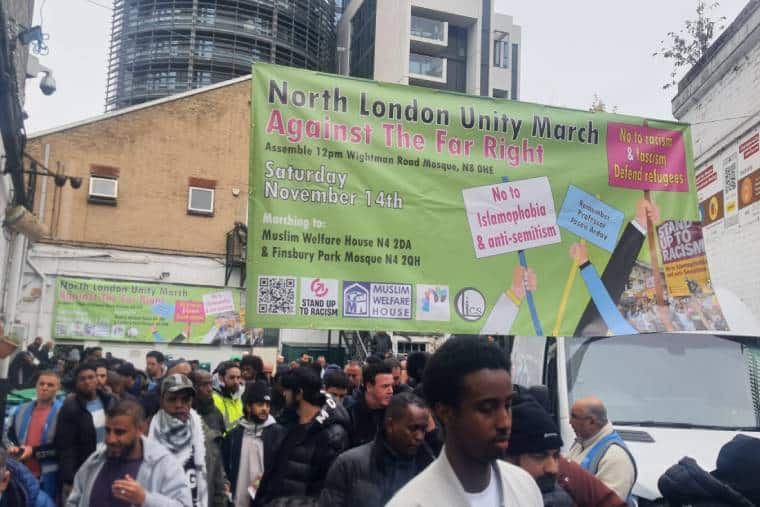
Banner outside Muslim Welfare House in Finsbury Park, north London, calling on people to join the unity march

Banner outside Muslim Welfare House in Finsbury Park, north London, calling on people to join the unity march

Anti-racists will take to the streets of London on Saturday with unity marches in the north, west and south of the capital.

Called by Stand Up To Racism (SUTR), they are backed by trade unions, Palestine organisations, councillors and Muslim groups.

A banner urging people to join the north London march flies outside Muslim Welfare House in Finsbury Park.

Toufik, a member of the Muslim Welfare House, told Socialist Worker, “We live in a climate where everything is going towards the far right.

“You see what’s going on in France with Marine Le Pen and here with Nigel Farage, Restore Britain and the rhetoric against Islam and Muslim and migrants.

“You go on social media and see the way they are talking about migrants and Muslims, it’s disgusting.

“On top of that some people want us to be quiet.

“We can’t be quiet—we have to attend marches like this.

“Muslims must understand that unless you complain, unless you participate, then nothing is going to change.”

Hate crimes against Muslims have risen by 15 percent since last year, according to Home Office statistics.

Toufik said, “Muslims are so frightened of what’s going on, we hear complaints all the time, especially from women wearing headscarves. They’re attacked every day.

“When people experience racism, they don’t report it. They don’t trust the system and think the police will do nothing about it.”

The far right has suffered setbacks in recent weeks with defeats in the Brazilian presidential and US midterm elections.

Revolts in France, Spain, Portugal and Italy show millions of people want an ­alternative to the centre and the far right.

But resistance against austerity doesn’t automatically defeat the far right—it has to go hand in hand with a fight against racism.

“In France, you see ­millions of people on the streets every week,” said Toufik. “People are frustrated with the regime.

“The people are ­talking about the cost of living crisis, how expensive everything is, the lack of education funding and problems with healthcare.

“But then look who is ­gaining momentum day by day–the far right. It is completely contradictory.

“The far right is saying their first priority is to ban the headscarf. As if the scarf is the problem.

“As if all the health and employment problems, and the education system failing will be sorted when women no longer wear a scarf.

“All the polls say Marine Le Pen is going to win the presidential election in France.

“In Germany, Portugal, Italy and everywhere it looks like the far right are gaining momentum.

“There’s some people saying not to speak up about these problems—but you can’t keep quiet.”


‘We won’t let the far right win in Solihull’

Residents in Solihull, near Birmingham, are building new networks to challenge the far right.

This comes after a Chelmsley Wood Patriots “patrol” terrorised two Indian students and chased them out of the town.

In a disturbing video posted on 14 October, a group of masked men are seen harassing three Indian men in a park.

The men explained that two of them were international students, who had just arrived in Britain.

The third man was their landlord, who was showing them around the area. The fascist thugs followed them home.

They smashed their windows for the next three nights in a row.

The two students left the area in the days after the incident in the park.

Sam, a local resident, told Socialist Worker, “I thought now is the time to form Solihull Stand Up To Racism (SUTR).

“I couldn’t sit by and do nothing. These are my neighbours and my friends.

“I’m not going to pretend this isn’t happening.

“I’m not going to have people tell me they’re scared to go out of their house.”

Sam, some members of the local church and local Green Party councillors met with the landlord in the house.

The “patrols” are still happening throughout Chelmsley Wood.

They began at the end of September, following a protest outside flats that some believed were housing migrants.

The flats were being used as accommodation for women and children fleeing domestic abuse.

The far right gathered anyway.

Local Reform UK councillors joined the protest, with one speaking to the crowd about how proud he was of them.

“In Chelmsley Wood, our issues are that we’ve had so much taken from us,” explained Sam.

“So much has been cut. The community is facing a lot, but it’s not because of immigration or boats.

“It’s the local government not doing what they’re meant to.”

The fascists have called another protest for Sunday. SUTR has organised a counter-protest.


Yet another washout for far right in York

Anti-fascists outnumbered far right protesters by over ten to one in York last Saturday.

The far right claimed it was mobilising 200 people to the town square. Yet only 30 showed up.

Around 350 people joined the counter-protest organised by Stand Up To Racism (SUTR).

It was backed by local trade unions, Palestine activists, LGBT+ groups and students.

The anti-racists took the square before the far right arrived, holding their ground for the entire afternoon.

The mobilisation came after a string of other attempts to establish a far right presence in York—which were defeated by anti‑racists each time.

Anti-racists chased far right “activist” Young Bob—real name Gregory Moffitt—out of York last month.

He tried to set up a Turning Point UK stall to “debate” abortion and mass deportation.

He was drowned out with chanting and had to be escorted away by police.

After that the far right tried to hold another protest in York but got chased out again.


Nazis manage to muster 25 in Newcastle

Over 100 anti-racists outnumbered 25 Nazis in Newcastle last Saturday.

SUTR was joined by Unison union activists and migrant workers.

As in York, anti-racists have shown off the far right again and again in Newcastle.

Among the far right in Newcastle were several with English Defence League (EDL) badges.

The EDL, once led by Nazi Tommy Robinson, was crushed a decade ago by anti-fascists.
Health workers round up: Manchester theatre workers up the ante

Posted on: November 10th, 2026 by Camilla Royle
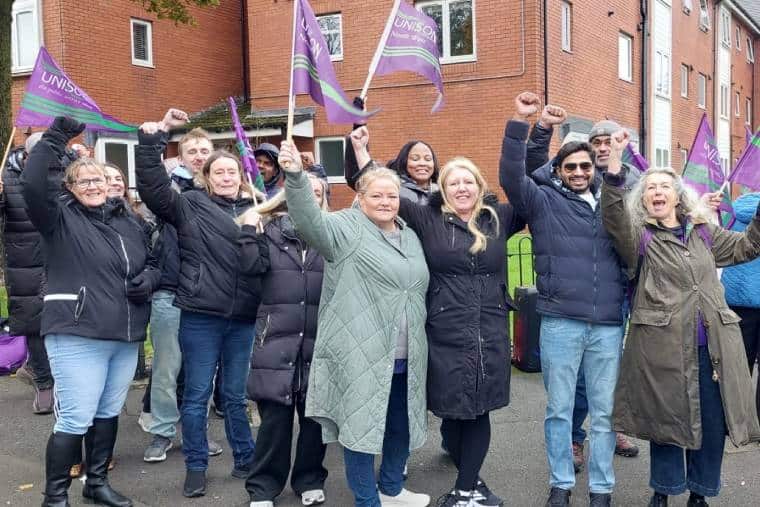
Oldham Theatre workers striking for overtime pay last month

Oldham Theatre workers striking for overtime pay last month (Pic: unisonnca on facebook)

NHS theatre workers in Greater Manchester are set to return to picket lines next week as part of their long-running dispute over overtime pay.

The more than 400 ­striking theatre staff at the Northern Care Alliance (NCA)—­including nurses, clinical support workers and housekeepers—work at the Salford Royal, Royal Oldham, Rochdale Infirmary and at Fairfield General Hospital in Bury.

NCA bosses have been using an NHS-owned agency, NHS Professionals, to pay workers less than the nationally agreed rates stipulated in the Agenda for Change agreement.

As a result, some workers stand to lose up to £80 per overtime shift.

Unison union members at the NCA last week voted by 99 percent on an 83 percent turnout to reject the trust’s latest offer.

Bosses had sought to end the dispute on their terms.

The new offer would have given workers enhanced ­overtime pay rates—but only for 12 months—before returning to management’s new, lower-paid system.

Unison said that bosses used “scare tactics” to try to win the vote, but to no avail.

As the latest deal was rejected, Unison ­organiser Kevin Dolan said, “Staff are sending a resounding ­message to NCA bosses.

“They’re standing together and won’t be deterred in their fight for what’s right.

“It’s disappointing the trust has resorted to scare tactics, by telling staff this was the final offer. But that’s not the trust’s decision to make.”

Unison is planning a 24-hour strike on Wednesday 18 November, a 48-hour strike starting on 23 November and a further 24-hour strike on 27 November.

Strikers know that the issue of undercutting normal overtime rates affects health workers across Britain.

That’s why they have decided to lobby a meeting of the Greater Manchester Health Board on their next strike day.

The NCA Unison branch is inviting all Unison branches in the north west of England to join the protest.

  • Lobby health bosses on Wednesday 18 November. Meet at 12.45pm at the Emmeline Pankhurst statue, St Peter’s Square, Manchester M2 5PD.

Health workers slam plan to slash NHS jobs and services in Scotland

Scottish government plans to slash the number of health boards from 14 to just two have sent a wave of anger through some health trade unions.

The two remaining bodies would cover the whole of the east and west of Scotland.

First minister and Scottish National Party leader John Swinney unveiled the plan in September, saying it would streamline management and free up resources for frontline care.

But health workers say the reorganisation could see the loss of up to 20,000 jobs in NHS Scotland and Scottish local authorities.

Dr Nóra ­­Murray-Cavanagh, the new head of the doctors’ BMA union in Scotland, said the moves would be “costly and time consuming”.

She called on Swinney to withdraw the plans and think again.

The BMA is not alone in raising concerns that consolidation could widen health inequalities if people are forced to travel further for treatment.

The patient safety commissioner, as well as some rural campaign groups, have echoed these fears.

Despite that, a health worker in Edinburgh told Socialist Worker that Unison, the biggest general health union, is doing little to oppose the plans.

“The union has strongly condemned aspects of the government’s moves, but it hasn’t opposed it outright,” he said.

“That’s why most people don’t understand what it exactly entails.”

He said that around 60 percent of the cuts will fall on the NHS, with services including IT and diagnostics being cut in the name of “reducing duplication”.

But many people also expect local ­authority-run social care and health provision to take a “big hit” too.

The Unison union member also thought that some leading activists were “sitting on their thumbs” over the reorganisation issue.

“Unison Scotland’s Health Committee, which is the senior governing body, has failed to wake up and realise what’s going on, and basically directed local branches to fight things on an individual case-by-case basis. That’s a recipe for disaster,” he said.

The Unison activist says that at a “minimum” the union needs to be ready to fight—instead of “fighting like rats in a sack for their own union positions.”

“Every affected branch should immediately convene an open meeting on the subject of the reorganisation, so that members can be alerted.

“We need bulletins and emails and posters.

“And we need to start talking up the possibility of strikes over the issue.

“This could be the biggest change to the NHS in Scotland since its formation.

“All health and local government unions should say directly that we will oppose any cuts to our services.”


Indefinite strike demands action on rebanding

Low-paid strikers in Leeds remain solid in their fight to win over pay bands.

The Unison union members work as operating theatre assistants in the Leeds Teaching Hospitals NHS trust. They began an indefinite strike on 5 October demanding their jobs are rebanded as band 3, to reflect the clinical work they do.

This includes reducing infection risks, assisting with specialist surgical equipment, supporting clinical teams during operations and helping patients recover afterwards.

All health unions at the trust should tell their members not to do the strikers’ work.

If the operating theatre workers win, everyone fighting for better pay gets a boost.


Lancashire blood workers’ action continues

Dozens of vital blood workers at Lancashire Teaching Hospitals trust (LTHT) returned to picket lines this week in the overtime and holiday pay dispute that began in June.

The Unite union members began a five-day strike on Monday.

They plan to repeat the action from 16-20 November and from 23-27 November.

Unite members are no longer providing laboratory cover for a range of urgent services, including emergency care, blood transfusions, surgery, cancer treatment and maternity services.

According to Unite, LTHT has spent more than £1 million, or £60,000 per week, on outsourcing the strikers’ work.

It added that bosses agreed to make a settlement offer but then stopped communicating with the union.

Alex Callinicos: Trump dug his own grave in midterms

Posted on: November 10th, 2026 by Camilla Royle
Donald Trump balloon at No Kings rally

Donald Trump unleashed the murderous thugs of Ice and faced disaster (Pic: flickr/ Mobilus In Mobili)

Donald Trump gambled big when he re-entered the White House in January last year—and he’s lost big.

He unleashed murderous migrant hunts by Ice, started a failed war with Iran and tried to turn Washington into a gold-plated monument to his own glory.

The reward has been sweeping victories for the Democrats. Perhaps the most spectacular were in Texas, long a Republican rotten state. The Democrats won every state‑wide vote, with Gina Hinojosa, a Latina calling herself an “economic populist”, elected governor. Many counties across the US swung towards the Democrats.

The Republican debacle poses two interesting but rather different questions. What are the long-term consequences? And, how will Trump himself react?

Addressing the first, the vote breakdown is interesting. According to the New York Times newspaper, “Voters of every demographic group nationally—across race, age, gender and education—swung back toward the Democratic Party, reversing a broad shift in support towards Republicans in 2024.”

Two groups are particularly noteworthy. Hispanic voters swung to Trump in 2024, but switched back to the Democrats this time—by 28 percentage points overall. Meanwhile, “white voters without a college degree have been the backbone of Trump’s base,” says the New York Times. Last week this group “swung more to the left than white college‑educated voters”.

Gillian Tett commented in the Financial Times newspaper, that the blue wave was “a howl of populist rage against elites in a ‘K-shaped’ economy where rich asset owners are winning at the expense of ordinary workers.”

The back-and-forth swings between the Republicans and the Democrats indicate the increased volatility caused by capitalism’s failure.

We see this also in Britain—Tory landslide in 2019, Labour landslide in 2024 and then the rapid collapse of support for Keir Starmer.

The Democrats’ leadership are set in the same mould of neoliberal imperialism as Starmer. They now control Congress. If they mess up, the pendulum could swing back to the Republicans, maybe as soon as the next presidential election in 2028.

There is, however, one very important change in these ­midterms, which is likely to last. They were a complete disaster for the most powerful pro-Israel lobby organisation, Aipac.

It used to exercise enormous sway over politicians in both major parties. But its efforts this time to brand and crush pro-Palestine candidates as “antisemites” utterly failed.

In Michigan, Abdul El-Sayed became the first Muslim senator despite the vast amounts of money Aipac poured into defeating him. This is an instance of the global shift in consciousness produced by the Gaza genocide, which appears to be particularly significant among Jews in the US.

So how will Trump react? His promotion of Stephen Miller, the fascist orchestrator of the Ice raids, as White House chief of staff is typical. Trump’s method is, as the writer Deborah Friedell puts it, “Deny, counterattack, declare victory. Trump found that he could bear losing, so long as he never had to admit he had lost.”

Does this mean that Trump will carry out his threat to mount a further attack on Iran? The US military build-up around the Gulf is continuing. The Middle East expert Alastair Crooke calls Trump “a lame duck with a loaded gun”. He may shoot.

But it’s very unlikely that any attack mounted by the US and Israel will succeed in removing or disarming a highly motivated Iranian regime.

It would also deepen the divisions among the Republicans—vice president JD Vance has already blamed the war for their defeat. A renewed bout of fighting will in all probability accelerate the decay of the US hegemony over western Asia.

Gideon Rachman mournfully writes in the Financial Times, “That kind of shift could fundamentally change the balance of power in the Middle East, while unnerving European allies and creating new opportunities for China in Asia and around the world.” Rather than making America great again, Trump is speeding up the decline of US imperialism.

No change from the top at Cop

Posted on: November 10th, 2026 by Camilla Royle
Young protesters in France calling for climate justice as part of a general strike

Young protesters in France calling for climate justice as part of a general strike on 5 November

In Andy Burnham’s first speech as prime minister, he made a point of saying that he would attend this year’s Cop31 talks.

The annual United Nations negotiations on climate change begin this week in Antalya, Turkey.

“The climate crisis is not a distant threat,” he said. “It is here and with us now.”

But the Labour prime minister has poured more fuel onto the fire since. He has pushed ahead with fossil fuel extraction at Jackdaw in the North Sea after a summer of heatwaves.

Scientists have announced that they expect 2026 to be the hottest year on record, due to the combined impacts of El Niño and the heating planet. The previous record was set just two years ago.

This year has seen villages washed away and more than a thousand people killed by flooding in Nepal and Tibet. Heavy rains and flooding killed hundreds and impacted 2.36 million people across southern Africa.

In Britain, farmers are reporting the worst cereal harvest on record after the unprecedented hot and dry weather.

But after more than 30 years of Cop talks, few even in the mainstream media think they can prevent catastrophe.

UN climate chief Simon Stiell admitted, “No single conference can bridge the chasm between the science and reality.”

It is easy to see why there is an atmosphere of pessimism around this year’s talks. Cop31 is jointly hosted by Turkey and Australia.

Turkey announced plans this summer to expand one of its largest coal plants. It has no plans to phase out its coal use. Australia is similarly hooked on coal. And its Labor government has overseen a boom in hyperscale data centres that soak up energy and water supplies.

Environmentalists breathed a sigh of relief that Luiz Inácio Lula da Silva was elected as president of Brazil rather than the far right candidate Flávio Bolsonaro.

When Bolsonaro’s father Jair was in office between 2019 and 2022, he oversaw the further destruction of the Amazon rainforest.

Lula is set to return to the Cop talks this year with a report on progress on last year’s plans to “phase out” fossil fuels. But this is a voluntary plan that allows the biggest emitters to keep polluting.

In Britain, Labour has slashed £3 billion from the energy department to allow more to be spent on the military.

Burnham understands that climate change is real. But even climate conscious politicians are pulling in the wrong direction. They are tied to the logic of a capitalist system where everything is subordinated to maximising profit. That logic is built into the system because of competition.

The system locks us into fossil fuel expansion. It means a drive to raise arms spending that uses up resources and wrecks the planet.

But worries about climate breakdown have fed into some of the explosive mass movements we are seeing across Europe.

France’s school students have sweltered in the heat over the summer, adding to their case that the school system is not good enough. Albania’s Flamingo Revolution was triggered by the sell-off of land to create a luxury resort.

Hope lies with the people who are resisting the destruction of their futures and revolting against the system.

Letters: Addressing Islamophobic violence in east London

Posted on: November 10th, 2026 by Frankie Murden
Newham Stand Up To Racism outside the Hassanah Centre

Newham Stand Up To Racism outside the Hasanah Centre

Last Friday, at 10.30pm after prayers, someone threw a metal rod through the window of the Hasanah Centre mosque in Stratford, east London.

This projectile had such force behind it that it landed 10 metres across the room and hit a wall. Both the Home Office and police said it could have been lethal, but thankfully no one was hurt. It was a very dangerous attack.

I went to the mosque with with someone who attends the mosque and told the imam that Newham Stand Up To Racism would like to show that the community supports the mosque.

We want to show our anger about what’s happened. We are their siblings and an attack on them is an attack on all of us. They were so friendly and really wanted it to happen.

We arranged a demonstration on Friday with speakers including the imam, councillors from Labour, the Green Party and independents and a statement from the NEU union.

This attack came in the context of a massive rise of racism and Islamophobia. This has not just been condoned but encouraged by the government and the mainstream media.

Attacks like this are not a surprise to people in Newham. We’ve had many attacks on Muslim properties and this is at least the third attack on a mosque this year.

There is a rise in racism that everyone needs to take seriously. Newham council passed a motion on Islamophobia awareness and the safety of

Muslim spaces recently, so there is an awareness of the changing situation.

We can all do something to support. We can address the political situation that scapegoats Muslims and migrants.

We will do everything we can to fight this.

Miriam, Newham Stand Up To Racism,


Solidarity with French workers

Hastings Trades Union Council (TUC) sent a message of solidarity to our twinned town of Dieppe, in Normandy, France, for the general strike on 5 November.

We wrote, “We are inspired by the resistance of students and workers.

“We hope that your example will give students and workers in Britain the confidence to also fight.

“We worry about the rise of Le Pen. The threat from the fascists is also a problem in Britain. We believe that racism is a weapon to divide the working class and must be defeated.”

The Dieppe branch of the French trade union federation CGT responded saying, “A huge thank you for your support.”

They added that, “We are fighting what we are being told is inevitable—the far right coming to power in a few months.
“You can count on us to never give up!”

As a result, we have been invited to join their May Day march—the day before the final round of the French presidential election. Workers of the world unite—smash the far right!

Simon Hester, chair of Hastings and District Trades Union Council


Free the Kilvey Three ­environmentalists

Protesters gathered last Friday to try to stop tree felling at Kilvey Hill, Swansea, where a private tourist development is planned. Three protesters, all over 70 years old, were arrested. They will be in court on 2 December.

They are three more people arrested and criminalised for fighting against injustice by the powerful who seem to be intent on destroying our world for fat profits.

Kilvey Hill is in an area of low wages where resources are few, but millions are being “loaned” to a multinational company to build a tourist toy on what was common land. 

Some claim the development will bring jobs. But £12 million quid could fund hundreds of jobs in work we actually need doing—public transport, flood defences, sustainable energy, social care, education and health.

Instead, Swansea is getting a gondola ride for tourists and we’ll get a few minimum wage seasonal jobs.

Save Kilvey Hill, free the Kilvey Three, people and planet before profit .

Heather Booker, Swansea


The rich are ­parasitic

Pundits, Tories and Labour ministers say migrants will “cost the country” £10 billion unless changes are made.

This refers to money the state might spend on migrants’ health, education or pensions. It ignores the fact that workers, migrants or not, create that wealth.

The cruellest part is that because migrants often earn little, they pay little tax and are deemed net takers. Meanwhile, those who become rich from our labour and pay more tax appear as net givers. The parasites become the heroes.

Donny Gluckstein, Edinburgh

A look through the history of Rock Against Racism

Posted on: November 10th, 2026 by Frankie Murden
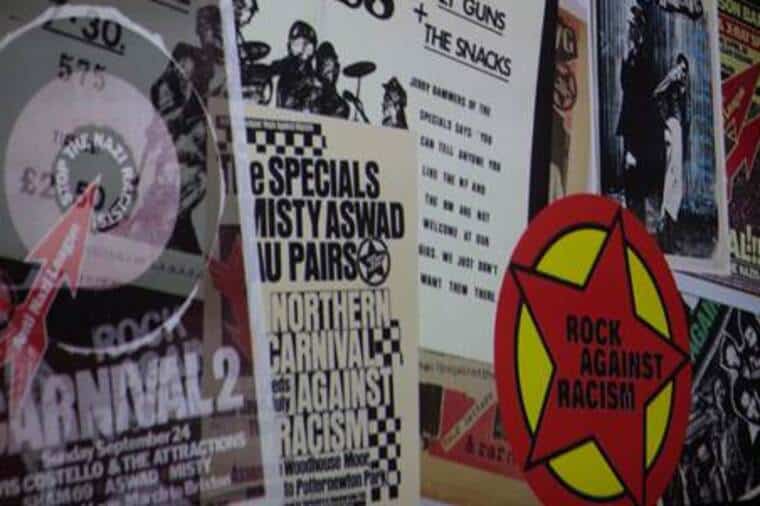
Rock Against Racism memorabilia

Rock Against Racism memorabilia

On 5 August 1976, during a gig in Birmingham, Eric Clapton ranted on stage in support of Enoch Powell. He said, “Stop Britain from becoming a black colony. Get the foreigners out” and “Keep Britain White”.

Red Saunders, an anti‑racist photographer, together with Roger Huddle had been thinking about a gig to combat the rise of racism. Clapton’s speech spurred them into action.

They wrote to New Musical Express magazine. They ended the letter with a call to action—“Keep the faith, black and white unite and fight. We want to organise a rank and file movement against the racist poison in rock music.

“We urge support—all those interested please write to ROCK AGAINST RACISM” They were inundated with hundreds of replies.

And so began the movement that was Rock Against Racism (RAR).

The paper containing that inciting letter is on display at the British Music Experience in an exhibit for the 50th anniversary of Rock Against Racism.

In the main hall are two large glass cabinets containing memorabilia from the time. There are newspapers, stickers, badges, posters, fanzines and large prints of Syd Shelton’s iconic photos from the Carnival Against the Nazis.

Captioned below is a timeline of the history of RAR. It goes from that initial rant in 1976 to the Northern Carnival in Manchester 1978 when “it became cool to be anti‑racist”, through to when the movement wound down.

What’s nice is that the museum also acknowledges the role the Anti Nazi League played in the fight against the National Front and then the Tories under Thatcher.

It also acknowledges the roles that Love Music Hate Racism and Stand Up To Racism play today.

It is a little disappointing how small the exhibit is, any anti-racists will get a kick out of a trip down memory lane.

Matt

  • 50 Years of Rock Against Racism, British Music Experience, Cunard Building, Liverpool L3 1DS, until 3 January 2027
  • Find more information here

New exhibition The Rupture explores a world in profound crisis

Posted on: November 10th, 2026 by Frankie Murden
Works explore themes of alienation, protest, the human ­condition and ­systems of power (Photo: talbotricegallery/Facebook)

Works explore themes of alienation, protest, the human ­condition and ­systems of power (Photo: talbotricegallery/Facebook)

“At a time of profound global uncertainty, The Rupture—No condition is permanent asks what it means to live through the breakdown of established systems, rules-based order and global relationships,” exhibition guide of Talbot Rice contemporary art gallery says.

“Amidst the rise of ­generative AI, neo-colonial threats, the reality of war and ­growing economic inequality, we also face the
escalating effects of climate change that knows no borders, causing extreme weather and planetary events around the world.”

The Rupture feels like an exhibition which is urgent and timely. It features 15 international ­artists and exhibits work that is largely moving image and photography based.

Works explore themes of alienation, protest, the human ­condition and ­systems of power.

The title of the exhibition draws from Palestinian artist Taysir Batniji’s work, a participatory sculpture of soap bricks. They’re engraved with the Arabic phrase “dawam el hal men al mohal”, translating to “­nothing is permanent’”that marks the end of the exhibition.

It is a powerful work that speaks to the idea of the inevitability of capitalist crises.

Other works such as Jenny Brady’s and Eoghan Ryan’s explore interpretation of language and systems of ­communication as politically volatile and ­complex areas.

Kiri Dalena’s work explores censorship and protest ­movements through photography. Li Yefan uses AI and film to explore the ­precarity of

Chinese migrant workers and the threat AI poses to them and their livelihoods in an unorthodox way.

Critique and exploration of the current global rules based order and the way in which it operates is questioned and spotlighted in this exhibition and well worth a visit.

The Talbot Rice Gallery has been at the forefront in ­putting on exhibitions and exhibiting artists that ask big questions about the world we live in whilst making ­contemporary art accessible to people around the world.

It feels a shame then, that the opening of this ­particular exhibition took place during the five week period of Edinburgh UCU union strikes, including staff at the Edinburgh College of Art.

They are are ­fighting against the closure of ­programmes and courses including Jewellery and Silversmithing, Textiles and Performance Costume amidst a general onslaught on the arts in Edinburgh.

Elsewhere with announced eviction of 150 artists in St Margarets house and the proposed demolition of Summarhall arts venue to build student housing, the exhibit feels incredibly ­relevant today.

  • The Rupture—No ­Condition is ­permanent, Talbot Rice Gallery, ­University of Edinburgh, South Bridge, Edinburgh EH8 9YL, until 13 February 2027
  • Find more information here

Workplace action round up

Posted on: November 10th, 2026 by Yuri

On the picket line in Barnsley, south Yorkshire, this week. Nursery workers are fighting against the Reform UK council’s attempt to outsource the service and slash their pensions.

University strike clowns give bosses a red nose

Workers at the University of Nottingham held a clown themed picket line on Monday morning. The UCU union members said, “If we’re going to deal with clowns, we might as well dress like them.” 

They are set to strike until 11 December as they resist an onslaught of job cuts. Bosses have already closed the departments of music, modern languages and American and Canadi-an studies. Children’s nursing and mental health nursing courses have been closed to new students from this year. And support for students has been cut to the bone.

Workers are demanding the bosses quit clowning around with their futures. They say the cuts will send the university into a death spiral, where it will no longer be attractive to new students.

At Glasgow Caledonian University, EIS-ULA union members are on strike from Tuesday to Friday this week. UCU members will join them on Tuesday, Thursday and Friday.

UCU members at Goldsmiths, in south London, have been on strike since 8 June and need financial support to keep their indefinite action going. Last week author China Miéville received the Goldsmiths Prize for his novel The Rouse. He announced he would be donating his £10,000 prize money to the strike fund.

There could be more university strikes in the pipeline. UCU branches at Cardiff University, the University of Lincoln and Birmingham City University are in dispute with bosses.

Industrial action ballots are underway at the Universities of Glasgow and Aberdeen. Workers at the Liverpool School of Tropical Medicine and at the University of Sunderland have ongoing consultative ballots. At Sunderland, some 80 people attended an online meeting last week after bosses announced plans to slash up to 188 jobs.

The UCU is backing the international youth day of action on 20 November.

It could help encourage university workers to join the revolt of young people and raise their own demands over cuts to education funding (see pages 8&9). But so far the union has refused to back this up with a campaign of nationwide strikes that could force university bosses to back down.

It has left branches such as Nottingham, Goldsmiths and elsewhere fighting alone against managers who are coordinating their assaults on workers and students.

  • Workers at the University of Sheffield International College (Usic) are planning five days of action over pay this Tuesday and Friday, next Monday and Wednesday and on 23 November. The UCU union members are in a long-running dispute that saw them strike already earlier this year. 
  • Usic is associated with the University of Sheffield and helps students prepare for university. It charg-es international students up to £27,500 a year plus thousands more for language classes.
  • UCU members at INTO Manchester, a similar private provider, are also in dispute with bosses.

Further education: College strikes will learn ’em

The UCU union is launching a strike ballot across further education and adult education. It is demanding a pay increase of 10 percent or £3,000, national bargaining arrangements and action over workloads. Last year, workers at dozens of colleges walked out on strike. But by early 2026, the number of branches taking part dwindled as many accepted pay deals.

These workers won better pay increases that they could not have achieved without a fight. But the number of branches pulling out of the dispute scuppered the national action over bargaining. This year the union is running separate disputes to try to avoid a repeat of this.

Some colleges will be in dispute over both pay and terms and conditions. Other branches who have won a pay increase of at least 3.5 percent may still be in dispute over terms and conditions. A third dispute concerns some adult education providers. The ballot is set to open in the second week of December and continue until 27 January.

Further education workers should act now to organise branch meetings and start a campaign at work to get the vote out. The UCU union is also set to lobby parliament this Wednesday to demand better for further education workers and students.


Private schools: No class bosses need schooling

Striking catering and cleaning staff at the private Forest School in Walthamstow, east London, have defied intimidation to continue their strike. The Unite union members walked out because the school is cutting their contracts to term-time only, slashing the pay by 13.5 percent. Many workers will be hundreds of pounds worse off every month.

The workers are contracted by Compass, a company that took £1.5 billion in profit last year. Forest School charges parents a whopping £10,898 per term. Last year it reported an income of £39 million. Yet management has launched an attack on the school’s lowest paid workers and is so far refusing to budge.

The picket line has been lively every day, with support from some students and parents. Management is trying to intimidate the strikers by filming them. But pickets say they are staying strong.


Local government: Striking traffic wardens won’t pay penalty

Traffic wardens in Greenwich in south London are taking action over plans to outsource them to a private firm. The GMB union members struck last Saturday from 6am until midnight. They refused bosses’ attempts to get them to call off action due to a fireworks display on Blackheath.

They are prepared to escalate with more strikes unless bosses get round the table.

Greenwich GMB branch president Donna Spicer told Socialist Worker the union believes the workers will be outsourced to private firm Apcoa. “The workers have council terms and conditions and good parental leave. They won’t have that any more with Apcoa,” she said.

“One of our members was physically assaulted by a member of the public and is off sick due to their injuries. It’s not okay that they are assaulted, but at least they have sick pay. They will lose that protection. We have been trying to speak to managers for months. There has not been any meaningful negotiation.”

Labour-run Greenwich council announced the outsourcing plans in February this year. The Labour government has promised to oversee “the biggest wave of insourcing in a generation”. But despite this, Labour councils are pressing ahead with privatising services. GMB traffic wardens working for Apcoa in another south London borough, Bromley, struck for ten days late last year and early this year over poverty wages.


Civil service: Massive win for pensions workers 

PCS civil service union members working for the civil service pension (CSP) scheme have won a pay increase of over 10 percent. The victory comes after significant strikes last year. Through taking action, workers have secured £2,500 backdated to April of this year. Staff who worked for the CSP scheme before it was outsourced to the private firm Capita have received an annual allowance of £4,000 for the next four years. The victory is especially significant as these are the workers who are still struggling to cope with the civil service pension crisis. This has left some 10,000 people without pension payments.