What are the base and superstructure?

Posted on: November 7th, 2026 by Camilla Royle
Paris Commune

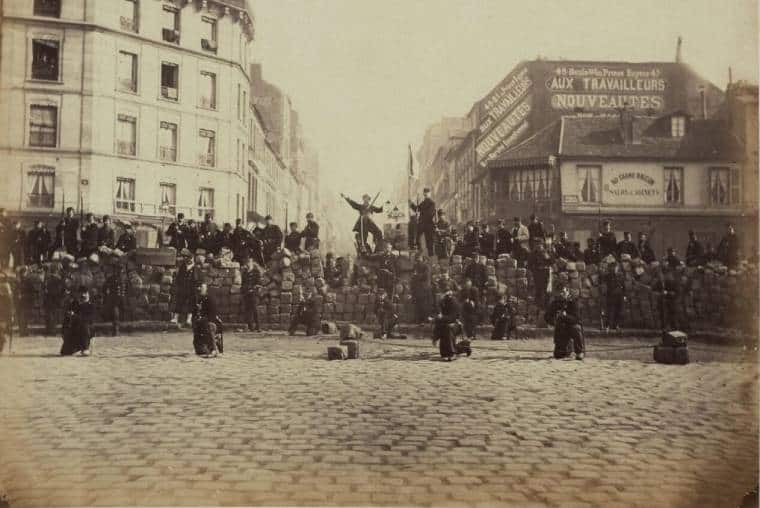
The Paris Commune, 1871, fought for radical change (Pic: public domain)

After Karl Marx’s death in 1883, some of his followers began to argue that socialism is inevitable.

They insisted that as the working class would grow, capitalism would break down and socialism would emerge triumphant from the ashes.

German socialist Karl Kautsky wrote, “Economic development will lead inevitably to the conquest of the government in the interests of the working class”.

Revolutionaries could gradually build up their organisations and wait for the glorious day.

This is a gross mischaracterisation of the real Marxist tradition. Marx distinguished between the base—how we produce what we need—and the superstructure that arose upon it. This included institutions like the state, politics, the media and the family.

Marxist Chris Harman explained, “The history of society is the history of changes in the ways in which production takes place, each associated with changes in the relations between human beings immediately around the productive process.

“And these changes in turn then exert a pressure on all the other social relations.”

Changes in production shape society. Marx understood the economic “base” as a combination of two things—the forces of production and the relations of production.

Forces of production are what we use in production, including raw materials, machinery and technology.

Relations of production are the way that labour is organised. This changes as society develops from medieval serfdom, to slavery, to wage labour.

The forces of production are dynamic. They develop until they come into conflict with the existing relations of production.

The bosses did not introduce the factory system in the belief it would create superior social relations. They did it to increase productivity.

But the factory system transformed everything about how we live. It educated and organised workers in ways that challenge the system that created it.

So developments in the forces of production impact on the relations of production. And developments in the base of society also come into conflict with the superstructure.

To explain society as a totality, Marxism must be able to show how the economic base generates and responds to the superstructures that spring from it, writes R J Robinson in Base and Superstructure—Understanding Marxism’s Second Biggest Idea.

The non-economic “superstructure” in every class society protects the source of ruling class privilege—how production is organised, the base.

This understanding reveals how the state and the law are not neutral, deriving their existence and function from economic relations.

These institutions can play an economic role, but they don’t always.

Society does not change its institutions like clothes. At times change can be so slow as to seem impossible.

The “superstructure” tries to prevent new forms of production that challenge existing monopolies of wealth and power.

Its religious institutions denounce radicalism as immoral. Laws declare new ways to be illegal. Its state uses violence to repress them.

Marx’s distinction between base and superstructure does not imply that only the economic base matters. The institutions of superstructure, like the state and the family, shape our lives and play an economic role also.

But gradual changes in the base create the possibility for radical ideas to emerge.

And when radical ideas emerge, people begin to fight for them. Their struggles decide whether the existing ruling class maintains its power, or whether a rising class overthrows it.

There is nothing inevitable about the new breaking through. History is littered with examples of societies that collapsed into the “ruin of the contending classes”, as Marx wrote.

The exact relationship between the base and the superstructure is controversial among Marxists.

But it explains how a materialist analysis depends on human activity to achieve change. What we do—and how we organise—really matters.

The far right is hurting—but it isn’t beaten

Posted on: November 7th, 2026 by Jude M
Image of Donald Trump pointing at the camera

Donald Trump is a lame duck president—and the far right is reeling—after humiliating defeats in the US midterm elections. (Photo: Flickr / Gage Skidmore)

The political centre was triumphalist last week as it became clear that Donald Trump’s far right Republicans had taken one hell of a shellacking in US midterm voting.

“An anti-authoritarian wave appears to be crashing over elections all over the world,” enthused the liberal New York Times newspaper. 

“In country after country that has struggled with creeping authoritarianism and democratic decay, outraged electorates have turned out in record numbers, delivering indisputable victories that have checked the autocratic advance,” it continued.

European leaders facing the challenge of the racist, populist right were particularly effusive. 

“It happened in Brazil. It just happened in the US. And it will soon happen in Spain,” said Spanish prime minister Pedro Sanchez, who faces an uphill battle in elections later this month.

The far right wave is “no longer growing, it is unravelling,” he added. Such sweeping claims are wishful thinking, unfortunately.

In France, Marine Le Pen of the fascist National Rally party is still expected to win next year’s presidential election. Most polls show her beating the left wing Jean-Luc Mélenchon in the second round of voting next May.


And in Germany the fascist AfD has surged since the 2025 federal elections produced a coalition government of conservatives and social democrats. 

Latest polls have them displacing chancellor Friedrich Merz’s Tory-like CDU party at the top of national voting intentions, with 27.1 percent. The CDU languishes in second place with just 19.8 percent.

German elections are not scheduled until 2029 at the latest. But Merz’s government already looks broken, meaning an early election is possible.

Part of the reason for the rushed claims is that the political centre denies that the far right has grown precisely because of its failures.

Social democratic parties were once offered a vision of growing prosperity in the here and now—and still better lives in the future. Today, they promise little or nothing.

But centrist parties, including social democrats, turned to authoritarian, racist policies to deflect blame for the social crises faced by millions of people.

This combination set in motion cycles of bitterness and resentment that fuelled the far right. And then those same centre parties lurched rightwards on immigration in a bid to “out-racist” the far right. 

There are no signs that the bitterness and resentment are receding. In fact, the opposite is true. The sense of grievance is growing everywhere.

But recently we have seen that some far right parties are increasingly vulnerable to the charge that they are “the same as the others.” They pose as “anti-establishment”, but don’t break with neoliberal policies when in office. 

Trump was seen as beholden to billionaires, while Nigel Farage has offered himself for sale to the highest bidders.

That means some right wingers are taking a hit at the ballot box or in the polls.

Not long ago leading political commentators were discussing “prime minister Farage” as though it were a racing certainty that his Reform UK would triumph. Few repeat that claim now.

One possibility is that the far right will react to such threats by swinging even further to the right. And there are other alternatives.

The racist bile and bitter anger behind the far right do not simply rise and fall with poll ratings. If one avenue closes, hatred finds others—either with more extreme parties or leaders or street movements. 

We have already seen such possibilities in Britain. The far right Restore Britain party offers hardened racists and fascists a different political vehicle to Reform UK. 

Meanwhile, black-clad fascists have blockaded ports and groups have terrorised young asylum seekers in their own homes.

Not long before there were racist riots and attempts to burn down hotels housing refugees. No one should rule out similar events happening again.

That’s why centrist claims that recent elections have fatally cut down the far right are worse than over-optimism—they are dangerous complacency.

Building the anti-racist movement—and struggle against the failed neoliberal centre—are vital to drive back the far right. 

Defending Andreas Malm’s key work

Posted on: November 7th, 2026 by Frankie Murden
Malm's How To Blow Up a Pipeline argued that we needed to tackle fossil fuel infrastructure in mass and militant ways

Malm’s How To Blow Up a Pipeline argued that we needed to tackle fossil fuel infrastructure in mass and militant ways

The Home Office’s decision to bar Andreas Malm’s entry to Britain shocked progressive movements.

Many have noted the irony that Malm was due to be joining a panel to discuss censorship in Britain.

The ban is the latest action of Labour’s repression of activists from the Palestine and environmental movements.

Malm is a professor of human ecology at Lund University in Sweden. In that capacity he has been at the forefront of exploring, and exposing, the links between environmental destruction and capitalism.

But Malm’s works are not dry academic texts. They are highly accessible but serious works of scholarship, designed to engage activists as well as scientists.

His work draws out deeper links between capitalist destruction of the planet and how this intersects with wider questions of colonialism, imperialism, racism and inequality.

The work that brought Malm to attention was his 2016 book Fossil Capital. This is a brilliant exploration of the way capitalism first adopted fossil fuels and what this means for contemporary environmental destruction.

Malm showed how and why fossil fuels were initially adopted and in doing so he drew out some key aspects of the “fossil fuel economy”.

It was the switch to coal power that meant that British manufacturers got a “ticket to the town” in the 18th century. Before this, mills and factories relied on water power to turn their engines. Factories had to be sited where there was sufficient water in rivers to drive their machinery. This meant that capitalists had to pay for workers’ housing.

Coal powered steam engines allowed the mill owners to, in the words of one writer, “supply the place of water, wind, or horse-mills, so that instead of carrying the work to the power, the prime mover is placed wherever it is most convenient to the manufacturer”.

Malm showed that the adoption of fossil fuels by capitalism was related to the desire to maximise profits through exploitation of the largest possible number of workers.

Malm went on to note that the adoption of fossil fuels became a site of class struggle.

Malm took this understanding further in another book, provocatively titled How to Blow Up a Pipeline, published in 2021. Here, he argued that we needed to tackle fossil fuel infrastructure in mass and militant ways.

He argued that the movement had to “damage and destroy new CO2-emitting devices. Put them out of commission, pick them apart, demolish them, burn them, blow them up.” But he cautioned that the movement could not destroy fossil capitalism on its own.

It raised important points about the role of mass movements and direct action. But its limit lay not in its defence of militant action but in a vision of socialism arising out of mass action by workers. Capitalism without fossil fuels will still be capitalism.

That said, Malm has always positioned himself on the side of the oppressed and exploited. Recently he as done this with two further books, one White Skin, Black Fuel, written jointly with the Zetkin Collective and another on Palestine.

The first of these is an exploration of the far right’s “anti‑climate politics” and how it dovetails with racism.

The authors conclude the “anti-climate politics of the far right is now a phenomenon of such rank that it must stand on the shoulders of a much wider and broader set of relations of the kind that we normally refer to as ‘racism’.”

Similarly, Malm argues that the needs of Western imperialism in the Middle East meant Palestine was subjected to “fossil empire”.

Perhaps this brief overview goes some way to explaining why Malm’s visit to Britain would worry the government.

His work shows that the British state has always protected the interests of British capitalism, which means the defence and expansion of the fossil fuel industry and the furthering of racist and genocidal policies.

Malm is right to link ecological destruction, racism and genocide, and right to insist that we need militant mass movements to fight back.

In turn, those movements need to stand in solidarity with Andreas Malm.

Cancer cases hit record high as NHS misses treatment targets

Posted on: November 7th, 2026 by Jude M

The NHS says 85 percent of people with cancer should start treatment within 62 days of an urgent referral. This target has not been met since 2015. (Pic: Stephen Dickter/Flickr)

The NHS is diagnosing a record number of new cancers, according to figures released this week. But experts say the health service is failing to meet its own targets for treatment.

According to the latest cancer registration statistics from NHS Digital, more than 373,000 were diagnosed with cancer in 2024, the highest figure on record.

Prostate, breast, lung and bowel cancers accounted for half of all new diagnoses.

Cancer that is diagnosed and treated at an early stage, when it isn’t too large and hasn’t spread, is more likely to be treated successfully.

According to Cancer Research UK, for every month a cancer patient waits before starting treatment, their chance of survival falls by around 10 percent, on average.

However, the charity says the NHS is repeatedly missing key targets designed to improve outcomes.

For example, some 78.6 percent of people were diagnosed or had cancer ruled out within 28 days of an urgent referral in August 2026. Had the 80 percent target been met, around 3,900 more patients could have benefitted. 

The NHS says 85 percent of people with cancer should start treatment within 62 days of an urgent referral. This target has not been met since 2015.

And the effect of delays to treatment can be appalling.

Alan was diagnosed with lung cancer after a nodule was found in June last year. The 70-year old was meant to have an operation within weeks but ended up waiting for five months, by which time the cancer had spread.

“I was so frustrated and angry and couldn’t understand why they would leave me like that,” Alan told the BBC. On two occasions, Alan’s scans were cancelled because machines had broken.

By the time Alan had his operation, the cancer had spread to his lymph nodes and the nodule “had grown at an alarming rate”, according to his lung specialist.

The Radiotherapy UK group says more than 2,800 extra patients would need to start treatment every month to achieve the 62-day target. 

That number is likely to grow as the number of diagnoses continues to rise.

NHS trusts that show the sharpest declines in treatment times say they are facing massive pressures from rising demand combined with shortages of skilled staff. Some also point to delays caused by private providers of diagnostic services.

Low pay and understaffing drive thousands of valuable staff out of the health service every month, and many trusts have frozen unfilled posts in an effort to save money.

But the effect of such managed decline is that thousands of people are waiting in pain and fear for urgent treatment, not knowing when it may come.

What next for the Democrats and the left after the ‘blue wave’?

Posted on: November 7th, 2026 by Jude M

Democratic candidate in Michigan, Abdul El Sayed, leaned leftwards and ran a simple campaign—“Get money out of politics, put money in your pocket, and pass Medicare for All.” (Photo: X / @theDemocrats)

Millions of people are rejoicing at Donald Trump’s and the Republican Party’s humiliation in the midterm elections this week. 

But the “blue wave” has raised sharp questions about what comes next for the Democrats—and the left. 

Members of the Democratic Socialists of America (DSA), which runs candidates in the Democrats, spoke to Socialist Worker. 

Saya, a volunteer with the DSA in north Texas, said the blue wave “felt amazing”. “Many of our members will not have seen a blue Texas for as long as they’ve been alive,” she said. 

“We are all experiencing a sense of renewed hope and confidence.” 

She added, ”Republican abuse of power. Deadly overseas wars that kill innocents. Attacks on marginalised groups and the threat of Ice in our communities. 

“The Epstein-billionaire class wielding too much power and the rise of Christian nationalism and fascism. 

“These were all top of the mind.”

The Democrats are not a social democratic party, such as Labour, let alone a left wing one. They are a liberal capitalist one—and those interests are still in the driving seat after the midterm elections. 

The centrist New Democrat Coalition has at least 140 members, making it the single biggest bloc in the caucus. 

The Blue Dog Coalition, which is even more right wing, has grown to over 20 members. 

The Congressional Progressive Caucus, which includes a wide spectrum of liberals, now has over 100 members. 

Only eight members of that grouping are card-carrying members of the DSA, including AOC. 

Saya said, “We would like to see moderate Democrats grow a spine and do everything in their power to block Trump’s agenda at every turn. They should not concede an inch to him on anything for any reason.

“Let’s see a refocus away from billionaire interests and back towards the people who keep the gears of society turning. 

“To the people who go to work every day, who are currently unable to buy a house, afford healthcare, raise a family or live meaningful lives.”

 The Democratic Party is doing its best to contain progressive policies. 

A flurry of centrist politicians, strategists and pundits have been downplaying the popularity of left wing policies. If DSA or progressive candidates did well, they argue, it was only because they were part of the Democratic “blue wave”. 

“Our wins are so big tonight that there’s no one part or wing of the Democratic Party that’s going to dictate anything,” says former Virginia governor Terry McAuliffe.

Centrists are pushing this narrative because their main argument—that left wing policies cannot win elections—rings hollow 

Democrats who leaned leftwards did well in former “red” and “swing” states, such as Texas and Michigan. 

And, policies championed by the left have a broader appeal. One poll shows that at least 66 percent of US adults support what’s known as “Medicare For All”, a single, public health insurance plan for everyone. 

That rises to up to 94 percent of Democratic voters and 72 percent of Independents. 

Second, sections of the Democratic leadership know that the best way to discipline people is to promote them.

Hakeem Jeffries, the Democratic leader in the House of Representatives, began work on bedding in a right wing agenda before the election. He is the typical corporate Democrat—heavily backed by the American Israel Public Affairs Committee (AIPAC). 

Jeffries set up a series of working groups this autumn to develop the Democrats’ agenda. He appointed centrist congresspeople Terri Sewell and DSA member Alexandria Ocasio-Cortez (AOC) to head the health care working group.

When the group reported back, AOC said, “There’s a large diversity of opinions in the Democratic caucus. 

“A lot of what we do is just compile all the different proposals among the caucus. Medicare for All is of course included.”

Jeffries has no intention of supporting public healthcare—and nor do most Democrats in the House of Representatives or Senate. “We’ll have a family conversation,” he said, dodging the question when asked about Medicare For All. 

The pressure will be on DSA supporters and left liberals, such as Abdul El-Sayed, to compromise for the sake of party unity ahead of the presidential election in 2028. 

AOC was once a rising star of the left, but lined up behind the Democratic Party over key issues. She, for instance, did not vote against US funding for Israel’s “iron dome” air defence system—switching her vote to an abstention.

Jeffries went on a charm offensive with progressive candidates ahead of the election to tie in their support for him to become Speaker of the House. 

Zohran Mamdani, Democratic mayor of New York who is a DSA member, has repeatedly reaffirmed his support for Jeffries’s bid. 

Liz, a DSA member in Oregon, said the mid terms were “an anti-Trump vote, 100 percent”. 

But she was less optimistic about what the Democrats would deliver. “It was a big splash for Democrats across the country, but when you look at the details you get some stuff that’s not looking good,” she said. 

“I think this is probably more similar to when Labour won the 2024 election in Britain. 

“Labour won by a landslide and everyone thought it would change things. But we know that, for example, it just stepped up the transphobia.” 

She added, ”I don’t expect the Democrats to do very much. Maybe they’ll make some conciliatory gesture, but I don’t think they’re going to end the war. 

“Even though they tend to not be as hawkish, it was not Joe Biden who finally pulled out of Afghanistan.

“The Democrats are probably going to slide right on trans+ issues and not going to move much on the labour front.” 

There are different ideas in the DSA about what next. 

Saya said, “We will keep organising to elect more progressive DSA candidates and continue building education and class consciousness in our communities. 

“We will keep campaigning locally for economic and social justice and building membership of our socialist organisation.”

Liz added that there are limitations to the DSA’s current strategy. She argued, ”The DSA needs a better labour strategy. It tends to be, ‘Join the union and vote for our candidate in your union elections.’ 

“Instead, we should be meeting workers where they are in workplaces and pushing actual resources and organisers into them. 

“When me and a comrade were organising our workplace, it basically turned into a recruitment ground for the DSA. 

“We were able to bring in so many people who were dissatisfied, who had socialist leanings but weren’t organised.

“It’s a long chain that needs to be thought through before we can start asserting real power. 

“It’s going to be an uphill battle. But when you fight you win—and when you win, you get to fight some more.” 

The “blue wave” in the US has boosted everyone who hates the far right—but it shows the limits of a purely electoral response. 

Hope for change lies with the sort of action we’re seeing on the streets of France, Italy, Spain, Portugal and elsewhere. 

In the US, the challenge is to use the renewed sense of hope and confidence to build movements and working class organisation outside the Democrats.

‘They put you in a small dark room and assault you’ says Palestinian in West Bank

Posted on: November 6th, 2026 by Camilla Royle
Israeli soldiers search homes in Umm al-Kheir last month

Israeli soldiers search homes in Umm al-Khair last month

Israeli forces withdrew from the city of Hebron in the West Bank on Monday morning after a ten-day siege.

But they left a trail of death and destruction behind—and are planning new assaults.

The Israeli military launched the siege after it murdered two Palestinian freedom fighters, who had shot dead two soldiers.

Israelis had already begun demolition of Palestinian neighbourhoods near the site of the shooting.

Reem, a head teacher in Hebron, told Socialist Worker, “The whole city was affected by the siege.

“The seven gates of the city were closed. We were under siege. We were not allowed to leave the city.

“Some people were more affected than others. But throughout the whole city, not many people could go out and buy things and traffic was less than usual.

“Schools were closed because it was difficult for teachers to reach them and because it was not safe.

“Settlers made use of the closure of the city. They attacked the farmers who were harvesting olives and kicked them out of their lands and stole the olive harvest.”

Israeli settlers attacked Palestinian olive groves at least 401 times last month.

Nisreen, who lives in Hebron, told Socialist Worker, “The army carried out forced displacement and closed off neighborhoods and the city.”

The Israeli withdrawal from Hebron does not mean much for villagers under constant attack from settlers.

Mahmoud is from the village of Umm al-Khair in the West Bank. “I think they will put more and more obstacles in the lives of the Palestinian people until it becomes impossible,” he told Socialist Worker.

“Umm al-Khair is now surrounded by three gates and the first one was closed for five days last week.

“The new ones are open, but the settlers will close them in time.

“Settlers attacked ten teachers in Masafer Yatta, our collection of villages, on Sunday.”

The Israeli settlers have the full support of the state to ethnically cleanse Palestinians and steal their land.

Mahmoud said, “It’s forbidden to speak to settlers, photograph them or treat them poorly.

“The settlers are a red line and there will be harsh punishment if you break these rules.

“They will put you in detention in terrible conditions—a small dark room where they brutally assault you.”

As well as in the West Bank, Israel is keeping up its attacks in Gaza. An Israeli drone murdered five Palestinians in al-Mawasi near Khan Younis on Sunday.

Another three were killed in drone strikes on the Rimal neighbourhood in Gaza city, including a four year old boy.

France erupts as 1.6 million strike back at Macron

Posted on: November 5th, 2026 by Jude M
Some 1.6 million joined protests across France on 5 November 2026 (Pic: Guy Smallman)

Some 1.6 million joined protests across France (Pic: Guy Smallman)

Striking workers and students flooded the streets of Paris on Thursday. Organisers said that 1.6 million marched, including some 350,000 in the capital.

At Le Havre, huge numbers of dock workers joined the march. Some 50,000 marched in Lyon and there were mass protests in at least 70 towns and cities including Marseille, Toulouse, Bordeaux, Grenoble and elsewhere.

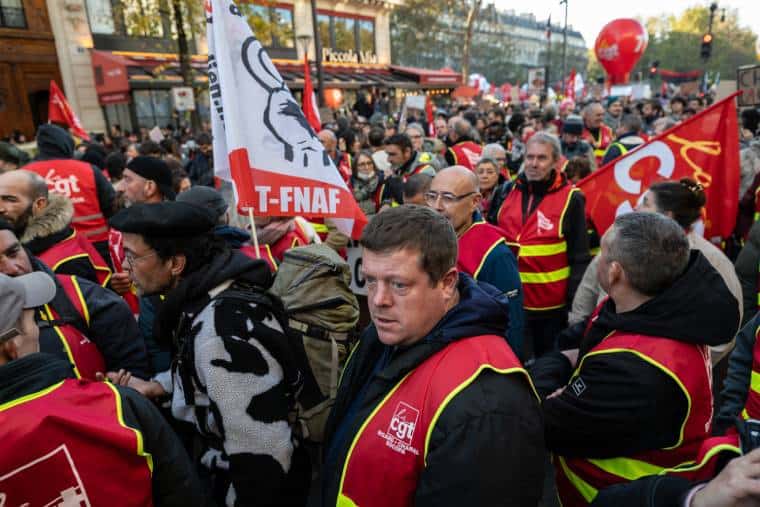
The general strike was supported by all the major union federations. And in Paris their supporters formed huge blocs that packed the streets.

The march brought together the unions’ sounds systems with floats created by art college students including a giant papier-mâché sculpture of president Emmanuel Macron looming over a burning school building.

A bloc of lawyers dressed in their black robes carried a banner reading “Colère noire”, a reference to the “black rage” they feel about the repression handed out to young people.

Protesters brought huge Palestine flags and anti-fascist chants regularly spread through the crowd.

Arnaud, a striking firefighter, told Socialist Worker that as a firefighter he is demanding better conditions because the state doesn’t reward workers and the public will pay the price if the fire service is eroded.

As a father, he demands a better future for the next generation. And as a son he stands with the retired people who get less and less each year.

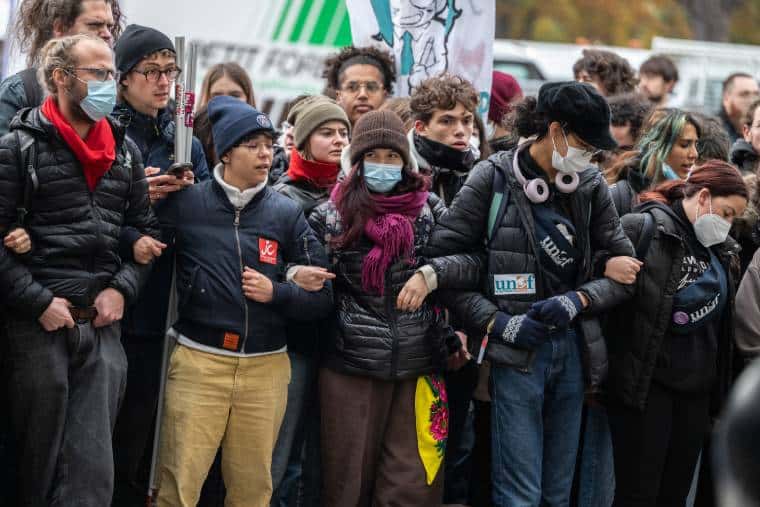
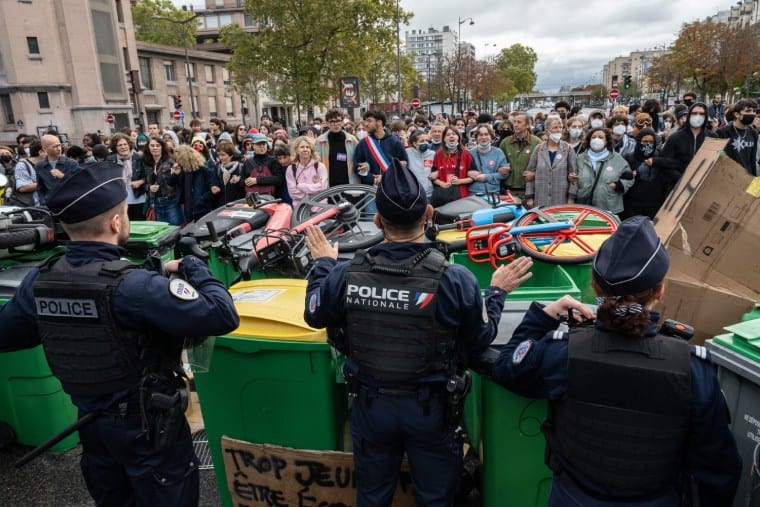
The day began with school students blockading their secondary schools. At the Hélène Boucher school in central Paris, police removed the blockades and aggressively forced the students to move, knocking some of them to the ground as they surrounded them and subjected them to bag checks.

But later that morning school students had regrouped and were using plastic wheelie bins to blockade the Rue de Rivoli and facing riot police in the centre of the city.

Students link arms against police violence during 5 November general strike in France

The movement was started by school students blockading their schools (Pic: Guy Smallman)

Students and workers from the suburb of Saint-Denis spontaneously marched through the Gare du Nord rail station before forming a feeder march to join the main demonstration.

They were led by rail and hospital workers and students and workers from the Paul Éluard school.

When they arrived they were briefly stopped by the police. But the cops were forced to give way.

Guillaume, a striking rail worker, said that the strike was strong, especially among train drivers. He told Socialist Worker that wages had not kept up with inflation and that energy prices had doubled in 15 years.

“There is a lot of money for shareholders and nothing for salaries,” he said. “We don’t have a political party for the workers here. The only movement for labour is here on the streets.

“After today, I think this movement will continue. The government doesn’t listen to the people and the police are very tough with young people. When they hit young people I think it’s time to strike.”

Paul Éluard was one of the first schools to be blockaded as school students refused to tolerate the conditions. Schoolworkers have been on strike there since 24 September for more resources and against police violence. It’s a renewable strike—workers decide each day whether to continue.

School student Monica told Socialist Worker, “We have been part of it since day one at our school. People around the world look at the news and think that we are always angry in France. But we have reason to be. We have had 10 years of Macron.

“We had the Gilets Jaunes protest over fuel prices. They told us things would change but nothing has changed. A lot of people are cold during the winter with no money for heating.”

At the Voltaire school, workers have also walked out on strike this week. They started picketing early in the morning, held a meeting in a local cafe and joined the main demonstration alongside students.

Strikers across the city had a choice about whether to join the protests as individuals or whether to organise and picket their workplace as a group.

Workers at the natural history museum formed a picket line in the morning. Marie from the CGT union federation explained that they have been in dispute for six months with the library closed by strikes every Saturday.

“At first it was about salaries,” she told Socialist Worker. “But we talked to each other during the strikes and we have other demands around the arrangement of the work and the management practices. When we all talked we realised it was something we all faced.

“Today is a national day. What is different today is that we are joining forces with students, university workers and workers from other museums.”

Members of the CGT union federation march in Paris during the general strike on 5 November 2026 (Pic: Guy Smallman)

Members of the CGT union federation form a huge bloc as part of the Paris demonstration (Pic: Guy Smallman)

Marie added that it’s important to join the demonstration in a group from the same workplace as some people feel nervous about joining the marches alone.

Kaïna, also a striking museum worker, said that workers themselves had voted to hold a picket line after a general assembly of 150 people.

She told Socialist Worker, “The picket line is an occasion to meet with other colleagues. And it’s important to be visible to the visitors to the museum. Most of them don’t even realise there are so many workers here.”

Other strikers were less confident. A worker from a consulting firm said he had not managed to get other colleagues to join the strike so far although he had tried to talk to them.

NGO worker Sam said that workers face low wages and lots of work pressure, “because it’s for a good cause”.

Sam said union members had organised at her workplace by holding general assemblies every week and going from door to door to speak to people about the strike.

The movement in France was started by teenage school students. Some argue that the school students’ demands should be more prominent—and that workers should be careful not to “take over” with their own issues.

But many workers say that their own demands are the same as those in the schools.

Sam told Socialist Worker, “We need to move on from talking about ‘helping’ and ‘protecting’ the students to talking about solidarity with our own strikes. The best way to protect them is to join them in the struggle and build our own power.”

But workers will have to organise against the trade union bureaucracy, which seeks to contain the movement’s potential. This means pushing for organisation and action at the base that goes beyond the union leaders’ vision.

Thursday’s general strike was a spectacular show of strength against Macron’s government and against the attempts by the police to contain it. CGT union federation leader Sophie Binet has promised to escalate the movement “to the next level”. To make this a reality and defeat Macron’s budget, workers will need to organise and spread the roots of the strike movement into every workplace.

‘We’re fighting for the whole NHS,’ says consultant striker

Posted on: November 5th, 2026 by Jude M
Consultants on the picket line at UCH hospital in central London in 2023 (Picture: Guy Smallman)

Consultants on the picket line at UCH hospital in central London in 2023 (Picture: Guy Smallman)

Hospital consultants and specialist doctors in England are preparing to strike later this month in a long-running fight over pay.

The government has earmarked a rise of just 2.4 percent for them—and all other health workers—next year, despite having earlier promised doctors “pay restoration.”

The doctors’ BMA union says time is running out for health secretary Yvette Cooper to take “meaningful steps” to avoid the 48-hour walkout set to begin on Wednesday 25 November.

Matt, an anaesthetist in Liverpool, said the mood among his colleagues was “disappointment” with the government.

“We’re annoyed that we’re in the same situation we were a few years ago, even after ministers promised something completely different,” he said.
“Just a modicum of fairness is all people want really.”

Matt says the Department of Health has “forced” doctors into preparing for strikes.

“There’s a strong feeling that there’s a profession to defend here,” he says.

“We feel a bit embarrassed about our lack of industrial action in the previous 20 years, to be honest, and the state we’ve left the profession in.

“And I think there is a view that says, if we don’t stand up and make a fight at some point, there’ll be nothing left for future generations.”

The decline of the NHS, and staff pay, can be traced back to the years following the 2008 financial crisis”, says Matt.

“Our pay has been cut in real terms by a third during the past 20 years of austerity,” he says.

“At the negotiation at the end of our last dispute in 2024, we were told we’d see a gradual restoration of our pay over several years, and in the future, an independent review body would look at our pay.

“But they, basically, just lied to us.

“So a 2.4 percent rise is another real terms pay cut. I don’t see how anyone in the NHS takes another real terms pay cut again.”

“Maybe we were fooled 20 years ago, at the end of the banking crisis. Back then, people said you’ve got to take a tough cut. And now 20 years later, it’s the same story. They are still saying they can’t afford to pay us.

“How come they can’t afford to pay us, but the bankers are still back on big money? I don’t see how that washes. Why can’t we tax billionaires? Why do we even have to have bankers?”

Matt says the impact of decades of doctors’ pay erosion can be seen easily across the profession.

“It’s a well-trodden path, starting at medical school and doing your training, and you can see the people on the ladder ahead of you, and those behind you.

“The people who are doing the same work as I did when I was a junior, now haven’t got the same prospects as I had. And it’s the same for me, looking at the people above me.”

In the past, employers have tried to use divide-and-rule tactics to separate consultants and doctors from the rest of the NHS workforce. Matt says the unions must stand firm and united against this.

“We need decent pay rises across the board, if we want a health service to function. A victory for one set of workers is also a victory for the next set.”