UCU union joint branch chair Geoff Goss on picket line
Workers at London South Bank University (LSBU) are on strike all this week over plans to turn them into a two-tier workforce.
The UCU union members have been in dispute with bosses since March. Management is trying to rip up the academics’ existing contracts.
They will transfer some workers who they think can bring in money through research grants to a new “teaching and research” contract.
Others are now employed through a “teaching and scholarship” contract—they were given a deadline to apply to it back in July. And new hires are employed not by the university but by a wholly-owned subsidiary company.
Around 150 people have lost their jobs already through compulsory or voluntary redundancy. This has left a workforce of about 400 academic staff members on three different types of contracts.
UCU joint branch chair Geoff Goss told Socialist Worker, “What is happening here is existential. If we lose this our workforce will be split and divided.
“They are doing draconian things, some of the worst practices you would see in the private sector—fire and rehire.”
“With 150 people gone it’s already not enough people,” said Elisa, the other branch chair.
“Some people who have left were the only person who could do that job. Staff are overworked and have increasing hours.”
Geoff explained that the situation has parallels with what is happening at the University of Brighton, where bosses want to derecognise the union.
At LSBU, hiring people through a subsidiary could mean the new employer won’t recognise the union. The workers won’t have the same terms and conditions as their colleagues, even if they are doing the same job.
The union branch is currently negotiating with bosses over the teaching and research contract. But union members want to find a resolution where all the workforce are included in negotiations and no-one is left behind.
“So far we haven’t seen anything material that protects all staff,” said Elisa. “But we are striking in week one of term and that is keeping the pressure on.”
UCU members mentioned that they have had a lot of support from students, who have been writing letters to management to demand that the bosses listen to the strikers.
“Higher education is in a mess, something is really going wrong with it,” said Geoff. “There is not enough investment from the government in the sector.
“I don’t think anyone has the answer. But I think there should be some effort to link up with other union branches to discuss how we can help each other out.”
I’m mostly involved in local neighbourhood organising in the suburb of Saint-Denis, it’s the epicentre of the blockade movement.
One of our main activities has been anti-fascism, preparing to protest at the Rassemblement National (RN) conference in Orléans on 24 October. We are organising to get people to go there in buses.
The CGT union federation is backing it and has put it on its calendar of activities. The union leadership calling for it doesn’t mean that they are building it. But it is pressure from below that is forcing them.
Different local CGT groups are taking up the call and getting people booked onto the buses.
I’m also trying to get people from my work to join, although it’s in the private sector and not traditionally the most political sector of the union movement.
The school students who are blockading the schools are raising slogans about the RN quite a bit.
The aims of the movement are around bread and butter issues, because the situation with school funding is catastrophic.
But it’s a movement that started in the professional high schools, it’s the section of high school students who have been identified as working class and as not on the path to go to university.
The fear and hatred of the RN and the police is nothing new to those students. So when it erupted in those schools it was immediately political.
The media would call them “racaille” meaning something like “scum”. And the police would be extremely violent. This has allowed it to spread beyond those particular high schools.
For example, there is an agricultural boarding school in the countryside in Brittany. They did a sit-in there and one of the demands is for a migrant student without papers to be regularised so he can’t be deported. It’s an overtly political demand.
The movement is giving itself the objective basis to fight the far right. There is unity between black and white students basically. And very different types of high school experience.
And because they are getting workers on board, this is a symptom of how deep the movement is. There are calls for strikes, the unions are calling on their members to defend the students.
Sometimes the calls to protect the students are a bit paternalistic. They are high school students, they are not young children. But it’s good that they are there.
I think the left has got better at addressing Islamophobia. There used to be figures on the left who opposed the hijab and who said they had the right to be Islamophobic for example.
Jean-Luc Mélenchon has changed quite a bit. He has said clearly that he was wrong on this before.
If you compare now and 2023, when there were last riots over the killing of a 17 year old, the reaction of a lot of the left was to call for calm and try to contain things.
There has been a bit of that now. But after three years of a very difficult economic situation, this time the overwhelming call is for solidarity.
We are in a race now with the RN. From the point of view of the ruling class, the question of whether they need to turn towards the RN to calm things down is not a theoretical question.
Sections of the ruling class will try to get the RN in the saddle to calm down the movement.
The only situation in which Mélenchon can beat the RN candidate Marine Le Pen is with a huge movement to oppose the RN. Because right now he is not beating her.
Unison union members employed by Oldham council‑owned company, MioCare, struck last week (photo: unisonnorthwest/Facebook)
Prime minister Andy Burnham’s promise of a “National Care Service”, running on similar principles to the NHS, was the centrepiece of Labour’s conference last month.
Britain’s broken social care system means that millions of people fear old age—and worry about their relatives.
But on closer examination, Burnham’s proposals have turned out to be somewhat less than what was promised.
Not only is the touted “free care” not really free, but the only care mentioned is for the elderly, with nothing said about younger adults needing care too.
Sandra, a residential carer in London, told Socialist Worker, that, while she welcomed his proposal, the details of how it would be funded and how far it would extend are vital.
“The report on how they plan to do this isn’t even due until 2027,” she said. “It is also far too limited. Burnham’s proposals are focused on personal care. But social care is much more than that.
“And, there are issues that I can see with it already.
“The key one is the plan to partly fund it through the removal of the ‘triple lock’ on pensions. This is very much in line with Burnham’s refusal to break with the self-imposed fiscal rules.”
Ending the triple lock guarantee risks the state pension gradually losing pace with earnings and causing pensioners’ income to fall in value compared to workers.
According to the charity Age UK, around 1.7 million people already live in pension poverty. Without the triple lock, that figure could rise quickly.
“A national care service should be funded through a redistribution of the wealth in society, not through money that could be going to people’s pensions,” says Sandra.
“It should be funded through a wealth tax, by taxing the corporations and the super-rich rather than going after pensioners. Many of whom are struggling to heat and eat as it is.”
Sandra explained that Labour’s promise of a national care service is only worthwhile if it starts to tackle the private sector’s profiteering.
Around 83 percent of residential care services are privatised in Britain and 85 percent of all adult care homes in England are run for profit.
Reinvested
“A lot of that money goes to private equity companies with bases in tax havens overseas,” said Sandra. “That is money that should be reinvested in care.”
“There is also still the question of whether people will have to pay for their accommodation costs, which often means people have to sell their homes to cover the cost of residential care at the end of their lives.”
Burnham rightly says the social care crisis is so huge that it impacts all other aspects of healthcare. But that means there must be massive investment in both the NHS and care services—investment that he is yet to promise.
“There are currently medically fit patients remaining in hospital beds because the social care services do not have the capacity to take them on,” says Sandra.
“Social care has often been seen as the poor sister to healthcare, but actually we need an integrated system where the NHS and care work more in step with each other.
“The strain on social care and the NHS means that staffing levels are so low across health because people are leaving the sector due to overwork and poor wages.
“And when people do fight back for better pay or improved terms and conditions, goodwill is often weaponised against us.”
Care strikers say, ‘We need cash now’
In his big speech, Andy Burnham also promised “proper recognition” for the people doing care work.
But carers in Greater Manchester are refusing to wait until 2030 to be paid their dues.
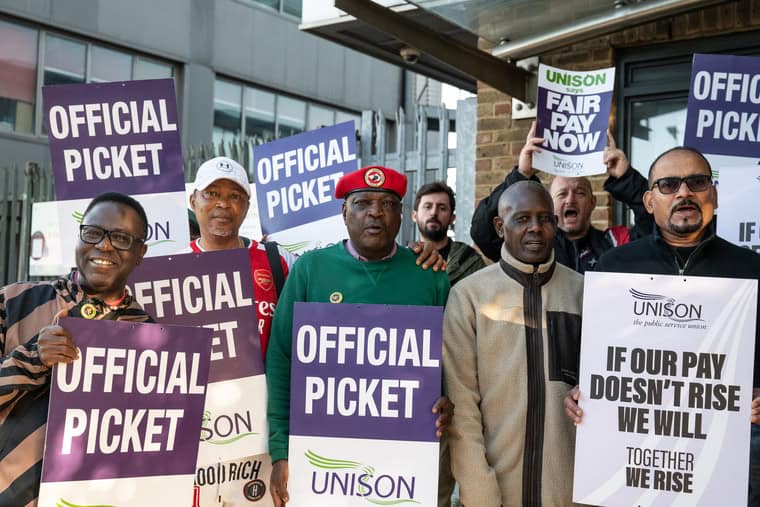
Unison union members employed by Oldham council‑owned company, MioCare, struck for wages and sick pay for 48 hours last week.
The strikers provide extra support to people in their homes to allow them to continue to live independently.
“We aren’t paid the same as care workers in other parts of the MioCare firm. We all wear the same uniform, but we are earning £2.10 less,” one told Socialist Worker.
“We’re only asking for equal pay for the same work. We don’t want anything more. We’re only asking for what we need to live and what’s fair.
“We do everything for the people we support—we clean, cook, wash people and give people their medication. But when we get sick, there’s nothing there to support us.”
Another striker echoed this, saying, “Sick pay is the main thing. People are taking themselves into work who are not well because they don’t get paid when they’re sick.
“That puts vulnerable people at risk because workers can’t afford to stay at home.
“There’s one poor lady who got so deep in her overdraft that she tried to take her own life.”
Another striker interjected, saying, “Someone got paid £45 for a whole month from MioCare because she got an injury at work and couldn’t come in.”
Strikers said they also felt Burnham’s promise of a National Care Service lacked “meat on the bones” given the urgency of the crisis.
“This National Care Service isn’t going to be happening until 2030,” said one. “He talked about free personal care for those who need it. But I didn’t hear anything about a pay rise for those providing it.”
The striker pointed out that carers are often praised by governments only for them to try to hold down costs by worsening conditions of the people providing it.
“We’re needing fair pay now,” she said. “People can’t afford to do this job, that’s why employers can’t get the staff. They say it’s going to cost billions. Well, why don’t the richest people give us the money?
Striking workers in the Northern Care Alliance (NCA) at Royal Oldham Hospital (Photo: UNISONNorthWest/X)
Health workers at four hospitals in Greater Manchester returned to picket lines this week as part of their long-running fight to win back proper overtime payments.
The Unison union members are theatre nurses and recovery staff for the Northern Care Alliance (NCA).
They work at Salford Royal, Royal Oldham, Fairfield General and Rochdale Infirmary hospitals.
Strikers are furious that NCA bosses have broken the national Agenda For Change contract by forcing worse overtime pay on them.
Under that contract, all workers get their normal pay plus 50 percent for overtime shifts. But bosses now use the internal agency NHS
Professionals, which is paying below their normal daily rate.
One striker on the picket line last week told Socialist Worker, “They just take us for granted and think we will put up with anything. But we won’t.”
Many on the picket were inspired by the recent victory at the Institute for Cancer Research.
They think Unison should now escalate its strikes too.
Strikers are also frustrated with increased workloads and being forced to work after their shifts have finished.
Many of the workers are migrants and fear nighttime travel at a time of increased racism. They also spoke of bosses’ restrictive holiday rules.
These force workers to take just two weeks’ holiday at a time, making journeys to visit family abroad much more difficult.
A striking theatre nurse said, “So far, we have struck for between two and three days in a week.
“But I think it would send a strong message to the new chief executive if we struck for a whole week.
“That would hit them hard and they would know that we mean business.”
A similar dispute has now erupted in Reading, in the south east of England.
Around 100 hospital porters at the Royal Berkshire Hospital, in Reading, struck last week in a fight centred on overtime rates.
Bosses there are also pushing workers off Agenda For Change rates onto the lower NHS Professionals rate.
The GMB union members say they are “being pushed towards poverty” and rejected a recent management offer to bridge their loss of earnings until next March.
Union rep Sergio Dias, who has been a porter at the hospital for 14 years, said bosses are not addressing workers’ long‑running concerns.
He says the pay changes mean that workers are losing about £7 an hour compared with what they were earning before.
That’s depriving porters of “hundreds of pounds a month,” said Sergio.
On the picket line, passers-by cheered and honked their car horns in support of the strikers.
Yuri Prasad with thanks to Karen Reissmann for reporting from Manchester
Tram strikes are good for the goose and the gander
Tram workers in Nottingham staged another solid two days of strikes last Friday and Saturday.
Not a tram moved as the GMB union members’ action hit the last two days of the city’s Goose Fair, which is attended by tens of thousands.
Senior Trams rep Anthony Brown reported that management have backed down after calling off negotiations before the strikes began last week.
They had agreed to meet this coming week.
Management will be presented with a threat of 18 more strike days over weekends leading up to and over Christmas.
That will take place if no move is made on the present 3.3 percent pay offer. GMB is demanding 4.1 percent.
Richard Buckwell
Strikers press home advantage with more action
Over 30 Unite union members at Oxford University Press (OUP) finance department began their second week of strikes on Monday.
They previously struck for two weeks last month in their fight against job cuts.
“This is my job now,” said a striking worker on the Unite picket line outside OUP last Thursday, holding a placard exposing the publisher’s motive—“Oxford University Press—Stop the greed”.
OUP plans to offshore almost the entire finance department to India.
Their partner in villainy is EXL Service, a multinational corporation based in the US with AI data centres around the world.
EXL Service boasts about innovations for “streamlining back-office operations” and “50 percent cost savings”.
That’s boss-talk for exploiting workers on lower pay scales abroad and for replacing human workers
with AI.
Published finances show that OUP is rolling in dosh.
It has cash reserves of almost a third of a billion pounds, profits of almost £50 million last year and a CEO pocketing well over £1 million annually.
The OUP strikers hung a large “Shame on Oxford University Press” banner on the railings in front of the building until management ordered security to stop it.
Since then, the banner has draped across the Unite official’s car, parked in front of those same railings, just as visible to passersby.
Tags: GMB, Health, Unison, Unite Posted in Trade Unions |
Comments Off on Union round-up: Manchester NHS workers strike again for overtime
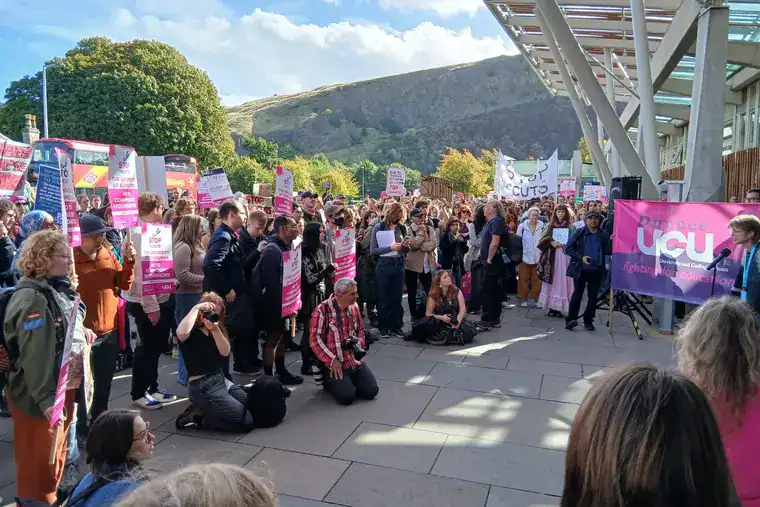
A demonstration against cuts to Scottish universities outside Holyrood (Photo: ucuedinburgh.bsky.social/bsky)
UCU union members working at the University of Edinburgh began five weeks of strikes on
28 September.
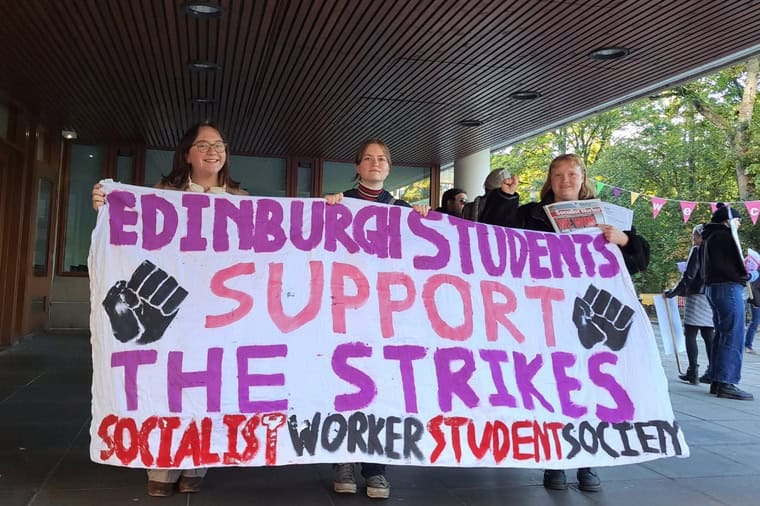
The Socialist Worker Student Society has been on picket lines every day. We’ve been arguing with other students about why supporting trade unionists is vital.
Edinburgh university is threatening 1,800 job losses and to cut 93 programmes, while not being anywhere close to running a deficit.
These cuts will affect the day-to-day realities of our education and we will have fewer course choices.
It’ll also mean less contact time with lecturers and tutors and staff who are too overwhelmed to support us effectively.
Our teachers’ working conditions are our learning conditions.
Our lecturers are fighting for our future jobs in academia, they are setting a precedent for working conditions in the field. And, as workers who are willing to fight against a corrupt management, they are setting an example for us.
In regards to actually winning the strike, the only way we can do this is with mass student and worker solidarity.
Students, by talking with lecturers and observing strikes by not going to lectures, can push workers who aren’t striking to come to their senses and fight for their jobs.
We are pushing students to join upcoming national mobilisations in Dundee and Glasgow and to support each other’s picket lines.
We want students to raise awareness to the Scottish government that the cuts universities are making are unacceptable, regardless of where they are taking place.
Students have a responsibility to stand up and fight for the people who make our education possible.
We need to be visible in our solidarity on the picket lines.
Sophie Lancaster, Edinburgh
Ed’s ironic hypocrisy
The slaughter in Gaza and the West Bank has seen liberal democracy on trial for complicity. And a guilty verdict is the only one that can be reached.
Alongside this complicity, we’ve seen the obscene attempt to portray protesting against genocide as terrorism and a systematic attempt to criminalise our right to protest.
Will it be different under Andy Burnham?
The proscription of Palestine Action should be lifted, cases against Palestine activists should be dropped. The government should support boycott, divestment and sanctions and halt arms sales to Israel.
Ed Miliband has begun to “express some regret” for Labour’s position over the past few years.
It is a bitter irony that a 94 year old Jewish ex-barrister arrested in Liverpool recently for peacefully protesting genocide was a friend of
Miliband’s mother. And it’s clear that if his mother were alive today, she would be sitting holding a sign, doing the exact same thing as thousands of activists have done over the past year.
I’m sure his father would have been with us too.
Simon O’Hara, Coventry
Trade unions must support the RNLI
Portsmouth Trades Union Council (TUC) has launched a campaign of solidarity with the Royal National Lifeboat Institution (RNLI). Delegates have been very concerned about recent attacks on the RNLI.
It is deplorable to accuse volunteers who risk their lives of being “traitors” and to threaten them. The RNLI’s commitment to try to save all lives, regardless of where people come from, is an essential principle. You cannot ask to see the passport of someone drowning before saving them.
Portsmouth TUC agreed to match a £500 donation by a Unite union branch to the RNLI. Portsmouth City Unison branch will also donate and we hope other branches will too.
Trade unionists along the south coast are particularly invited to join the solidarity campaign.
Arranging delegations of workers to local RNLI stations would allow the trade union movement to thank and support the volunteers.
We can never allow the politics of division to compromise safety at sea.
Jon Woods, Chair of Portsmouth TUC
Reject racist division
I am a student at a school that Restore Britain’s Rupert Lowe recently posted about on X. He said it was “unacceptable” that our school is not overwhelmingly white and British.
My classmates—black, brown, white, Jewish, Muslim and atheist—reject his divisive image of our school. The real division within education is class.
Lowe’s racist comment shows that he will target anybody, even children, to spread division. We all must build Stand Up To Racism and fight Restore Britain.
Joshua, Coventry
Tags: Students, Trade Unions Posted in Letters |
Comments Off on Letters: Students and striking university workers must unite to win
Socialist Worker has campaigned on a break with the EU on a left wing, internationalist and anti-racist basis (Photo: WikipediaCommons)
Headlines flashed last week as Andy Burnham said he could “go all the way” to rejoin the European Union (EU).
In a quieter announcement, five EU countries—Greece, Germany, Austria, Denmark and the Netherlands—set out plans to open an offshore detention centre in Africa.
This second headline shows the EU’s true colours.
Burnham floating the idea of rejoining is an attempt to win back some lost Labour voters.
The vile racism that was fostered in the Leave campaign and the aftermath of the 2016 referendum has made the Remain camp much more appealing. If Boris Johnson and Nigel Farage hate something, it must be good—right?
But the EU is a capitalist project built on exclusion and unaccountability to protect national interests and boost big business.
After the Second World War, the US wanted to reconstruct European capitalism so it would have a large single market that its firms could dominate.
Economic integration was always interwoven with US military dominance through the Nato warmongers’ alliance.
Bosses across the continent needed bigger markets and to expand on a regional level. So, the European Coal and Steel Community was established in 1953 and in 1957, the European Economic Community was formed between Belgium, France, Italy, Luxembourg, the Netherlands and West Germany.
The organisation has expanded in scope and numbers over time, until the EU was established in its current form in 1993.
Since then, it has enabled European states to compete as part of a bigger regional bloc.
It protects its member states and businesses and aims to spread their influence across its weaker neighbours in eastern Europe, the Balkans and sub-Saharan Africa.
Neoliberalism is hardwired into the project. So is racism.
The reality of the EU is thousands of migrants losing their lives drowning, border guards shooting them dead and their detention at the hands of European militaries.
Over 72,000 migrants have been recorded as having died trying to get to the safe haven of the EU since 1993. We can be sure the real number is much higher.
The leaders of the “free world” in Brussels have reinforced racist policies to uphold the historical myth that Europe is a white, Christian territory.
In 2008, the EU established the Return Directive. This required governments to close their borders, open detention centres and lock up migrants for 18 months.
In 2016, the then German chancellor Angela Merkel, who was frequently praised for so graciously taking in so many Syrian refugees, attempted to change “the definition of a worker” to cut out migrants.
The EU praises itself for fostering “unprecedented peace, economic integration and stability across the continent”.
But it pushes austerity in its member countries and helps to spread wars outside its borders. And this war drive has never been bigger—EU members states currently spend some €418 billion on defence.
Every member of the union implements sweeping cuts to all spending but defence—and public services and working class people suffer the most.
And, it’s difficult to see the claimed political stability the EU is supposed to guarantee. Germany, European power, is facing its third government in as many years.
There, as well as in France, Italy, Hungary and others, the far right is growing out of the failures of EU centrists.
Those leading the charge to rejoin the EU are not doing so because they reject the racist right. Burnham’s proposals rest on the idea that “Brexit has changed the nature of immigration to this country”.
He says, “What we had was a more revolving door form of migration”, but “Now, immigration is more likely to be a permanent settlement”.
This feeds the far right’s talks of a “migrant invasion” out to steal your job, house and daughter.
Since 2016, Socialist Worker has campaigned on a break with the EU on a left wing, internationalist and anti-racist basis.
We want to break up the apparatuses of power, weaken the ruling classes and take things into democratic control.
Socialists should use renewed debates around Brexit to stand against racist scapegoating—from the right, far right and centre—and to argue for a vision of international cooperation led by workers, for workers.
‘We want Camden council to know that we mean business’ (Photo: Guy Smallman)
Camden, in north London, with its famous clubs and vibrant music scene, is a playground for tourists.
However, for striking traffic wardens, this labyrinth of crowded restaurants and dive bars is a world completely beyond their reach due to low pay and long hours.
These predominantly black and migrant workers, who patrol our streets whether it’s lashing it down or scorching hot, are in the midst of what is shaping up to be a defining fightback against outsourcing.
Jane, one of dozens of traffic wardens embarking on eight weeks of strikes across the borough, told Socialist Worker that she works 42.5 hours a week. “It’s almost a full day more each week than council workers,” she said. She currently receive just 20 days of annual leave—the statutory minimum.
Camden alone experiences footfall of over 30 million people every year. Without the traffic wardens, the city would be gridlocked.
The Unison union members are employed by private contractor NSL, part of Marston Holdings, rather than Camden Council itself. They are demanding a £2 an hour pay rise, seven extra days of annual leave and sick pay from day one.
“We are met with hostility on a daily basis as part of our job,” Jane told Socialist Worker.
“There have been cases when we’ve been physically attacked, and verbal abuse is the norm. That’s our reality.”
“We only report when it happens about ten percent of the time because it happens so often.
“Otherwise, we’d be forever in the office writing reports and we’d never be working. And they know that, because we’ve told them about the abuse.
“The company do nothing about it. They send us out all by ourselves. The police go out in twos, but we go out by ourselves.”
The traffic wardens are completely excluded from their own local life by low pay and little respite from a gruelling schedule.
Jane told Socialist Worker that the most recent pay offer from NSL was simply not good enough. Unison members overwhelmingly rejected it at a mass meeting last week.
“The pay rise they’ve been offered is linked to RPI, but it’s a real terms wage cut for us because we live in London”, she said. “It’s covering nothing.”
The traffic wardens struck for better wages in 2023 and won an 18.1 percent pay increase after moving to an indefinite strike. After 56 days, NSL was forced to improve on its initial pay offer of just 57p an hour.
It was a significant victory won through workers’ determination. However, Jane explained that pay has since been eroded by soaring inflation.
“Rent alone has just killed everything. So, the equivalent we’re on now is less than when we went on strike before.”
“Bills have just gone through the roof. And our wage is just not keeping up. Everyone’s skint. We shouldn’t be skint, not with these hours.
“We’re the ones out there earning the money. It’s disgusting and we’ve had enough.”
NSL’s parent company Marston Holdings has a contract with Camden Council worth around £100 million.
“Marston Holdings is a massive company. They are loaded because, quite frankly, they’re nasty. The company makes its money sending bailiffs to collect unpaid debts for people.
“They’ve added an extra day to our week, they’ve taken seven days of our holiday. They’ve taken three days of our sick pay,” she said. “We need sick pay from day one.
“We work outside in all weathers and we’re exposed to everybody so of course we are prone to getting sick.
“We worked through Covid-19 and all of us came down with it multiple times because we were working with the public. But then we were being penalised for being ill. It’s not fair. It’s never been fair.”
She added, “Time is the most important asset anyone’s got. And they’re absolutely stealing it from us.”
The dispute exposes a wider problem with the way local councils run public services.
Jane explained that the Labour‑run Camden council had the opportunity in January to take this contract in house. But it didn’t. Instead, the council extended the contract until 2030.
Traffic wardens will have to fight a separate employer for conditions that other council employees already enjoy.
“If we’d been in-sourced we’d have the holiday, we’d have the sick pay, we’d have the pension. And our hours would only be about 36 hours a week for the same sort of money,” said Jane.
Labour promised to deliver “the biggest wave of in-sourcing of public services in a generation”. But outsourcing remains widespread in its own constituencies.
Spending on private contractors for key public services has doubled since Labour took office under Keir Starmer, who was then MP for Camden’s
Holborn and St Pancras constituency. The RMT and Unison unions found that outsourcing costs across essential sectors reached £6.2 billion in 2025, compared with £3.5 billion in 2024.
“Insource Now” is a new joint campaign between the two unions.
It aims to put pressure on Burnham’s government to end decades of outsourcing with disastrous consequences for workers.
“As far as I’m concerned, Labour are a bunch of hypocrites,” said Jane.
“The MP for Camden was prime minister when they signed the new contract with NSL for four years. Now, we’re stuck with them.
“I’ve been a Labour supporter all my life because I’m a working person. But from how they’ve chosen to run the council, I feel that they’ve sold us out,” she said.
The traffic wardens brought their fight directly to Camden council, with workers from all three picket lines rallying at the council headquarters on Thursday.
Strikers told Socialist Worker that the council must answer for why workers delivering a public service are employed by a private company that treats them worse than the council’s own workforce.
“Camden council has given the running of this service to NSL so that they can cut their costs,” said striker Joel from outside the council headquarters.
“We’re here to make noise to make sure that Camden residents know that the council has knowingly put us in this position by choosing to contract us out to this private company which rips up our terms and conditions.
“We want Camden council to know that we mean business.”
He added, “This service is one of the only profitable services in the council. But none of that is being reinvested back into the workers or the running of the council services.
“That’s money that could be put into libraries, schools and wage rises for other workers. It’s all going to the private company. That has to end.”
Joel emphasised that the upcoming Holborn and St Pancras by-election taking place this Thursday is a chance for strikers to force candidates to commit to being on the side of working people, not big business.
“Whoever is elected in the by-election, we want them to consider the welfare of the workers,” he said.
“The council cannot wash its hands and pretend that this dispute has nothing to do with it. And neither can the politicians.
“Workers are very important to society and therefore we need a good wage for ourselves. “We all have families and children to look after.”
The Camden council leader, Sagal Abdi-Wali, is running for Labour in the by-election.
She was leader when the council renewed the contract with NSL, choosing to side with private companies that care more about profits than people.
Yanis, another striker who attended the action outside the council building, told Socialist Worker that, by making that decision, Labour chose to maintain a “two-tier workforce”.
“All we want is for NSL to match what Camden offers to its own staff. Those it hires directly have much more than we do.
“We work a 42.5 hour week and people still have to take on overtime just to pay for the basic bills. The company pushes us down that road,” he said.
For too long, public services have been outsourced to private companies who make their money by driving down pay and conditions for workers and providing poor quality services to the public. “We need enough annual leave to recover, sick pay that allows us to stay home when we’re ill and wages that allow us to keep up with the cost of living,” said Yanis.
“We’re not going to stop until we win, for however long it takes.”
Camden traffic wardens are proving that no outsourced worker needs to accept this. Public sector workers have an interest in fighting for the insourcing of services so that money can be reinvested into the workforce and services as a whole.
Next week, traffic wardens will unite with other council workers who are also at the sharp end of the financial crisis facing Britain’s local authorities.
They will be joined by teaching assistants in two Camden schools who are fighting their own battle with Camden council over pay, as well as striking teachers in the NEU union.
Liz Wheatley, branch secretary of Camden Unison, told Socialist Worker, “Strikers from Camden across Unison and the NEU are keen to highlight their disputes and keep the pressure on the council to resolve them.
“But also, to receive and give solidarity to those who are fighting back—be it in their workplaces against the bosses, or on the streets against the far right.
“This will be an opportunity to bring people together to map out how people can fight and how we can win.”
Workers’ names have been changed
Posted in In Depth, Trade Unions |
Comments Off on These traffic wardens are blocking the road to outsourcing
What Burnham seeks has nothing to do with genuine socialist politics (Photo: number10gov/Flickr)
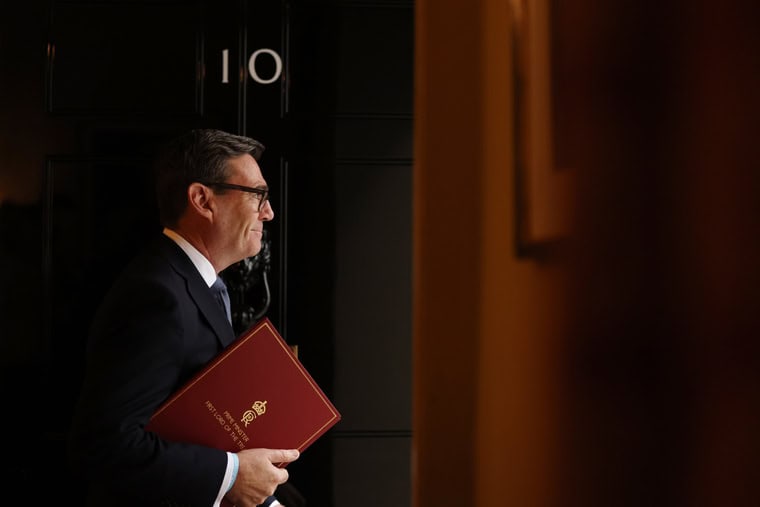
Andy Burnham speech at the Labour Party conference confirmed what should have been clear from his surgical removal of Keir Starmer. Behind all the schmaltz, he is a bold and intelligent politician.
Nevertheless, what he’s seeking has nothing to do with genuine socialist politics.
Burnham showed he understands what happened at the last general election in July 2024. The huge parliamentary majority Starmer won then was a mirage, nowhere comparable the genuine Labour landslides Clement Attlee won in 1945, Harold Wilson in 1966 and Tony Blair in 1997.
The huge shift in parliamentary seats in 2024 is the kind of result the first-past-the-post election system delivers when party support fragments.
A five-party system emerged—Labour, Tories, Reform, Lib Dems and Greens. Indeed, it’s a seven-party system when you take into account the SNP and Plaid Cymru, but they aren’t competing for office at Westminster. So, how do you win in this set-up? Starmer’s mean and inept government showed, instead, how to lose.
But then the Gorton and Denton by-election in February added another ingredient to the mix. The Greens’ victory demonstrated it wasn’t inevitable that the far right would be the main beneficiary from Starmer’s collapse. A progressive alternative is possible. Burnham is trying to ensure that a rebranded Labour plays this role.
In his speech, he repeated his critique of the neoliberal reconstruction of British society under Margaret Thatcher in the 1980s. This helps to polarise against a Tory party that, under Kemi Badenoch, is moving sharply in a Thatcherite direction.
Burnham, however, went beyond rhetoric and made three concrete proposals. First, to create a National Care Service comparable to the NHS. Second, to set up a national commission on electoral reform. And, third, to address “Britain’s long-term relationship” with the European Union (EU)—including, possibly, Burnham later clarified, rejoining.
This platform implies, as Robert Shrimsley of the Financial Times newspaper noted, “a shrewd political strategy, calculated to rebuild the electoral coalition on the left and then drive through voting reform in the explicit belief it will keep the right out”.
Opinion polls show that Reform UK is no longer the front-runner and that large numbers of left-of-centre voters are willing to vote tactically to keep Nigel Farage out of 10 Downing Street. The logic of Burnham’s package is a coalition with the Lib Dems, enthusiasts for both electoral reform and rejoining the EU.
Shrimsley also says “New Andy is unapologetically Old Labour” and wants “to wind back the clock”, presumably to the Britain of the 1950s and 1960s. This is nonsense.
Burnham proposes to help finance social care reform by amending the triple lock meant to protect state pensions. After April 2030, these will still rise by the higher of inflation or 2.5 percent, but will no longer be linked tightly to earnings.
As the Green economist James Meadway points out, “this is a cut in expected pensions to pay for social care. That is likely to be somewhat regressive—the winners are those who no longer have to sell a house to pay for care, but those losing out on the pension will include people who do not own their home or never need care.”
It is still a clever move. Breaking the Triple Lock means pain for poorer pensioners, but years away. It is also what big business and its echo chambers in the BBC and Institute of Fiscal Studies have been stridently demanding. Burnham is signalling to them that he can be “tough” when it comes to welfare spending.
In many ways the kind of policy shift he is making was pioneered by his foreign secretary, Ed Miliband, when he announced a ban on trade with illegal Israeli settlements in Palestine. It generated a huge amount of noise, largely thanks to the furious reaction from Israel. This gave Miliband kudos from many in the Palestine movement. But it changed very little in Britain’s economic and security relationship with Israel.
This is the Burnham formula—a dramatic change in tone, but minimal change in reality. This makes a real left alternative ever more urgent.
Tags: Andy Burnham, Labour Posted in Alex Callinicos, Labour |
Comments Off on Alex Callinicos: The Burnham formula—dramatic change in tone, minimal change in reality