A photo from Liverpool in around 1905 – “slum” housing was often demolished to make way for roads and railways (Pic: Wikimedia commons)
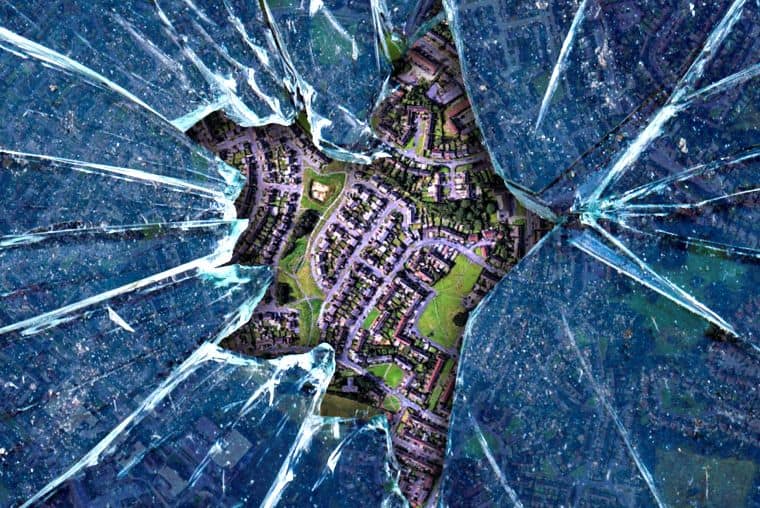
Housing in Britain is at crisis point. Workers are pushed to the edges of the cities they service but can’t afford to live in. In the countryside, local people are priced out.
Landlords drive up rents or leave properties empty knowing they will rise in value—while families live in bed and breakfast hostels.
In his book Against Landlords, Nick Bano says that between 2008 to 2018 the value of Britain’s housing stock rose by £750 million a day. Rising rents fuel speculative building developments riddled with corruption.
At the same time, cash-strapped councils allow their housing stock to deteriorate. It makes horrors like the Grenfell fire of 2017 possible.
Access to shelter is a basic human need. But capitalism treats homes as just another commodity.
In feudal societies, the land was the basis of all economic and political power. Peasant farmers paid rent for the right to work the land.
This situation was transformed by of industrialisation and urbanisation in the early 19th century. Workers were kicked off the land and forced into towns and cities.
In the 1840s, Frederick Engels exposed the dreadful conditions workers endured in the slums of new industrial cities.
He described stinking pools of filth in the streets and families forced to share damp, unfurnished cellars. Behind every door lay starvation, disease and vermin. For Engels, the slums were part of the war the capitalist class waged against the non-possessing classes. Engels accused the wealthy of “social murder” because they knew about conditions in the slums but did nothing to alleviate them.
Karl Marx called landlords a “sybarite excrescence”—a parasitical growth. He described how landlords thrived on poverty which was “a more fruitful source for house-rent than the silver mines of Spain”. Rent was an important source of income, but it was not the central dynamic of capitalism. That was exploitation, the way bosses profit from the labour power of workers by extracting more value than they pay in wages.
In the 1870s, Engels revealed the true nature of the slum clearance programmes in The Housing Question. He wrote, “The infamous holes and cellars in which the capitalist mode of production confines our workers night after night are not abolished—they are merely shifted elsewhere”.
The houses of the poor were demolished to make way for new, wide streets and railways. “At the very time when masses of workers are streaming into the towns, workers’ dwellings are pulled down on a large scale,” Engels wrote.
He rejected the arguments of socialists who wanted every worker to become the owner of their own dwelling. Engels believed the solution to the housing crisis was the socialisation of land and homes.
Tenants do have power to fight back against the landlords. One of the largest rent strikes in British history began in February 1915 when Glasgow’s landlords announced a rent increase of 25 percent.
Women’s tenant organisations blocked evictions and led a rent strike involving 20,000 families. The strike forced parliament to freeze rents.
The expansion in public sector housing during the long boom of the 1950s and 1960s led to the construction of some estates designed for communities.
This was thrown into reverse in the 1980s with the right to buy scheme, privatisation and the lifting of rent caps. It laid the basis for today’s housing crisis.
Socialists do argue for mass council house building. But it isn’t just an issue of lack of supply. Bano argues that the problem today is that homes are too expensive, not that there aren’t enough.
But it will take a major confrontation to prize the keys from the grasp of the landlords.
Russian revolutionary Vladimir Lenin argued that when, and only when, the working class has conquered political power, can workers expropriate the landlords and billet the homeless in their mansions.
Then new homes can be designed to support multiple new ways of living.


Without struggle, hope can dissipate
Has the Soviet Union discredited the idea?
The right claims that cultural Marxism is a project to subvert Western society