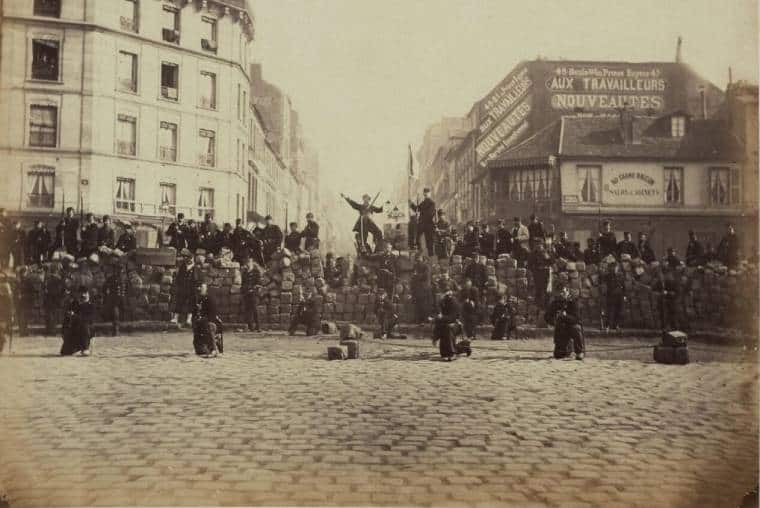
The global trade in goods has expanded since Marx’s day (Pic: Wikimedia commons)
Donald Trump says “tariff” is the most beautiful word in the dictionary. He is using tariffs to make American imperialism great again. This marks a break from the high point of neoliberalism where the United States tried to break down barriers to trade.
Some socialists historically saw tariffs as a way to protect local industry to the benefit of workers. Others have welcomed free trade as a means of undermining repressive states.
Karl Marx and Frederick Engels refused to accept that either tariffs or free trade would benefit workers. In 1845 Engels wrote, “We have no intention of defending protective tariffs any more than free trade, but rather of criticising both systems from our own standpoint. Ours is the communist standpoint.”
That communist standpoint asserts the independent interests of the working class. But socialists do not stay neutral when there are arguments between protectionists and advocates of free trade.
Marx and Engels were active socialists in England in the 1840s. At the time, the Corn Laws were a tariff on cheap imported food that benefited farmers and landowners. They kept the price of food high and the landowners rich.
But factory owners wanted cheaper food so they could drive down wages.
Marx and Engels supported the repeal of the Corn Laws. But they understood that free trade is the freedom of capital to “crush the worker”. Marx insisted that free trade “breaks up old nationalities and pushes the antagonism of the proletariat and the bourgeoisie to the extreme point. In a word, the free trade system hastens the social revolution.” He said, “It is in this revolutionary sense alone that I vote in favour of free trade.”
Marx and Engels took the same approach to tariffs. They understood that tariffs were an economic weapon deployed by the state. “The system of protective tariffs places in the hands of the capital of one country the weapons which enable it to defy the capital of other countries,” they wrote.
They also pointed out the hypocrisy of advanced powers. They demanded free trade, but had all sheltered their own emerging industries through protective duties and by forcing monopolies on colonial markets.
This analysis is vital for responding to Trump’s tariff wars. Trump pushes tariffs as an instrument to dominate weaker economies, to raise revenues and to restore US industrial growth.
Some US unions argue that tariffs will protect jobs from foreign competition. But tariffs are more likely to damage workers’ living standards.
Trade wars will see slower growth, higher inflation and the risk that falling demand for US products abroad will lead to higher unemployment. In the 1930s, protectionist trade wars led to real wars—that is a real danger in today’s unstable world.
Protectionism also ties workers to their bosses. Marx argued that protectionists tell workers, “It is better to be exploited by one’s fellow countrymen than by foreigners.”
But that doesn’t mean free trade is the answer. US workers have seen their living standards decline throughout the era of “globalisation” and “free trade” treaties imposed by neoliberal governments since the 1980s.
As economist Paul Krugman admits, “Much of the elite defence of globalisation is basically dishonest—false claims of inevitability, scare tactics, vastly exaggerated claims for the benefits of trade liberalisation.”
“Free trade” agreements are engineered to benefit US firms, as levers to pry open sectors of other countries’ economies to investment and services. They allow for the free movement of capital across borders, but not the free movement of labour.
Neither protectionism nor free trade will solve capitalism’s economic crisis.
As the Marxist economist Rudolf Hilferding wrote, the solution lies in “neither protectionism nor free trade, but socialism, the organisation of production, the conscious control of the economy not by and for the benefit of the capitalist magnates but by and for society as a whole.”


Why have institutions like churches covered up abuse for centuries?