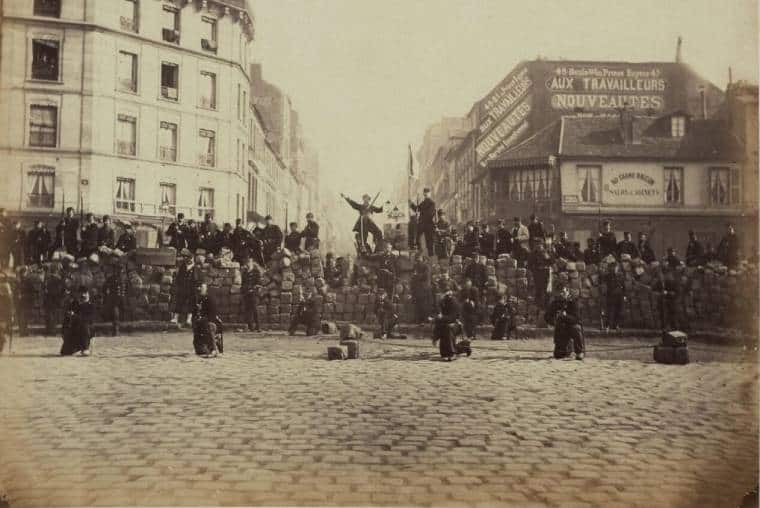
Street battle in Berlin, Germany, in March 1848. Marx supported the uprising with a new revolutionary paper
Karl Marx is often presented as a dry theoretician who spent his days writing obscure books. But Marx’s great friend Frederick Engels rightly said, “Marx was above all else a revolutionary.”
There were plenty of socialists before Marx who stood against exploitation and oppression. But what makes Marxism unique is that it’s the theory and practice of working class self-emancipation. It’s the idea that, through their own collective struggles, working class people can overthrow the system and build a different society run from the bottom up.
So what was it that made Marx draw those conclusions? He engaged with radical ideas and action to clarify the best strategies for resistance.
As an activist in the German student rebellion of the 1830s, Marx looked for ideas that could explain the oppressive society around him. He and his friends interpreted the philosophical ideas of the day in subversive ways. They placed human beings, rather than God, at the centre of the world. And all the while they fought for an end to the monarchy and feudal lords.
At the time, Marx was in alliance with liberal capitalists who wanted democrat reform, but didn’t want revolt to go too far. He came to see that the old landowners and new capitalists shared a common interest in defending private property. So he began to analyse how the underlying economic structures shaped politics and society.
Exiled in Paris, Marx met working class followers of the early socialists Henri Saint Simon and Charles Fourier. They had devastating critiques of the effect of private property and capitalist competition on human beings and looked forward to a world of universal freedom. Unfortunately, they had no idea how reach this future.
The political economists of Britain were also influential on Marx’s thinking. The analysis of Adam Smith and David Ricardo helped him identify the role of workers in producing profit and the inevitable antagonism between bosses and workers.
This insight allowed Marx to conclude that the struggles of the emerging working class had the potential to change the world. Workers produced the wealth and had the capacity not only to bring capitalism to its knees, but also to replace it with a socialist society.
Marx developed his ideas through his interactions with radical workers, by learning from them. He constantly looked for ways to encourage militancy and political organisation.
In the mid-1840s, Marx was leading the League of the Just and then the Communist League, for which he wrote The Communist Manifesto.
It was published in 1848 as revolutions erupted across Europe. Marx rushed to Germany to support the uprising with a new revolutionary paper. By May 1849, the revolution was crushed. Marx was put on trial for “insulting officials” but turned the case into a indictment of the capitalist class and was acquitted.
The authorities still banned his paper. The last issue finished with Marx’s pledge that his demand everywhere and always would be “the emancipation of the working class”.
By the summer of 1850, Marx despaired waiting for a new wave of revolt. For the next 15 years, he toiled away in the British Library on his economic writings. Capital is a work of great depth and originality, but Marx did not write it in isolation.
In 1864 he assumed a leading role in a new organisation, the International Working Men’s Association. Through the International, Marx mixed with socialist workers and trade unionists. Their experiences and their campaigns to win reforms such as the eight-hour day animate the pages of Capital.
When a new revolution broke out in Paris in 1871, it was Marx’s daughters who were the activists. The government’s slaughter of the Paris Commune confirmed his instinct that the state must be smashed.
He never stopped fighting for his guiding principle—the self‑emancipation of the working class.


Why have institutions like churches covered up abuse for centuries?