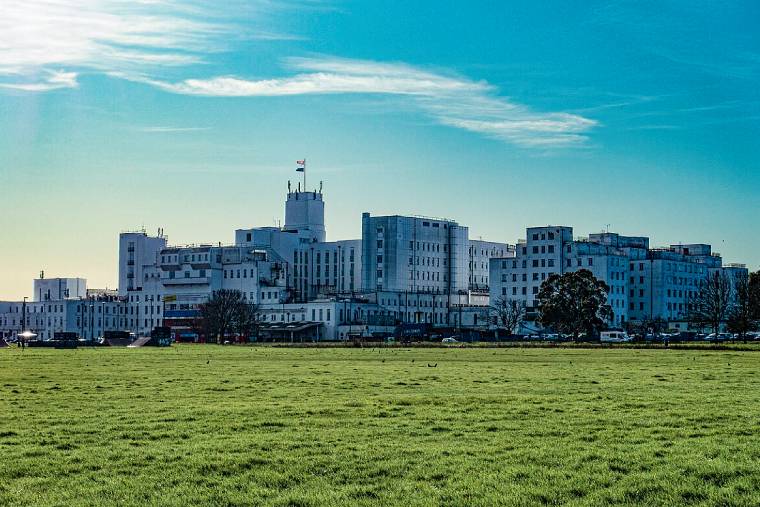
St Helier Hospital is part of the trust (Pic: Wikimedia commons)
Hundreds of cleaners, porters, caterers and help desk workers at Epsom and St Helier hospitals (ESTH NHS), in south London, are set to strike.
The UVW union members, who are overwhelmingly black or from migrant backgrounds, say bosses treat them as “second class”.
They report having worse contracts than other staff at their hospitals—despite being employed by the same trust.
Leading union activist Farrokh told Socialist Worker that the strike vote was “fantastic”. He added that although some 300 people were balloted, scores more have since joined the union.
“Since being brought back in house in 2021, we have four different contracts for people doing the same job,” he said.
Farrokh explained that a minority of staff are on the main Agenda For Change (AFC) contract that most NHS staff are on. This provides the best pay, overtime and unsocial hours rates, as well as holidays and sickness benefits.
But Farrokh reports that other staff are on a contract the Trust labelled as “Protected AFC”.
Far from being protected, these workers found their pay and conditions were being eroded. They were not even allowed to join the normal NHS pension scheme.
Some staff who started work after 2021 were put on “Mickey Mouse contracts,” says Farrokh.
And bank staff, who do occasional shifts, are on a separate zero hours contract.
“So, we have three permanent contracts now. That means that, for example, I work with somebody on a weekend, or at night, and we are moving the patient around. I get £13.85 an hour, and they get nearly double that.
“That’s for doing the same job, in the same building and all paid by the same employer.”
Paying different rates to employees for doing the same work raises important equality questions.
That’s one reason most NHS employers prefer to stick to AFC contracts for all directly employed staff.
ESTH’s own 2023 report into the gender pay gap says, “All staff except for medical and very senior management are on Agenda For Change pay scales, which provide a clear structure for paying employees equally, irrespective of gender.”
Yet, we know that was untrue then and is still untrue now.
Farrokh says that workers have long attempted to raise their grievances through long-established health unions but were thwarted.
Four years ago, when bosses took the outsourced workers back in house, the main union was the GMB.
“It could not resolve this,” says Farrokh. “I think it was more a lack of organisation than a lack of desire.
“People were very, very disenchanted. And then, two years ago, they joined Unison. The union said, ‘we’re going to sort this for you. We are the biggest public sector union in the country—we’ll do this for you.’
“At first, it was very promising. But then Unison started to come up with excuses.”
Farrokh says that at this point workers became really disenchanted and some even became anti-union.
“Then one of our guys, a real fighter, contacted Black Lives Matter and they put us in touch with the UVW.”
Farrokh points out that many workers believe that racism is behind their mistreatment—and that the UVW has a good record of winning strikes involving migrant workers.
“People ask, how is it that in the hospital, the majority of workers are not ‘white English,’ but the Trust board is almost exclusively white?
“And they notice that the majority of the lowest paid workers are part of an ethnic minority or are migrants.”
In February this year, many workers decided to join the UVW, saying, “Let’s see what they can do.
“And my God, not a week goes by when these UVW guys are not in our hospital. It’s as if they’ve got no other cases to deal with,” says Farrokh.
But it’s not simply the union machinery that’s building workers’ organisation.
Farrokh says workers have organised their own WhatsApp groups to get around working different shifts at multiple sites. “That’s how we’ve won 300 people to vote for strikes—and people are still signing up,” he says.
The union has given management a short time to respond to the strike vote and its demands, but Farrokh says after that, the union will call strikes.
“We’ve got the upper hand now,” he says.


Unions have called a general strike
Interview with a member of French revolutionary socialist group Autonomie de Classe