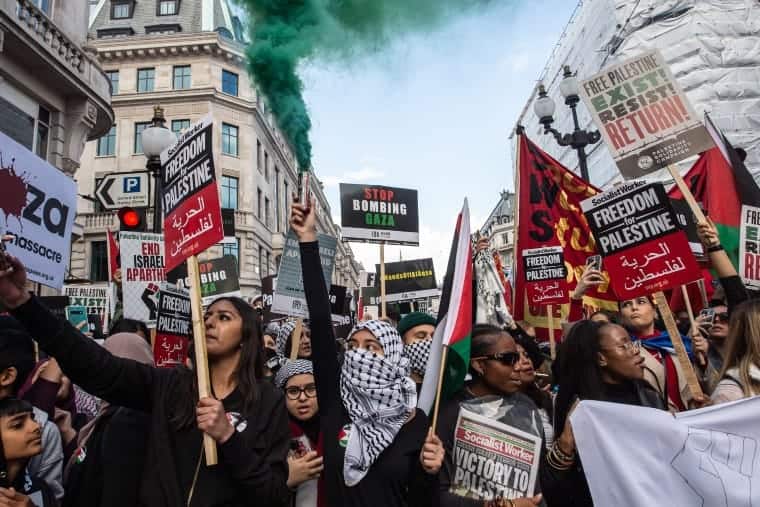
Trade unionists march for Palestine (Picture: Sean Vernell)
The TUC union federation’s congress this month took place with the backdrop of a world in turmoil.
At home, Nigel Farage and Reform UK and fascist forces are growing in confidence. Indeed, the following weekend Nazi Tommy Robinson mobilised over 100,000 onto the streets of London in the biggest far right march in British history.
Abroad, Israel is ramping up the genocide, the horrific proxy war in Ukraine drags on and the United States and China rattle sabres in Asia. And on top of that, the ecological crisis that is having a devastating impact on our planet is accelerating.
The stakes could not be higher as the far right feeds off the despair and builds through anti-migrant racism.
Will the trade union movement rise to the challenge of mobilising against the threat? And will it mount resistance to Labour’s austerity mark 2 and offer hope to millions of working class people?
There were signs of hope for the left at TUC. Congress is often described as the echo of working class battles and not the battle itself. It is mainly attended by full time officials of unions and not rank and file workers. And the TUC bureaucracy is notorious for doing its utmost to ensure that there are no debates or disagreements on congress floor through “compositing”—combining—different motions.
Over the last four years the GMB and Unite unions’ right wing arguments have managed to shape the key issues at congress. In 2022, they successfully carried a motion calling for the “immediate increase in arms spending”. This militarist position placed the TUC on the side of the warmongers and against the popular movement around Palestine.
At last year’s congress, we saw a significant movement away from this position. The NEU education union brought a motion calling for a ban of all arms sales to Israel. And an emergency motion brought by the UCU union called on the TUC to campaign against escalations of war in the Middle East and to support workplace days of action over Palestine.
At this year’s congress, the UCU brought a Wages Not Weapons motion to overturn the 2022 policy on supporting an increase in arms spending. It was carried on a card vote—where union delegation votes are counted proportionately to total union membership—by just under 600,000 votes.
While the motions carried at the TUC might seem to have little effect on the ground, it would be a mistake to dismiss the shift that has taken place.
First, it reflects the power of the Palestine solidarity movement. It has reshaped the political discourse around war and militarism within the trade union movement. No longer can the leaders of unions that represent workers in the arms and energy industries, GMB and Unite, have a veto in debates on military spending.
Second, these motions are the product of campaigning in workplaces and union branches. Take for example the UCU’s Wages Not Weapons motion.

That was first debated and carried in UCU branches and then taken to the UCU conference, where delegates called on the union to take it to the TUC. And Stop The War (STW) launched a petition in support of the motion which 1,200 people signed.
STW, the Campaign for Nuclear Disarmament (CND), Campaign Against Climate Change (CACC) and others organised a lobby of the TUC conference. UCU produced an excellent video and statement with the support of ten unions, and flyers and T-shirts which delegates wore on the day of the debate.
This campaigning approach was also carried out by Stand Up To Racism (SUTR), CACC and trans+ rights activists, which allowed their motions to be debated and carried. Congress passed motions calling on members to join the SUTR counter-protest against Tommy Robinson last Saturday and to lift the ban on Palestine Action. It supported a year of climate action and called for the overturning of the Supreme Court’s transphobic ruling.
Third, carrying theses motions at the TUC opens up spaces in branches and workplaces for activists to organise around these issues. One of the next big tests will be on workplace day of action to stop the genocide on 9 October.
The challenge for the trade movement will now be to make itself visible on the streets. A new wave of attacks is coming out way with Labour’s next budget on 26 November. We need to harness the creativity, power and bravery of the Palestine, anti-racist and trans+ liberation movements to build a national anti-austerity movement.
At the moment, some unions are encouraging local strikes. These are important and we need to build solidarity with all those taking action, such as the Birmingham bin workers, UCU members in a number of universities and RMT union members on the Tube.
But we are not going to stop Starmer’s attacks workplace by workplace or council by council. These attacks are driven nationally by central government and we need an anti-austerity movement that mirrors these attacks.
On the day of the budget, we need to see trade unions coming together to protests across Britain and a mass lobby of parliament. Failure to respond to these attacks will only allow Farage and the far right to continue to feed off the despair.
We all face an urgent challenge to respond to the threat of the fascists and the far right. The union leaders need to turn words into action, official backing into mobilising members for mobilisations against the likes of Tommy Robinson.
We need a new left party that could put a message of hope to millions of people. Many delegates were supportive of the initiative launched by Jeremy Corbyn and Zarah Sultana, but wanted them to speed up the process of turning it into something meaningful on the ground.
But we need working class struggle to turn the tables on Starmer and the rise of the far right that grows out of racism and despair. The trade union movement has the collective power to offer hope to the millions of people who are suffering from these continued attacks.


Build for the Palestine national demonstration on 10 October
Racism first developed as a justification for enslavement