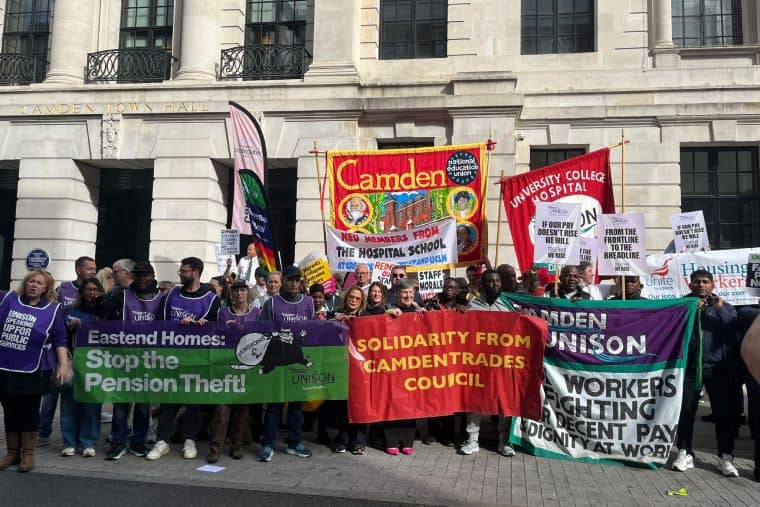
Union members come out totally transformed in their view of what management is doing (Photo: UniteSharon/X)
Workers at the Institute of Cancer Research (ICR) have forced bosses to concede to several of their demands.
Bosses have agreed to bring back a canteen that serves hot food at the Sutton site in south London, to backtrack on plans to take some workers out of the USS pension scheme and to reinstate an incremental pay scale—a key demand of the strike.
The Unite union members are continuing to negotiate to win a pay uplift that doesn’t leave the lowest‑paid workers behind, with further talks taking place on Tuesday. As of Tuesday, they had taken 65 days of action, but they are still determined to win better pay for all.
Strikers explained that bosses had wanted them to call off the strikes while negotiations were ongoing. But they kept striking and picketing throughout to keep the pressure up.
Mahmood, who works in the ICR storeroom, told Socialist Worker, “Without the strikes they wouldn’t have come to the table.”
The strikers—some of whom work as data scientists—had used their skills to model a new pay structure. But bosses kept presenting alternative models, sometimes in the meetings themselves rather than in advance so that Unite members wouldn’t have a chance to consider them.
Striker Lynn told Socialist Worker she was “shocked” at how long it had taken senior managers to do the financial modelling.
She said that things started to move when bosses brought in extra people to help them.
By contrast, the lowest paid workers at ICR have to do more with fewer people. Before the strike started, they had been asked to take on more responsibilities and had been expected to travel between the two sites in different parts of London.
“The lowest paid get asked to do more with less. I don’t want ICR to look like that,” Lynn said.
Strikers have recently visited other picket lines. Last week, they met striking health workers at Guy’s and St Thomas’s Hospitals and they visited bus drivers in north London whose strike won air con.
Earlier in the week they visited the Park Theatre with flyers to put pressure on the theatre’s chair, Anthony Clare, who is also a trustee on the board of the ICR.
And, Lynn said that taking union members into negotiations in a large group, rather than just sending a small negotiating team, had been vital.
Union members come out totally transformed in their view of what management is doing. They see what they are really like. Otherwise, it’s just the union’s word versus theirs.
“Every union should do this if they can,” she added.
At the rally last week, Imperial College UCU union member Faye came with a message of solidarity and a donation from the branch of £1,000 to the strikers.
ICR striker and anti-racist activist Yann-Vaï spoke about the scandal of workers spending tens of thousands on visas for themselves and their family to live in Britain and work at the ICR.
And he said, “It’s been heartbreaking to see fascists marching in Dover and Portsmouth, we really have to do something about that.”
Yann-Vaï encouraged the striking workers to join Stand Up To Racism unity marches as well as the counter‑protest in Portsmouth.
Unite rep Teige said, “When we return to work—whenever that is—it needs to be on our terms. We should get all of our members and all walk into the workplace together. And if any of you is being mistreated we will not stand for it. We are going back as a collective.”
As Mahmood said, “People are aware of their rights now—they know that they have the union behind them. Before that the union reps were part of management. Now the reps are real people in front of you.”


MioCare strikers in Greater Manchester want answers about proposed National Care Service
The GMB union members at the Royal Berkshire Hospital say they are 'being pushed towards poverty'