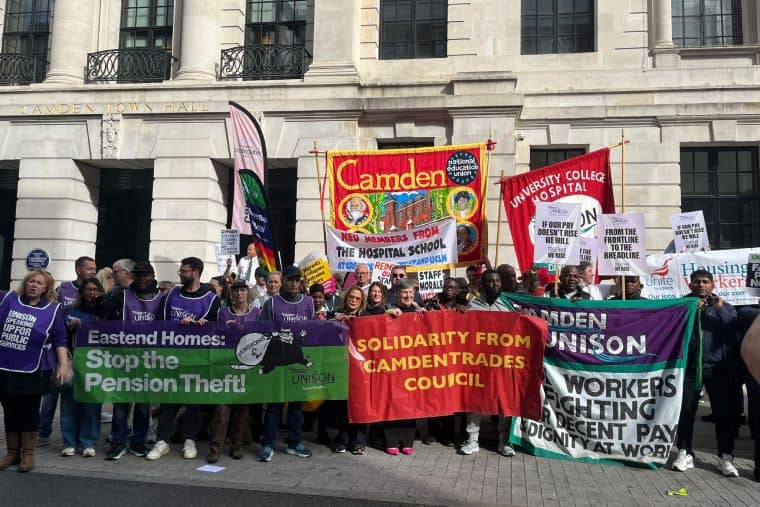
Defiant strikers in Stratford, east London (Picture: Alan Kenny)
More than 300 PCS union members working as security guards in job centres began another seven-day strike on Monday this week and will finish on Sunday.
They are striking alongside over 1,000 more security guards—members of the GMB union who began their dispute in May this year.
Employer G4S, which turns over billions of pounds every year, only pays its workers the minimum wage. PCS members have organised picket lines in at least 16 locations across England.
The next round of strikes will take place from 29 July to 4 August. The GMB has also scheduled strikes from 29 July to 4 August. To see the list of picket lines to visit across England go to tinyurl.com/PCSJobCentre
Around 60 PCS members working as cleaners and security guards in Whitehall have voted to strike over pay in a ballot that closed last Monday.
They are employed by outsourced facilities company ISS at the government Department for Energy and Net Zero (DESNZ). The workers are fighting for their pay to be uplifted to £17 an hour.
PCS has said the strike will last for five days, from Monday to Friday next week. The strike will impact the last few days of parliament before the summer when ministers will still be using the building.
The PCS pay claim submitted in January covered pay, improvements in terms and conditions to move towards alignment with civil servants employed by DESNZ.
Strikers intend to pressure the new Labour government to bring them in-house as part of the civil service when the current contract with ISS ends in April 2025.
Workers won’t go with the wind Around 300 workers who make wind turbines in Hull are voting for strikes over pay. The workers, who construct 108 metre-long wind turbine blades by hand, are angry at a 4.5 percent pay offer.
Since 2018 wages at the factory have dropped by 11.9 percent in real terms. Siemens Gamesa Renewable Energy (SGRE), which owns the factory, made £394 million in profits over the last five years.
SGRE’s revenue is expected to double in 2024 to £1.5 billion, with pre-tax profits on course to hit £100 million for the year. The workers, in the Unite union, are voting until Wednesday next week.
‘Solidarity forever’ was the message at the 138th Durham Miners Gala. Coinciding with the 40th anniversary of the Great Miners Strike, the city was abuzz with memories of class struggle.
Heather Wood, national secretary of Women Against Pit Closures said “it wasn’t about coal, it was about getting back at us for 1974 when we beat the Tory government… It was about trying to wipe us off the face of this earth”.
But “we are still here, we’re stronger than ever, because we are not simply fighting as miners, miners’ wives, miners’ families; we are trade unionists”. The day was filled with uncertainty about the prospect of struggle under Starmer.
In 2012, Ed Milliband, then Labour leader, addressed the gala, the first in 23 years to do so. In 2024, the labour leadership has once again become absent from the platform.
Those who were present were keen to pressure the new government to enact change.
Unison general secretary Christina McAnea said “we need them to step up to the mark and do the right thing in ending the appalling violence and carnage that we see every day in Gaza and the West Bank.
She added “We need to push further to make free school meals government policy”. The ongoing genocide in Palestine was a thread which ran throughout.
Hanan Ashwari, Palestinian diplomat, speaking from Ramallah said it was “a continuation of Israel’s impunity that it has enjoyed with full support, if not complicity, of the west, of most western countries… However, there is a new movement… people of conscience who are rising up”.
Alan Mardghum, general secretary of the Durham Miners Association said “we must push for a ceasefire in Gaza… for an end to all arms sales to Israel”.
The spectre of Reform UK was also present after the far-right party snatched 26 percent of the vote in North Durham.
Mardghum says it’s not migrants to blame “It’s the multimillionaires in the big boats, who don’t pay their tax. But the message is hard to get across to some people, they fall for it because they hear the ‘immigration, immigration, immigration’ panic all the time”.
This year’s gala exposed the loose threads fraying at the edges of the labour movement as they begin to relate to a labour government, but also put on display the power that will actually bring change from below, the working class.
By Liam Tuckwood
Around 300 workers who make wind turbines in Hull are voting for strikes over pay. The workers, who construct 108 metre-long wind turbine blades by hand, are angry at a 4.5 percent pay offer.
Since 2018 wages at the factory have dropped by 11.9 percent in real terms. Siemens Gamesa Renewable Energy (SGRE), which owns the factory, made £394 million in profits over the last five years.
SGRE’s revenue is expected to double in 2024 to £1.5 billion, with pre-tax profits on course to hit £100 million for the year. The workers, in the Unite union, are voting until Wednesday next week.
The employment Appeal Tribunal has accepted the UVW union’s appeal against Great Ormond Street hospital.
Cleaners, who are all migrant workers from marginalised groups, at the hospital are seeking £10 million in compensation for years of denied NHS pay.
Hospital bosses outsource the cleaners on worse pay and terms and conditions than the NHS. Cleaners want compensation for the years they worked privately on worse pay than other workers directly employed by the NHS.
If the court finds in favour of the workers, each claimant could be awarded between £80,000 and £190,000 each.


Strikers are demanding an unallocated €1.6 billion go towards workers' pay rise
MioCare strikers in Greater Manchester want answers about proposed National Care Service