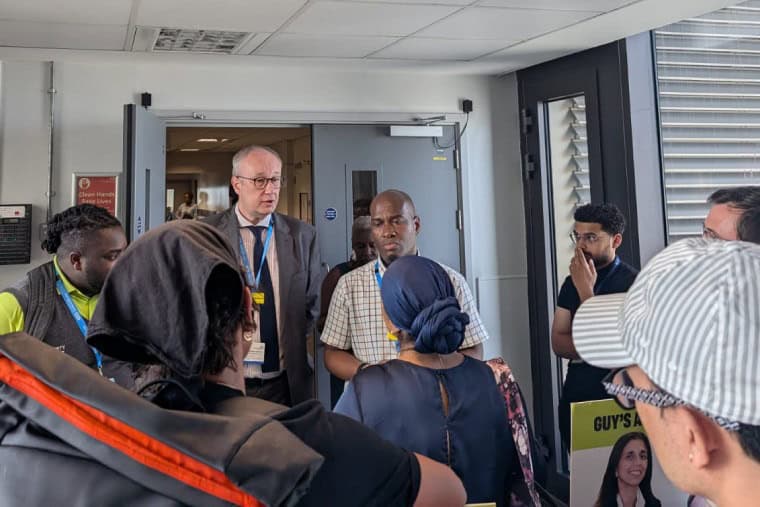
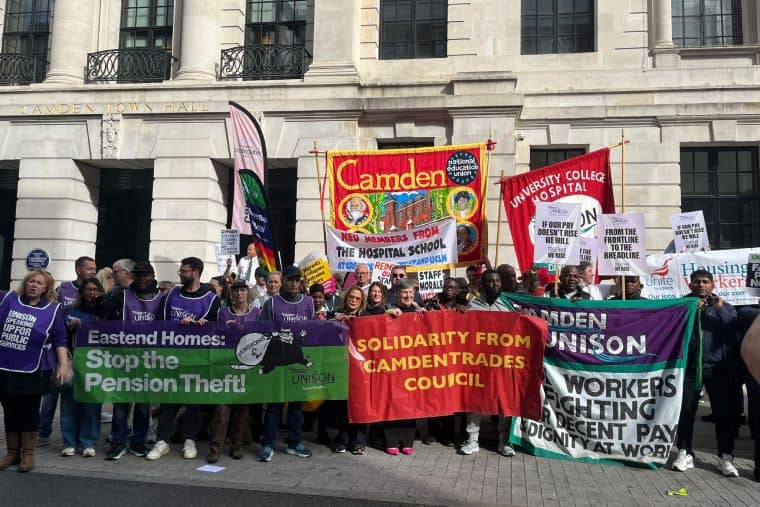
Health Care Assistants strike in Leicester (see below)
Thousands of nurses in the RCN union are voting on whether to accept the government’s 5.5 percent pay award.
The NHS pay review body announced the award for 2024-25 last month, and ministers agreed to implement it.
The RCN is making no recommendation for how to vote on the ballot.
That is a mistake. The 5.5 percent award might sound good after years of below-inflation pay rises, especially as the RPI measure of inflation stood at 2.9 percent last month.
But such a marginal gain will do nothing to improve the recruitment crisis, short staffing and overwork that nurses endure now.
And many nurses will know that their personal inflation rate is much higher than the state’s figure.
Rents and mortgages have spiralled, the cost of childcare is going through the roof—if you can even get it—and the price of getting to and from work is only going upwards.
If the RCN had put itself fully behind a fight, the review body and the government would have come up with a better award.
That must be the lesson from the junior doctors. In a bid to end the long running junior doctors’ strike, the government said it awarded them 22 percent over two years.
We might disagree with how that percentage was calculated, but it is certainly a better offer than the 5.5 percent for everyone on an Agenda for Change NHS contract.
The doctors got a better deal because they fought—and that’s why nurses should reject the award in the RCN ballot and argue for a fight to win a better deal.
The Unite union is organising a consultation on pay but is also not making a recommendation. There was no news at the start of this week from the Unison and GMB unions about their ballots.
That means hundreds of thousands of nurses, porters, cooks, cleaners, therapists and others are still in the dark about their union’s plans.
Activists and union branches should already be agitating for action to win a better deal.
Hospital bosses in the Leicestershire area are fighting dirty—and the wider union movement must now hit back.
Health care assistants (HCAs) at five hospitals across Leicester and Northamptonshire walked out on a 26-day strike over grading, pay and backpay on Monday of last week.
The strike, which involves hundreds of Unison union members, is part of a national struggle to win the correct pay banding for assistants who mostly work alongside nurses in hospital wards.
Unison officials say that the NHS trust boss Richard Mitchell is refusing to acknowledge that there is a “legal formal trade dispute with a recognised union”. Mitchell is “refusing to enter into any form of negotiation” and “ignoring ACAS’s offer of conciliation”.
Strikers have told Socialist Worker that matrons—effectively ward managers—are spreading rumours to undermine the strike. Matrons are also threatening to delete posts and replace strikers with agency workers, sources said.
Bosses in trusts across England accept that they were wrong to place HCAs in band 2, the NHS’s lowest, because they recognise the workers are skilled and perform medical tasks as part of their job.
Unison strikes have forced 18 trusts to pay out for five years, to 2018—leading to large awards for long-standing staff.
But Leicester and associated hospitals are offering backpay only to 2021.
The fight in Leicester and associated hospitals is now at a crucial stage.
Every health trade union branch should invite a speaker from Leicester to address them—and start writing cheques that show solidarity.
Cleaners, porters, catering and other hospital workers are set to strike next week over plans to move their jobs out of the NHS.
Hundreds of workers for East Suffolk and North Essex Foundation Trust will walk out from Monday next week until Friday next week.
The action will hit at Colchester Hospital and community sites, including Felixstowe and Aldeburgh hospitals in Suffolk.
The Unison union says its members at Ipswich Hospital received fewer days of annual leave, less sick pay and had missed out on a one-off “Covid bonus” for NHS staff when their jobs were outsourced.
Sarah Gray, who works at Aldeburgh hospital, said that “staff should be treated just like other NHS colleagues”.
Scores of workers in the GMB union in Asda Lowestoft, near Norwich, struck last Friday against a management that consistently refuses to engage with workers’ grievances.
Strikers on the picket line spoke about how the workforce in the store has nearly halved since the 2000s. Workers are still given fewer hours but have more and more tasks placed on their shoulders.
The strike begun at 3am on last Friday morning and continued until late evening.
Morale was high as strikers blew horns and passing motorists honked their car horns in support, with a background of disco music in the sweltering heat. Clearly this struggle will continue with fresh days of action. Escalation will be necessary if the management continues to be intransigent.
Kevin Wingfield
More than 1,500 job centre security guards were set to strike from Monday to Sunday this week.
The company G4S employs the workers on behalf of the Department for Work and Pensions—but
G4S is refusing to meet the GMB and PCS unions without setting preconditions.
Some 90 percent of workers are paid just the minimum wage.
Workers are currently paid £11.44 an hour and have had no pay rise since 2022.
Bosses recently offered strikers just 23p extra an hour, but workers are keeping up their fight for £15 an hour.
The government gives G4S millions in taxpayer cash to run the job security contract.
This money shouldn’t be used to line shareholder pockets while staff struggle to get by.
G4S has deployed workers from other areas and employed new workers from agencies paying £2 more than the guards currently receive.
The strike is having a significant effect, with many job centres across England having to close entirely and some others offering only phone appointments.
Outsourced cleaners, caterers and facilities staff working at the foreign, commonwealth and development office in East Kilbride near Glasgow are to vote on strikes.
The ballot of PCS union members will run from 16 to 30 August.
Refuse workers for Redbridge Civic Services (RCS) are set to strike for two weeks from Thursday next week to 5 September.
Workers previously struck for a week at the start of July.
RCS is a wholly-owned subsidiary of the council.
That means refuse workers working for RCS don’t technically work for the council.
They face worse conditions than other council workers.
Workers consistently start and finish late due to vehicles breaking down and not being repaired.
RCS workers have just ten days of paid sick leave compared to six months for other council workers.
There is currently an overtime ban following the July strike.
Union leaders have called off planned refuse worker strikes in Scotland. Workers were set to strike for eight days from Wednesday of this week at 26 local authorities.
Cosla, the local government bosses’ organisation, offered an improved deal worth 4.27 percent overall.
Unison, Unite and GMB union all suspended the strikes. Unison is asking workers to reject the deal in a ballot. Unite will recommend it.
Workers should vote no to the deal.
As Unison previously noted, “the value of these workers’ pay has dropped 25 percent over the past 14 years.”
Even of the deal goes to a vote, the strikes should have gone ahead.
Workers at Sheffield Hallam University plan to start the academic year with a bang by shutting it down.
UCU union members are planning to strike for four days from 23 September in a bid to save jobs and conditions.
Some 400 jobs are at risk, despite around 140 academics having taken voluntary redundancy since December 2023.
Workers are also fighting for proper fixed-term contracts for associate lecturers—something bosses promised to implement in September 2023.
Yet now the university fatcats want workers to stay on zero-hours contracts.
They’re also trying to slash some £15 million from the university budget this year, threatening a further round of job cuts. Despite this, bosses are pushing ahead with expensive building projects.
Workers at Goldsmiths, University of London, are also set to strike indefinitely from Monday 23 September. It’s part of the long running dispute over the university’s brutal redundancy programme.
Over 90 members of staff are at risk of losing their jobs before the start of the next academic year in September.
Originally over 130 staff were going to be made redundant, including more than one in six academics.
Goldsmiths staff have already struck for ten days, ending on 28 June.
Members of the Unite union, working for the UCU higher and further education union, have called an all-out strike to escalate their dispute.
It’s disgraceful that UCU leaders haven’t settled the dispute—and are instead fighting the workers’ claims.
Around 200 Unite members have called indefinite action from 2 September.
They last walked out in May for three days during UCU’s conference, disrupting the national event.
Despite acknowledging the need to address racism, UCU is refusing to withdraw dismissal-related procedures against black staff.
The dispute is also over repeated breaches of their collective agreements and broken industrial relations.
UCU has also announced an effective pay freeze. It told staff it was suspending long-delayed talks over this year’s pay uplift.
No offer has been made in response to Unite’s annual claim submitted in April, and the pay anniversary date was 1 August.
The Unite members are currently taking action short of a strike in the form of an overtime ban and work to rule.
UCU needs to listen to its workers and resolve the dispute immediately.
Accuations of racism are serious matter should be treated as such.
The Caiwu cleaners’ union scheduled a demonstration for Friday this week against cuts at Meta.
Caiwu said, “At Meta our members working for Churchill Group have been subject to mass redundancies and trade union victimisation.”
Since the dispute began, Caiwu says the company has made five of its members redundant on spurious grounds.
The union adds, “We were shocked to discover that the same unscrupulous employer has been awarded the contract at the Houses of Parliament.”
Caiwu said parliament is “threatening to cut 25 percent of staff. So much for a New Deal for Working People, Starmer.”
Over 50 workers at the Jiffy packaging plant in Winsford, Cheshire, are escalating their strike following a “pathetic” pay offer.
Workers walked out on Monday last week and are set to be out until Friday this week. They previously walked out for two weeks in July.
But their Unite union says Jiffy is still unwilling to negotiate. Bosses offered workers just 1.5 percent.
The workers want better sick pay and an 8 percent increase.
Bus workers at First South West struck on Friday of last week and Monday of this week over pay.
Bosses have tried to go round the workers’ RMT union to push through a pay deal based on selling conditions.
Strikers were out on picket lines in Camborne, Helston, Truro, Taunton and Yeovil.
RMT union members working on key Scottish rail services have voted for strikes.
ScotRail and Caledonian Sleeper workers were separately balloted after rejecting pay offers from both companies.
Workers at ScotRail returned an 85 percent vote for action on a 64 percent turnout. And Caledonian Sleeper workers produced a 90 percent strike vote on a 66 percent turnout.
Workers at the private Jags School in Dulwich, south London, plan strikes on 2, 3 and 5 September against pay cuts.
The outsourced cleaners, many of who are migrants, are part of the UVW union. Workers voted unanimously for the strike.


Strikers are demanding an unallocated €1.6 billion go towards workers' pay rise
MioCare strikers in Greater Manchester want answers about proposed National Care Service