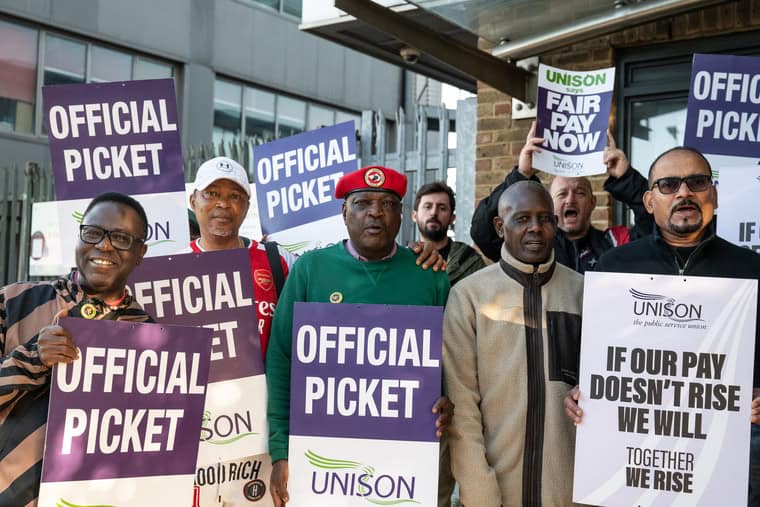
Workers on the picket line at Robert Gordon University, Scotland (Picture: EIS / X)
As university term starts again after the summer break, strikes are also returning to the universities. At the University of Nottingham, there are 20 days of action planned, from 22 September to 3 October, and again from 13 October to 24 October.
University of Bradford UCU members are set to strike for two weeks from this coming Monday.
At the University of Leicester, strikes are planned from 29 September to 17 October.
In Scotland, EIS members at Robert Gordon University struck last week. At the University of the West of Scotland, EIS are set to strike on Tuesday this week, Monday and Tuesday next week and six days in October.
They are fighting a wave of cuts in higher education that put careers on the line, carve students out of education and send workloads spiralling for the remaining staff.
The Universities of Kent and Greenwich have announced plans to merge next year. It’s a further sign of a crisis that could see universities go bankrupt. The UCU has warned that this could lead to redundancies unless there is resistance.
At Leicester, bosses want to cut the budget for staff by £11 million. The cuts threaten teaching in geography and environment, education, chemistry, modern languages, history and film studies.
Hundreds of administrative staff who keep the university running have also been told their jobs are at risk.
Meanwhile, bosses are splashing out £40 million a year on capital expenditure—investments such as new buildings. Branch chair Joseph Choonara told Socialist Worker, “The fact we are taking this unprecedented action shows the anger and determination in the branch.
“If we don’t fight over these issues, bosses will continue to drive through a market driven model of education that harms staff, students and the local economy.
“In our branch we have stood in solidarity with the Palestine movement, including students who were arrested for taking part in an occupation last year.
“We stand with other striking workers and with the anti-racist movement. We hope they will now join us on the picket lines.
“Of course this isn’t just an issue for Leicester. Building solidarity with other branches fighting back is crucial.”
UCU, Unison, GMB, Unite and EIS are united in saying this is not good enough. The UCU is set to ballot members from Monday 20 October for six weeks.
The fight over pay is not a diversion from the battles taking place in universities over course closures and jobs. The unions should use the industrial action ballots and strikes to make the case for a fully funded education system and an end to market driven chaos.
Hard-hitting bus strikes are set to get going over the next couple of weeks.
First West of England bus drivers in Bristol are set for walkouts from Tuesday for four days. Around 600 Unite union members were set to strike early September, but the action was suspended as a new offer was put forward.
But workers are keeping the bosses’ feet to the fire after rejecting the offer.
In Manchester, over 2,000 bus workers from the Bee Network are set to begin a four-day walkout on Friday.
At Stagecoach and Metroline Manchester, some 2,000 workers have rejected a 3.5 percent pay offer. And at First Bus Rochdale, 110 workers have rejected a 6 percent pay offer.
Striking together, the Unite members could bring Manchester to a halt.
Some 800 bus workers at Arriva in south east England are set for 16 days of strikes from 23 September. The Unite members are furious as Arriva has made no pay offer.
Meanwhile, Stagecoach drivers at Birkenhead, Chorley and Preston are set to strike over pay.
Arriva drivers in Birkenhead earn £2.69 an hour more than Birkenhead Stagecoach drivers and £2.13 an hour more than Stagecoach drivers in Chorley and Preston.
Workers are set to walk out from 29 September to 5 October and from 13-19 October.
Supporters and trade unionists should show their solidarity with the long‑running Birmingham bin strike this Saturday.
Workers will be marching through Birmingham to the City Chambers to show they will not bow down to a Labour council pushing savage cuts.
The Unite union members are refusing to accept the council’s austerity cuts, which will make many £8,000 a year worse off.
To break the strike, the Labour-run council has used the police to break picket lines. It has got a court injunction to make it illegal for workers to block the scab lorries. And it has spent some £6.5 million on scab labour.
In July, the council announced mass sackings to break the strike, threatening 130 workers with compulsory redundancy.
The pressure is mounting, and the strike is now at a crunch point.
Previously, workers have shut down bin depots and blocked scab lorries. But that momentum is currently absent—rebuilding it is the way to win.
Workers from the Cefas Endeavour, a government surveying ship, based at the port of Lowestoft in Suffolk, struck for four days from last Tuesday.
There was a strong picket over all four days, which also marched through the centre of Lowestoft and to the Cefas centre. The strike was solid, with outside maintenance workers being turned away from the large picket line.
Of the three main demands, management has moved on two but still reject the demand of a 6.5 percent pay rise.
Strikers on the picket line said that employers AW Crewing can afford a decent pay rise for skilled workers. There is a palpable determination to continue the strike at other ports.
Stephen Mynott, Lowestoft


MioCare strikers in Greater Manchester want answers about proposed National Care Service
The GMB union members at the Royal Berkshire Hospital say they are 'being pushed towards poverty'
Jude Mckechnie spoke to the workers leading the fightback against outsourcing