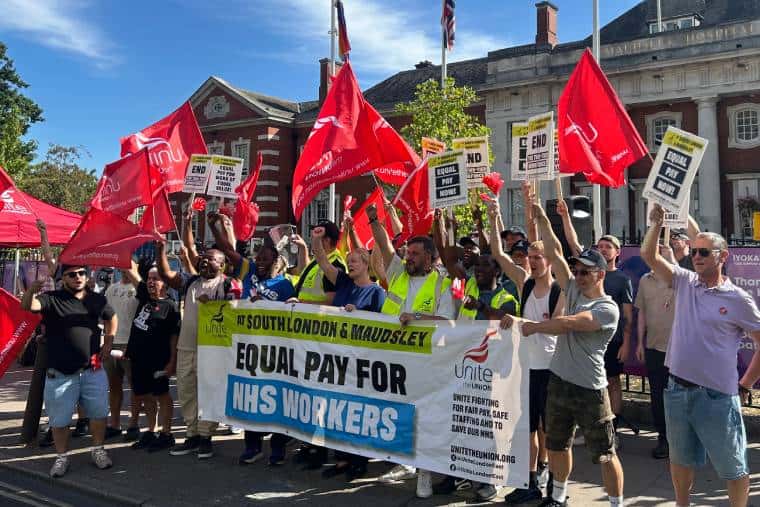
doctors on the picket line outside St Thomas’ hospital in central London in November (Photo: Guy Smallman)
Resident doctors delivered a stinging rebuke to health secretary Wes Streeting and his attempted use of moral blackmail to stop a five-day strike from Wednesday 17 December.
In an online poll, BMA union members voted by 83.2 percent against his offer. Some 65 percent of eligible doctors voted, the BMA announced on Monday 15 December.
Streeting had warned that the combination of the flu virus and the walkout would “push the NHS over the edge” and lead it to “collapse.”
He demanded that the BMA call off its action and end the dispute over pay and jobs.
The department of health even produced graphics urging acceptance designed to look as though they had come from the union.
Prime minister Keir Starmer joined in. He was, of course, furious at the prospects of a walkout. Starmer told the Guardian newspaper that it was “frankly beyond belief” that the “irresponsible” strike would go ahead.
It was blatant scaremongering—and an attempt to bully the doctors back to work.
The real reasons why the NHS struggles with even an entirely predictable yearly flu virus is that it is woefully underfunded, understaffed and has too few beds.
A big part of the resident doctors’ dispute centres on the lack of training jobs for doctors who have completed their initial qualifications.
The crisis results from the number of places is not keeping up with the number of graduates. And it means thousands of doctors compete for posts—but many end up without work at all.
No wonder doctors are leaving the NHS to work in Australia, Canada and other places where work is less pressurised and better paid.
Without doctors who have completed further training, the NHS loses out on specialists that we all depended on.
The government’s weak offer also made no movement on pay.
The BMA rightly demands pay restoration that would see salaries return to the levels they were at 15 years ago.
Streeting’s offer made only small moves on this, and no move at all on pay.
Unsurprisingly, BMA members threw it out. Now, with the strike set to go ahead, it’s vital that trade unionists, health workers and NHS campaigners make urgent plans to show their support on the picket lines.
“If the doctors win, it will be good for all NHS workers, so other health workers should get behind the BMA struggle,” says Jordan.
She’s an occupational therapist and Unison union activist in London.
“Their victory would make a victory for others more likely and we are all feeling the impact of low pay,” she added.
“Wes Streeting is trying to blame doctors for the issues in the NHS, but doctors are not to blame.
“This government is continuing the underfunding of the previous government and it’s really dishonest to try and blame the doctors.
“Doctors didn’t cause flu. Doctors didn’t cause corridor care. Doctors didn’t cause the waiting lists.”
Striking resident doctor Dennis told Socialist Worker that solidarity can make all the difference.
“It has a really massive effect,” he said. “We are under attack from most of the media and the department of health.
“Some doctors are worried that they are turning the public against us.
“So, I think having people and particularly other health workers, standing alongside us is just such a huge boost.
“It creates a sense that we’re all working together.
“That’s the lesson of our pay campaign in 2023. We had a big demonstration alongside the teachers. It was immense.
“It made me and my colleagues the most motivated I’ve ever known. It filled us with optimism.”
Dennis says that today, millions of workers—especially those in the public sector—are seeing their pay eroded and share a need to hit back.
“I feel like we’re in the same boat now. Look at the parallels between the issues of pay and conditions that affect so many workers.
“So having some of them along side us would be really huge.
“We are stronger together, and I think solidarity really galvanises everyone involved.”


Health workers set to strike across four Manchester hospitals
Bus workers rejected an offer and came back out
Deadline to accept new conditions approaches