All governments are held in check by neoliberal Office for Budget responsibility (Photo: flickr/Number 10)
Just who runs the Office for Budget Responsibility (OBR), the so-called financial “watchdog” whose predictions can make or ruin a government?
It was the OBR that last week insisted that chancellor Rachel Reeves’s disability cuts didn’t go far enough and that still more lives must be sacrificed. Reeves, or course, complied.
The powerful but unelected OBR is far from neutral and independent.
It is chaired by Richard Hughes, a neoliberal economist. He has worked for the International Monetary Fund (IMF), whose cuts and privatisation programmes ravaged the Global South.
Hughes sits on the all‑powerful, three person Budget Responsibility Committee with David Miles.
Miles was the top economist at bankers Morgan Stanley during the great financial crash of 2007-9, during which his bank faced potential collapse.
It lost over 80 percent of its market value and was forced to run cap-in-hand to the Treasury, so that the public could bail it out. That’s the same state that Miles and his monetarist friends had long wanted cut down to size.
Thankfully, the experience of the slump doesn’t seem to have affected Miles’s career.
When not doing the OBR’s work of enforcing neoliberalism on governments in Britain, Miles is also doing the same in Ireland, where he helps run the central bank.
Also on the Committee is Tom Josephs, who also cut his teeth at the globally despised IMF, where he “advised” governments in Africa and the Middle East.
During his time there the IMF recommended structural adjustment programmes— the economic equivalent of Medieval “medical” leaches.
The IMF pushed spending cuts, tax rises and privatisation on already weak economies.
With these monetarist superbrains at the helm, is it any wonder that the OBR’s hallowed forecasts are regularly proved wrong?
In 2023, for example, the OBR was forced to admit “genuine errors” in its predictions as it persistently missed the huge spike in prices and grossly overestimated economic growth.
In reality, the OBR’s “economic forecasts” are political interventions into government on the side of free market economics.
Veteran newspaper columnists, we are told, are paid big money because of their unique “insights” into political life.
Really? Well, someone at the Guardian should be asking leading opinion writer Polly Toynbee for their money back.
After last year’s landslide general election win for Labour, the headline on Toynbee’s column happily predicted, “Starmer will bin the two-child benefit cap and outdo New Labour on tackling poverty—I’ll bet on it.”
Yet by the time of the chancellor’s Spring Statement, her piece was titled, “Dear Rachel Reeves: if there is no alternative to cuts, at least do them with care.”
Now, after one of the biggest ever assaults on the welfare state by a Labour government, the former Liberal Democrat can only sigh.
“Investing in warfare with money stolen from welfare will never be forgotten or forgiven,” she wrote last week.
“Wheelchairs beaten into armaments will be an abiding image that may stay with this government.”
Quite right, Polly. If only someone with a newspaper column had predicted such an outcome.
Chancellor Reeves made much of being “within touching distance” of her party’s pledge to build 1.5 million homes in England while in office.
This, Labour says, will “make a dent” in the housing crisis. But the latest projections show that Labour is set to miss its target by at least 200,000 homes.
Noble Francis, economics director at the Construction Products Association (CPA), said that “the government will fail to meet its target by around 50 percent—and even that is assuming strong growth”.
One reason for the failure is that there simply aren’t enough skilled workers to build them. That’s despite Labour’s announcement of funding to train a further 60,000 new workers.
A recent report said the construction sector would need over 250,000 extra workers just to meet demand until 2028—and that’s without Labour’s 1.5 million home target.
Once overseas workers would have helped. But Labour’s pandering to racism has now bricked up that route.
The apparently endless series of revelations of “bad apples” among serving police officers continues.
A Metropolitan Police officer was dismissed last week after an inquiry found he had texted escorts and sex workers on his work phone.
PC Shabul Miah sent messages to “a large number” of different phone numbers linked to escort workers and sex worker websites last year.
Some of the messages were sent on the Met-issued device while he was on duty.
Assistant Commissioner Laurence Taylor, chair of the panel, said PC Miah’s behaviour could have led to him “exploiting a vulnerable individual or funding organised crime” and left him at risk of being blackmailed.
With cases of disgraced cops continuing at pace, isn’t it about time the government admitted the whole police barrel is rotten?
Given how keen Labour is to get even desperately sick people into work, it’s surprising that ministers have stayed silent on King Charles’s absence from work recently.
The king, like millions of other people in Britain, lives with cancer and the sometimes devastating effects of treatment.
So, instead of touring the world cutting ribbons, Charles is putting his feet up. No such treatment for mere mortals, unfortunately.
The Department for Work and Pensions routinely denies its Personal Independence Payment (Pip) for thousands of cancer patients. And the cuts announced this month can only make that situation far worse.
Recent data shows nearly one in five applicants with cancer are rejected— including nearly half of those with testicular cancer, a third of those with prostate cancer and 30 percent of those with bladder cancer.
Those refused benefits are forced into a life of extreme poverty or into jobs that further endanger their health.
That’s not a problem that the king is likely to face given that he is worth a staggering £1.8 billion.


A staffing crisis in the NHS
Health workers set to strike across four Manchester hospitals
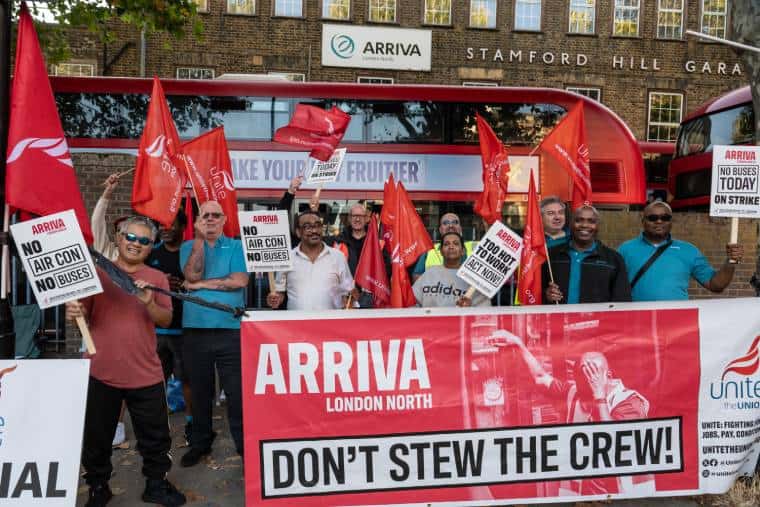
Bus workers rejected an offer and came back out