Solidarity on the mass picket for the Birmingham bin strike
Birmingham bin strikers won an important victory on Friday morning. Workers and hundreds of supporters from across Britain shut down all three depots—Perry Barr, Pershore Street and Atlas.
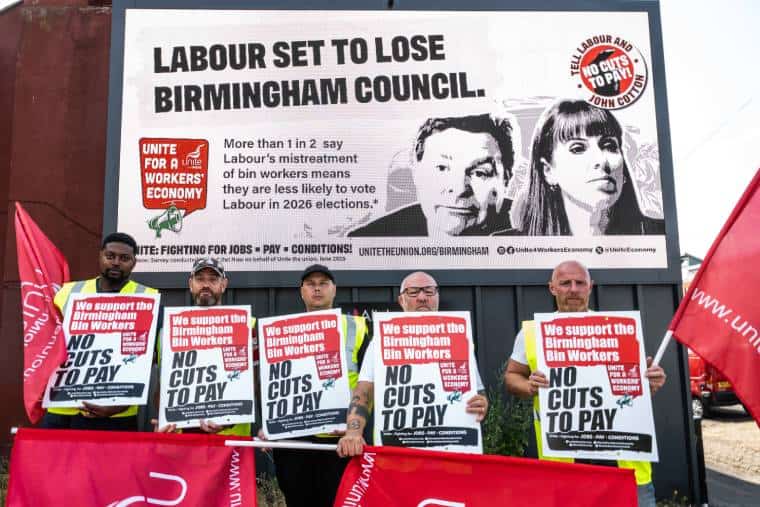
The Labour-run council in Birmingham has been on the front foot in its war on the Unite union members. They have been on indefinite strike since March to stop a pay cut of up to £8,000 a year.
Bosses withdrew from negotiations with Unite and threatened to sack 130 workers—and used a court order against picketing.
But the day of mega pickets, organised by Strike Map and others, showed that workers, and the trade union movement, could turn the tide.
Picket lines at the three depots were supposed to start at 6am. But at the 11th hour, the council told scab workers to get to Perry Barr and Pershore Street at 4am—to beat the pickets.
But by 4am, trade unionists were blocking scab lorries from leaving Pershore Street and Perry Barr. Arguments broke out between scabs and strikers and supporters, but the pickets stood firm.
A few scab lorries left both depots very early on, but trade unionists blocked the entrances very quickly after.
And activists shut down the scab site in nearby Coventry—meaning that Birmingham’s strike-breaking operation ground to a halt for the day.
Outside Pershore Street, striker Steve told Socialist Worker, “This is important because there are a lot of people losing a lot of money.
“It’s also really important that it’s here, because Pershore Street is the only yard that hasn’t been shut down before.”
Steve said that the mega picket was “extremely effective”. “We’re all behind this. We can win this if we dig our heels in,” he said.
By 6am, hundreds of workers and supporters had rallied outside Atlas. At one point, some activists broke from the main picket line to block an exit that was reportedly going to be used as a back-up.
“This is what solidarity looks like,” one activist told Socialist Worker. “The council is doing its best to shut the strike down. But when we do this, it shows the council and Labour that the workers won’t roll over.”
No scab lorries even tried to leave Atlas. “If we win this, it’s good for everyone,” striker Darren told Socialist Worker at the depot.
“Other people can learn from this. It shows people the way forward, that they don’t have to put up with the attacks.”

At Perry Barr, two lorries managed to leave early in the morning, but all others were blocked. At around 6.30am, the police descended. They tried to break up the picket line, demanding that the trucks go through.
Jae Robinson, a Unite Community member, was outside Pershore Street. She told Socialist Worker, “This destruction of workers’ livelihoods cannot happen—after the bin workers, who’s next?
“They cut money so they can spend it on weapons to murder people in the US’s proxy wars. They grab, grab, grab. Dump the cuts, dump the councillors.”
Jeremy Corbyn visited all three depots, the day after he and Zarah Sultana announced plans to set up a new left party. He said, “The financial problems of Birmingham are in no way the responsibility of the bin workers.
“Me and my colleagues will continue to raise this in parliament, but it’s more important to raise it outside as well.”
Corbyn warned, “Don’t think this is unique to Birmingham. If they get away with this massive wage cut in Birmingham, don’t think that it won’t be a London borough or Manchester next.”
Corbyn slammed the Labour government’s betrayals, saying, “90 percent of the choices made in the last year have been the wrong choices.
“We’re working hard on supporting people in a grassroots, community-based organisation that brings together trade unions and community groups. It’s already 190,000 strong—it’s yourparty.uk.”
Ayoub Khan, the Independent MP for Birmingham Perry Barr, visited the picket lines. He had previously asked Labour if the army could be used to “assist the local charities and organisations” to clear the backlog—strike-breaking.

Trade unionists had come to show solidarity in the sharpest industrial dispute facing the Labour government. NEU, PCS, UVW, FBU and Unison union members all had delegations there.
The IWGB union also sent a delegation. One member outside Pershore Street, told Socialist Worker, “This is history—it’s an opportunity for unions around Britain to show what they can do, to show what workers can do.
Laura, another IWGB member, told Socialist Worker, “We need to build solidarity during a running dispute. It’s looked quite bleak for quite a long time. But workers are coming back with strength, and this is a big part of that.”
Striking doctors from the BMA union came to show their support—on the first day of their five-day strike. Emma Runswick, BMA deputy chair and doctor, told the Pershore Street picket line, “Although we have very different jobs, we are in the same struggle.
“We’re talking about the same struggle against the Labour Party. They could pay us what we are worth. They choose instead to run us down, to ‘break the union’ in health secretary Wes Streeting’s words. Where is the labour in the Labour Party?
“We are in the same class—the working class. That means we need to stand together—today, and forever.”
Another health worker, Jordan Rivera from NHS Workers Say No and Unison, was at the Atlas picket line. She said, “A council is trying to make workers pay for mistakes that have nothing to do with them.
“We’re disgusted that a man in charge of the health service can openly receive donations from private healthcare companies—it’s a blatant conflict of interest.”
Jordan added, “It’s a disgrace that key workers need to defend themselves like this under a Labour government.
“Labour is an utter disappointment. It should be supporting workers, not feeding racism, attacking disabled people and supporting genocide.”
Joel Mayfield echoed Jordan’s hatred of Labour. He’d come from the Veolia refuse strike in Sheffield, where workers have been all-out for nearly 11 months in their fight for union recognition.
They held their own mega picket earlier this month—inspired by the first mega picket in Birmingham in May. Joel slammed the Labour government as “scab-loving, back-stabbing strike-breakers”.
A hatred of Labour and how it has tried to break the strike ran through the second mega picket in Birmingham on Friday. The Labour-run council has used the police, emergency powers and a court injunction in its efforts to run a scab operation.
Unite leaders haven’t called on workers to defy the injunction and relied on legal challenges.
But, once again, the mega picket showed that workers and trade unionists have power to defeat Labour’s attacks in the city. Solidarity and mass pickets that stop scabs are workers’ most powerful tools.


Bus workers rejected an offer and came back out
New report demolishes fossil fuel industry lies