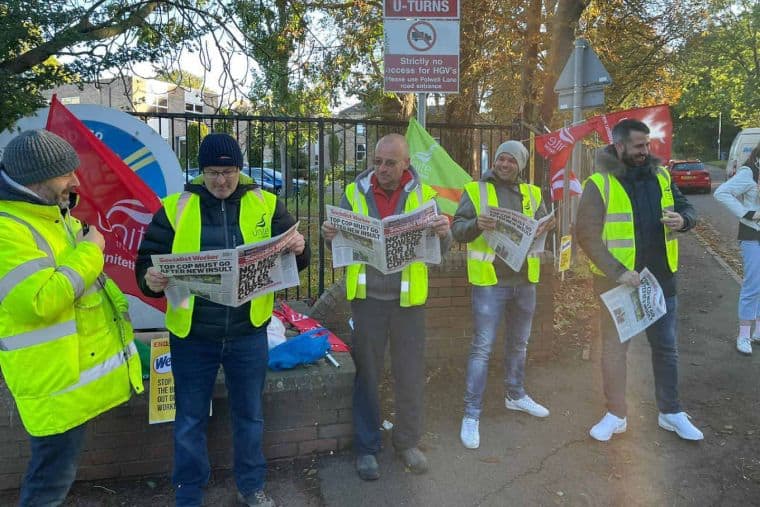
Revolutionaries get involved in struggle and use our paper to argue for our ideas
The far left is sectarian—at least that’s a claim made by those who want to drop their principles to cosy up to more moderate figures. They accuse revolutionary socialists of insisting on “sectarian purity politics”.
But is it really “sectarian” to show up at demonstrations and sell Socialist Worker? Or to insist on principled support for trans+ rights? Or to oppose migration controls?
Back in the early 19th century, there were socialists who developed grand theories while shunning working class people and their movements. They believed an enlightened few should hand socialist ideas down to the masses.
That is why Karl Marx and Frederick Engels argued in The Communist Manifesto that socialists should “not set up any sectarian principles of their own, by which to shape and mould the proletarian movement”. They insisted that socialists must be part of working class struggles.
Marx wrote, “The sect sees the justification for its existence and its point of honour not in what it has in common with the class movement but in the particular shibboleth which distinguishes it from the movement.”
Finding common ground doesn’t mean burying political differences. It means uniting with people despite political differences in the interest of building a movement.
Some organisations use the language of Marxism and revolution. But they do nothing but criticise actual social movements.
These sectarians place excessive emphasis on propaganda. They only turn up to demonstrations to give lectures about some abstract idea of revolution.
As Leon Trotsky explained, “The sectarian looks upon life as a great school with himself as a teacher there. Though he may swear by Marxism in every sentence, the sectarian is the direct negation of dialectical materialism, which takes experience as its point of departure.
“To a Marxist, discussion is an important but functional instrument of the class struggle. To the sectarian, discussion is a goal in itself.
“However, the more he discusses, the more the actual tasks escape him.”
Despite Trotsky’s own views, there has been a genuine problem of sectarianism in the Trotskyist movement. The old Monty Python joke about the People’s Front of Judea, who bitterly oppose the splitters of the Judean People’s Front, has some basis in reality.
Trotskyist organisations have a history of doctrinaire squabbling because they were small and largely isolated from mass workers’ movements. Larger, more influential Communist parties sought to destroy all Trotskyist opposition.
Isolation pushed Trotskyists to turn inward—transforming Trotsky’s legacy into a rigid dogma. If the dogma becomes the most important thing, the logic is to split over interpretations of that dogma.
Real involvement in workers’ movements is the antidote to this. It allows ideas to be tested in practice, rather than through abstract debate.
There is a world of difference between sectarianism and principled revolutionary organisation.
Marx and Engels directed socialism towards a fusion with the working class movement. That meant immersing a party in strikes and protest movements while maintaining revolutionary politics and solidarity with the oppressed.
Some people accuse the Socialist Workers Party of being sectarian because we build our party as we build movements and campaigns.
If you believe that your organisation has the politics capable of deepening and strengthening the movement, then it is natural that you argue for those ideas.
And if you are confident your party can link struggles together effectively and generalise the best experiences, then you want to recruit people.
Sectarians put the interests of their party before the interests of the movement and the class. They abstain from movements and spend all their energy on building their own organisations.
Real socialism depends on building the movement and the party together, and enriching theory through practice.


Even the most perfect meritocratic society would be unequal
A system that lasted for hundreds of years
Socialism is a broad term, but communism is something different