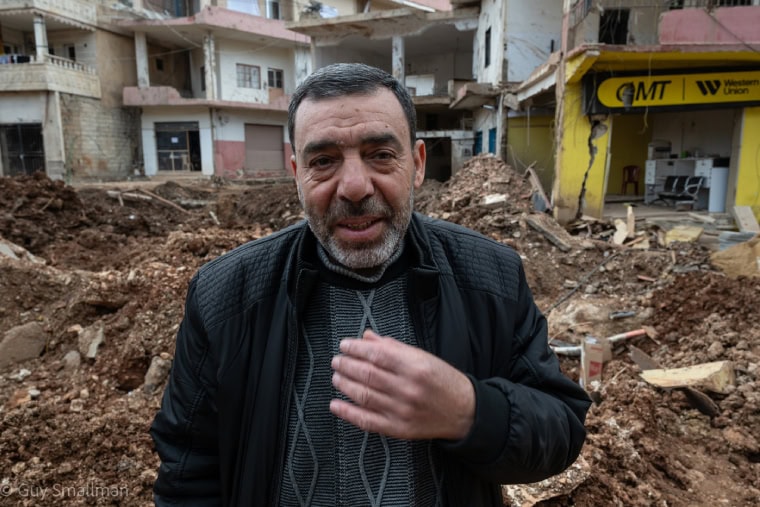
Mayor Sayyed Hani el Moussawi stands amid the wreckage of Nabi Chit (Picture: Guy Smallman)
Nabi Chit, a small town in eastern Lebanon nestled in the fertile Bekaa Valley, has a long history of resistance. It is the birthplace of former Hezbollah secretary general Abbas al-Musawi—assassinated by the Israelis in 1992—and his shrine greeted us as we entered from the main road.
Israel has repeatedly targeted the village which hosted a resistance radio station, the Voice of the Oppressed. In 1998 it targeted the station radio mast, but hit a home, killing a mother and six of her children.
Late last year, the Israelis struck again, this time claiming to hit a resistance weapons factory.
But the deadliest raid began on 6 March. Israeli commandos, many disguised as Lebanese soldiers and Hezbollah medics, stormed into the village on the pretext of hunting for the remains of Ron Arad. He was an Israeli pilot killed in Israel’s 1982 war on Lebanon.
As we arrived in the town square bulldozers were filling in a giant crater as workers reconnected the drainage pipes exposed below. Twenty feet above a worker was busy reconnecting power lines that had been destroyed by the blast.
The bomb had been big enough to blow cars and vans onto the roofs of nearby three-story buildings. It had been the murderous centre piece of a deadly raid.
Wreckage of Nabi Chit (Photo: Guy Smallman)
One of the engineers proudly told us how quickly and efficiently the efforts to repair the town were going after the devastating strike. Here, this work is considered to be act of resistance.
Mayor Sayyed Hani el Moussawi spoke to Socialist Worker about the raid and how the village rose to fight off the Israelis.
On 6 March, “The Israelis warned Nabi Chit and neighbouring villages to evacuate by noon,” he said. “We took this very seriously, as we know when Israelis attack, they will spare no one, not women nor children.
“At the time, we were fasting for the holy month of Ramadan. That afternoon, the airstrikes began, intensifying as sunset approached. We noticed that the targets were random. By 8 pm, Israeli commandos began to infiltrate through the nearby Syrian border, some two kilometres to the east.
“We heard rumours that the enemy was planning to attack the village and began to take precautions. We later discovered that the enemy used airstrikes as cover for a raid on the cemetery, where they believe Ron Aran’s remains are interred.
“His remains are not here—they have never been here. We have no idea where they are.”
According to the mayor, the Israeli raid failed in its mission. Despite their massive firepower, they were forced into a hasty retreat. “We discovered that the Israelis had broken through the cemetery wall and had begun to dig up graves,” he continued.
“Until this time, local resistance fighters had been taking shelter from the airstrikes.
“But once we discovered that the Israelis were in the village, the fighters appeared and fought an epic gun battle.
“The Israelis made a hasty retreat under the cover of airstrikes. Some 40 to 50 airstrikes hit the village and surrounding roads. They fired artillery, dropped bombs, used helicopter gunships and quad-drones.
“The bombardment was random, targeting not only Nabi Chit but also the surrounding villages. Some 26 civilians were killed in the bombardments—that number rises to 36 if you include the surrounding villages.
“An elderly civilian, Abu Ali Hussein Shokr and 11 members of his family were martyred in one of the strikes. Unfortunately, the family home was near the cemetery and received a direct hit.
“Once the battle began, villages across the area joined in, firing into the air in an attempt to drive off the drones and helicopter gunships.
“The village suffered heavy damage in the battle. There are huge craters in the centre of the village.
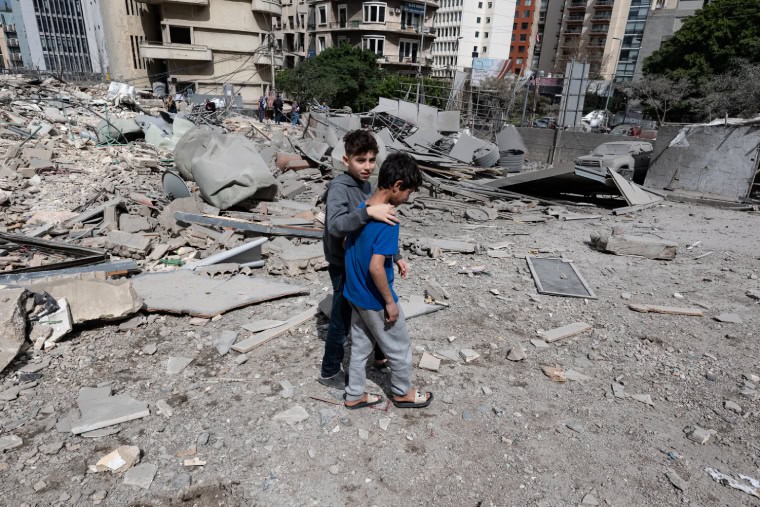
“The West must understand that resistance is our right, as it was the right of the French to resist the Nazi occupation or the Vietnamese to resist the American occupation.”
We were then shown more destroyed buildings around the town—all of them residential. Local men who were involved in the clean-up spoke of their anger that the attack had clearly come from across the Syrian border a few miles away.
Syria’s new president Ahmed al-Sharaa, who led the armed Islamist group HTS, became an ally of the West. He has joined the call for the Lebanese resistance led by Hezbollah to be disarmed.
But in recent days, he has distanced himself from Donald Trump’s increasingly disastrous war on Iran. Now, he is trying to prevent Syria from being drawn into the conflict, rejecting the use of Syrian territory for military operations.
He is the latest in a long line of regional allies to distance himself from Trump as the US-Israeli war becomes increasingly chaotic and unwinnable.


Fascist Tommy Robinson didn’t receive the same treatment
Russia has threatened revenge after British-made drones targeted its oil refineries and transport networks
Progressive candidate has won primary in Republican dominated state
Rank-and-file rebellion secures pay rise