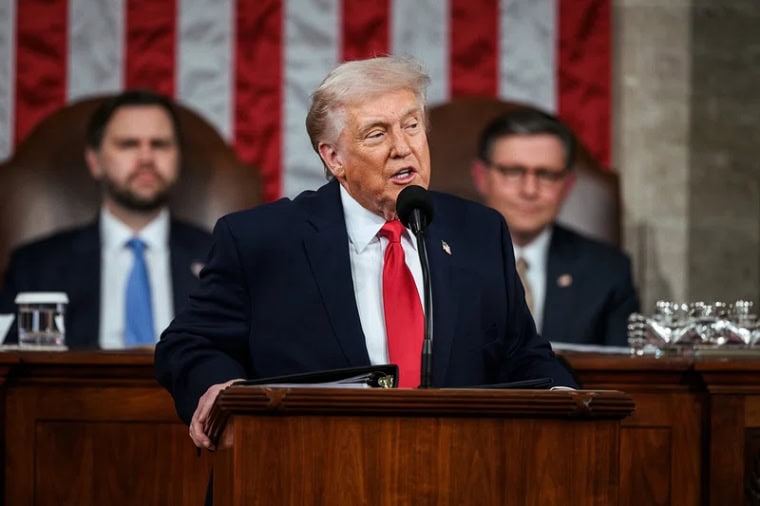
Donald Trump continues to “drill baby drill” in the United States (Photo: WikipediaCommons)
When we think about where fuel and power come from, the idea of an “energy transition” has entered the popular imagination.
It tells us that we used to burn wood, then coal, then there was an age of oil and soon we will be in a new age of renewables.
It is a comforting story that tells us that technology will free the world from reliance on the planet‑wrecking fuels of the past.
Iran’s near closure of the Strait of Hormuz has exposed how fragile these claims are and how central oil still is to the global economy.
There hasn’t been a smooth global transition away from oil. Instead oil use has become foundational in many areas of the economy including agriculture, construction and transport.
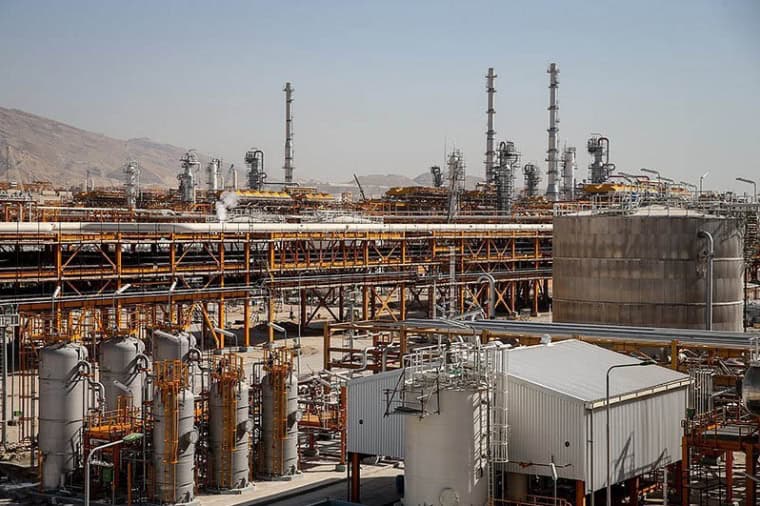
During the past two decades, the Gulf states have diversified to produce petroleum products, including plastics. Sulphur is a by-product of the oil industry.
It is critical to producing fertilisers, metals and semiconductors. The supply of sulphur is also threatened by the closure of the Strait of Hormuz.
The head of the International Energy Agency, Fatih Birol, has said that leaders of the West didn’t fully understand the importance of the Strait of Hormuz when they launched their assault on Iran.
He warned that the fallout from the war could be worse than the combined effect of the 1973 and 1979 oil shocks and the gas crisis sparked by Russia’s invasion of Ukraine in 2022.
It has taken more oil and gas out of circulation than these events put together.
The black rain that fell on Tehran after Israeli warplanes set fire to two oil depots in early March is a human and environmental catastrophe.
In turn, Iran has attacked Bahrain’s one oil refinery and the world’s largest natural gas export plant in Qatar.
Donald Trump has been desperate to re-open the strait to global shipping. He even threatened to “obliterate” Iran’s energy infrastructure if it failed to cooperate, before backing down.
About 20 percent of the world’s oil supplies—equating to a quarter of the maritime oil—passes through the Strait of Hormuz. Most of it comes from just five countries—Saudi Arabia (37 percent of the total), Iraq (23 percent), the United Arab Emirates (UAE) (13 percent), Iran (11 percent) and Kuwait (10 percent).
Most of this oil goes to China, India and other Asian countries. A small proportion, just 2.5 percent, is exported to the US. Saudi Arabia sends its oil to a range of destinations, including to other Gulf states.
But up to 90 percent of Iran’s oil goes to China. It’s an arrangement that avoids Western sanctions on Iran and gives China a discounted price.
In the book Crude Capitalism, Adam Hanieh explains how the Gulf states came to be so powerful and why these states continue to play an outsized role in the supply of oil.
After the Second World War, there was a global expansion in the use of oil. The Gulf states were crucial to that.
Saudi Arabia worked with the US to drill for oil in the desert in the 1930s as the Standard Oil Company of California forged a deal with the Saudi state, creating the subsidiary California Arabian Standard Oil Company.
After oil started flowing from the Dammam No 7 well—appropriately known as the Prosperity Well—production rapidly expanded.
Saudi Arabia controls the world’s largest offshore oil field, the Safaniya Oil Field.
But the Gulf states are not just unique because they have a large supply of oil. Hanieh cautions against treating the Gulf states merely as a “giant oil spigot” without considering the distinctive nature of these societies.
The six Gulf states of Saudi Arabia, UAE, Bahrain, Kuwait, Oman and Qatar are monarchies where the royal families intervene in the economy through their various business interests.
Glittering cities such as Dubai and Abu Dhabi are built by an army of migrant workers who can be deported if they try to organise.
In the 1970s, the Saudi government increased its share of ownership in Aramco—Arabian American Oil Company— turning it into a fully state-owned enterprise by 1980. This was part of a wave of nationalisation of oil in the Gulf.
The Gulf states established Opec, the Organisation of the Petroleum Exporting Countries, in 1960, with Saudi Arabia as the leading player.
When the Iranian leader Mohammad Mosaddegh nationalised oil, it was a threat to Western power in the region.
Britain and the US backed a coup against him in 1953.
By contrast, the Saudi form of the state managed capitalism suited Western interests. The world’s biggest superpower cultivated a close relationship with the monarchy of Saudi Arabia.
The US promised to ensure the regime’s survival, at a time when monarchies and dictatorships across the region were being toppled.
In exchange, Saudi Arabia and the other Gulf states agreed to price oil in the US dollar. This helps ensure the continued power of the US. Countries around the world have an advantage if they hold reserves in dollars. It also means that the US is able to throw its political weight around by imposing sanctions.
Hanieh underlines that the national oil companies (Nocs), have grown to become vast behemoths.
Saudi Aramco is easily the world’s biggest oil company in the world. Its profits last year exceeded the combined profits of the biggest five Western private sector firms, including Shell, ExxonMobil and Chevron.
The central role of oil in the global economy has enabled these companies to make phenomenal profits.
But this doesn’t mean energy use has “transitioned” away from older sources like coal.
In the book More and More and More, Jean-Baptiste Fressoz demolishes the reformist concept of an energy transition.
He points out that a third of the world’s population is still reliant on wood for heating.
Neither is coal an energy source of the past. Coal consumption in China has increased by ten times since 1980. China has increasingly turned to hydro-electric and wind power. But the renewables boom hasn’t replaced its use of fossil fuels. It has merely contributed to a dramatic increase in the overall amount of energy generated,
Different sources of energy are also entangled with each other. For example, the availability of oil has expanded access to coal. At its height in the 2000s, strip mining in the US used millions of tonnes of ammonium nitrate and petrol each year to blast coal out of the ground.
Wherever there is oil, US bombs seem to follow. But this doesn’t mean the US is simply scouring the globe to secure oil for itself.
According to the US Energy Information Agency, domestic production overtook consumption in 2019. The US is still hooked on fossil fuels, with record levels of domestic crude oil production as well as gas from fracking.
Managers of US oil refineries do desire Venezuela’s supply of heavy crude oil. But Iran’s oil is of less interest.
Instead, as Hanieh argues, the US strategy is about controlling the flow of resources to its rivals, primarily China. Trump combines this with a “drill, baby, drill” approach at home.
If China is able to source alternative supplies of fuel, this could be a huge miscalculation for Trump. There are occasional reports of Chinese owned ships passing through the Strait of Hormuz.
The liquefied petroleum carrier Lucky Gas navigated the passage last month.
But China could still suffer from a closure of the strait and from rising prices.
Under capitalism there are no good options. Slowing down the supply of oil may raise the profits of US businesses. But skyrocketing fuel prices will cause more pain for working class people globally.
In the Philippines there is a national emergency driven by the fuel supply crisis.
Vegetable farmers have stopped planting their crops and drivers have seen their wages plummet.
In Sri Lanka, the state has introduced fuel rationing and a four-day week.
On the other hand, starting the oil flowing again would also be catastrophic.
A study in 2021 put things in very concrete terms. Two thirds of the Middle East’s oil should stay in the ground if we want to try to avoid heating the planet above 1.5 degrees.
Some of the deepest impacts will be felt in the region itself, where war and climate breakdown are already placing strain on access to drinking water. In Britain, entrenching fossil fuels further is being proposed as a solution.
The offshore energy industry is using the war to try to pressure the Labour government to look again at drilling for oil and gas in the North Sea.
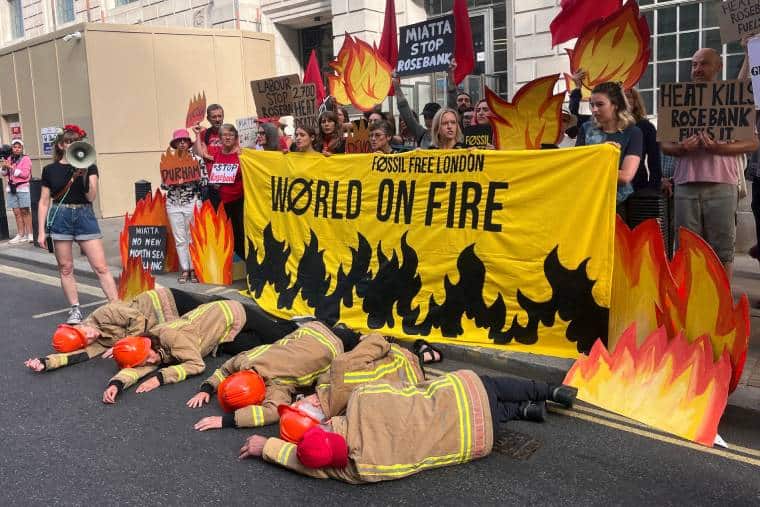
Capitalism is driving us to disaster. We can’t rely on it peacefully transitioning away from oil. Instead it will take a movement with workers at the core of it to shut down the fossil fuel machine.


New report demolishes fossil fuel industry lies
Thousands of residents in London have been without water for months
The climate crisis is impossible to ignore