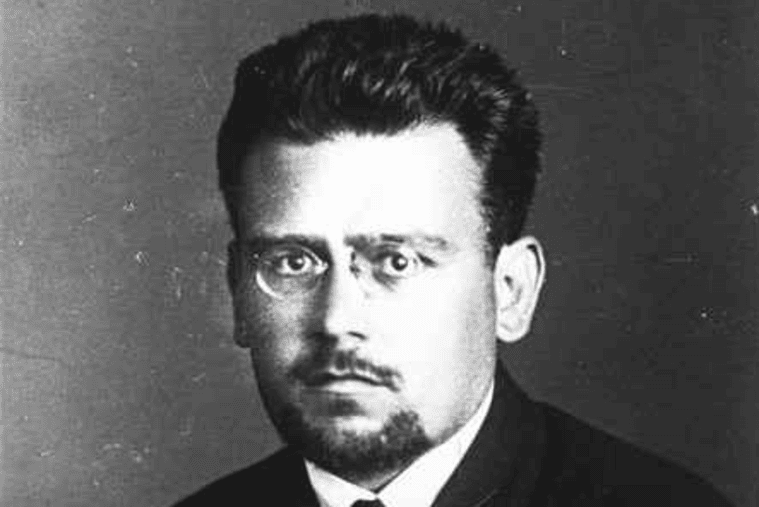
Amadeo Bordiga, ultra-left Italian Communist (Photo: Wikimedia Commons)
Revolutionary socialists are often accused of being “ultra-left”.
Labour Party loyalists have used the accusation to smear socialists organising outside parliament. And trade union leaders have undermined militants by denouncing them as ultra-left.
But the idea of ultra-leftism began with the revolutionary Vladimir Lenin—someone Labour MPs and union bureaucrats would definitely dismiss as ultra-left.
For Lenin, being ultra-left didn’t just mean being really radical—it meant being cut off from the working class.
Revolutionary socialists will always be a minority within the working class movement this side of a revolution.
The majority of workers accept aspects of capitalist ideology and “reformism”—that they can win changes within the present system but can’t get rid of it entirely.
But struggle can radicalise people and build the self‑confidence and organisation of the class into a wider challenge to the system and state.
To achieve this, we have to maintain a firm adherence to Marxist principles alongside the closest possible links with the broader workers’ movement.
Revolutionaries must be more politically advanced than most workers. They must challenge all bigotry, illusions in reformist leaders and general passivity.
But we must not be so far ahead that we become isolated from the best militants.
Take the need to build strikes over Donald Trump’s war and rising inflation. It’s no good just raising the slogan “general strike now” when that seems leaps ahead of what’s possible for most workers.
But nor should we march at the pace of the slowest sections of the movement, or be afraid of putting arguments that don’t immediately win a majority.
We have to put an argument for strikes that goes beyond what the union leaders say and connects with the best militants. It’s a constant balancing act—what’s ultra-left one day can be conservative the next, for example.
The most significant examples of ultra-leftism developed in the wake of the Russian Revolution of 1917.
Millions of workers embraced revolutionary politics, but millions more still looked to reformist leaders.
Revolutionaries set up an international organisation, the Comintern. Within it were several influential ultra-left groups and leaders, including the Italian Amadeo Bordiga and Sylvia Pankhurst.
They were against working in trade unions and they refused to participate in elections. They were convinced that the majority of the working class shared their revolutionary ideas.
Lenin challenged them in his Left Wing Communism—An Infantile Disorder. “Whilst you lack the strength to do away with bourgeois parliaments you must work within them,” he argued.
Lenin’s arguments carried the day and the positions of the “Left” Communists were rejected by the Comintern. The Comintern adopted the united front, which meant uniting in action with reformists, while arguing for revolutionary politics.But a new form of ultra‑leftism developed as Joseph Stalin consolidated his power.
Communist parties were ordered to reject united action against the Nazis—reformists were dubbed “social fascists”. Communists were told to split from the trade unions to form “red” trade unions.
Stalin then shifted towards the Popular Front—alliances between Communists, Social Democrats and liberal capitalist parties. In practice, it meant subordinating socialist politics to keep the most right wing elements on board.
In June 1936, a Popular Front government was elected in France which raised workers’ expectations.
The leaders of the trade unions and left parties derailed workers’ strikes to prop up the Popular Front. The Communists denounced those who opposed them as “ultra-left”.
Today, there is a low level of class confidence and that creates challenges.
For now, our task is winning a militant minority to struggle and to socialist politics. But that is linked to building a bigger organisation that appeals to and influences millions of workers.


Even the most perfect meritocratic society would be unequal
A system that lasted for hundreds of years
Socialism is a broad term, but communism is something different