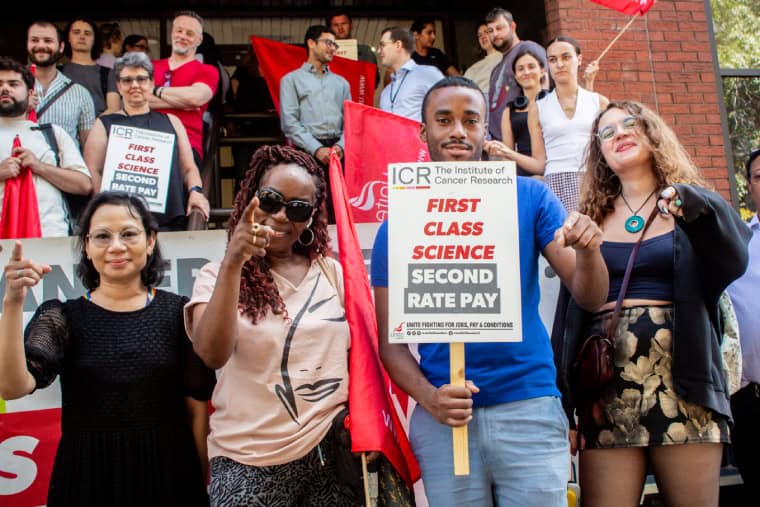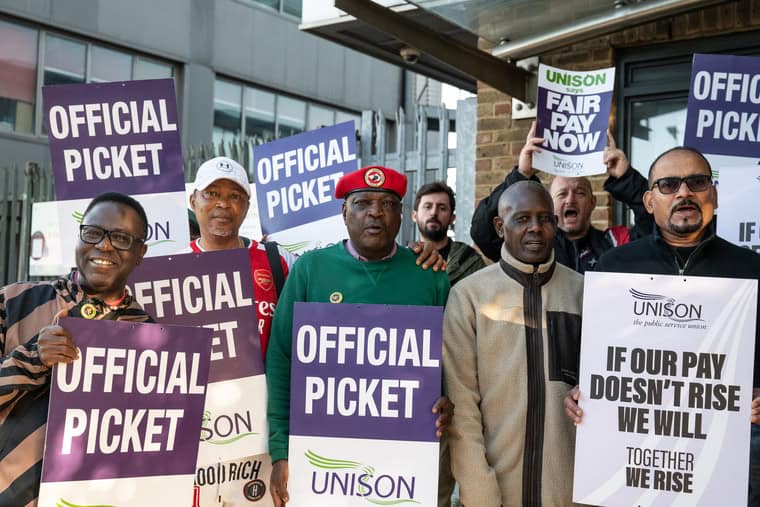
‘We want Camden council to know that we mean business’ (Photo: Guy Smallman)
Camden, in north London, with its famous clubs and vibrant music scene, is a playground for tourists.
However, for striking traffic wardens, this labyrinth of crowded restaurants and dive bars is a world completely beyond their reach due to low pay and long hours.
These predominantly black and migrant workers, who patrol our streets whether it’s lashing it down or scorching hot, are in the midst of what is shaping up to be a defining fightback against outsourcing.
Jane, one of dozens of traffic wardens embarking on eight weeks of strikes across the borough, told Socialist Worker that she works 42.5 hours a week. “It’s almost a full day more each week than council workers,” she said. She currently receive just 20 days of annual leave—the statutory minimum.
Camden alone experiences footfall of over 30 million people every year. Without the traffic wardens, the city would be gridlocked.
The Unison union members are employed by private contractor NSL, part of Marston Holdings, rather than Camden Council itself. They are demanding a £2 an hour pay rise, seven extra days of annual leave and sick pay from day one.
“We are met with hostility on a daily basis as part of our job,” Jane told Socialist Worker.
“There have been cases when we’ve been physically attacked, and verbal abuse is the norm. That’s our reality.”
“We only report when it happens about ten percent of the time because it happens so often.
“Otherwise, we’d be forever in the office writing reports and we’d never be working. And they know that, because we’ve told them about the abuse.
“The company do nothing about it. They send us out all by ourselves. The police go out in twos, but we go out by ourselves.”
The traffic wardens are completely excluded from their own local life by low pay and little respite from a gruelling schedule.
Jane told Socialist Worker that the most recent pay offer from NSL was simply not good enough. Unison members overwhelmingly rejected it at a mass meeting last week.
“The pay rise they’ve been offered is linked to RPI, but it’s a real terms wage cut for us because we live in London”, she said. “It’s covering nothing.”
The traffic wardens struck for better wages in 2023 and won an 18.1 percent pay increase after moving to an indefinite strike. After 56 days, NSL was forced to improve on its initial pay offer of just 57p an hour.

It was a significant victory won through workers’ determination. However, Jane explained that pay has since been eroded by soaring inflation.
“Rent alone has just killed everything. So, the equivalent we’re on now is less than when we went on strike before.”
“Bills have just gone through the roof. And our wage is just not keeping up. Everyone’s skint. We shouldn’t be skint, not with these hours.
“We’re the ones out there earning the money. It’s disgusting and we’ve had enough.”
NSL’s parent company Marston Holdings has a contract with Camden Council worth around £100 million.
“Marston Holdings is a massive company. They are loaded because, quite frankly, they’re nasty. The company makes its money sending bailiffs to collect unpaid debts for people.
“They’ve added an extra day to our week, they’ve taken seven days of our holiday. They’ve taken three days of our sick pay,” she said. “We need sick pay from day one.
“We work outside in all weathers and we’re exposed to everybody so of course we are prone to getting sick.
“We worked through Covid-19 and all of us came down with it multiple times because we were working with the public. But then we were being penalised for being ill. It’s not fair. It’s never been fair.”
She added, “Time is the most important asset anyone’s got. And they’re absolutely stealing it from us.”
The dispute exposes a wider problem with the way local councils run public services.
Jane explained that the Labour‑run Camden council had the opportunity in January to take this contract in house. But it didn’t. Instead, the council extended the contract until 2030.
Traffic wardens will have to fight a separate employer for conditions that other council employees already enjoy.
“If we’d been in-sourced we’d have the holiday, we’d have the sick pay, we’d have the pension. And our hours would only be about 36 hours a week for the same sort of money,” said Jane.
Labour promised to deliver “the biggest wave of in-sourcing of public services in a generation”. But outsourcing remains widespread in its own constituencies.
Spending on private contractors for key public services has doubled since Labour took office under Keir Starmer, who was then MP for Camden’s
Holborn and St Pancras constituency. The RMT and Unison unions found that outsourcing costs across essential sectors reached £6.2 billion in 2025, compared with £3.5 billion in 2024.
“Insource Now” is a new joint campaign between the two unions.
It aims to put pressure on Burnham’s government to end decades of outsourcing with disastrous consequences for workers.
“As far as I’m concerned, Labour are a bunch of hypocrites,” said Jane.
“The MP for Camden was prime minister when they signed the new contract with NSL for four years. Now, we’re stuck with them.
“I’ve been a Labour supporter all my life because I’m a working person. But from how they’ve chosen to run the council, I feel that they’ve sold us out,” she said.
The traffic wardens brought their fight directly to Camden council, with workers from all three picket lines rallying at the council headquarters on Thursday.
Strikers told Socialist Worker that the council must answer for why workers delivering a public service are employed by a private company that treats them worse than the council’s own workforce.
“Camden council has given the running of this service to NSL so that they can cut their costs,” said striker Joel from outside the council headquarters.
“We’re here to make noise to make sure that Camden residents know that the council has knowingly put us in this position by choosing to contract us out to this private company which rips up our terms and conditions.
“We want Camden council to know that we mean business.”
He added, “This service is one of the only profitable services in the council. But none of that is being reinvested back into the workers or the running of the council services.
“That’s money that could be put into libraries, schools and wage rises for other workers. It’s all going to the private company. That has to end.”
Joel emphasised that the upcoming Holborn and St Pancras by-election taking place this Thursday is a chance for strikers to force candidates to commit to being on the side of working people, not big business.
“Whoever is elected in the by-election, we want them to consider the welfare of the workers,” he said.
“The council cannot wash its hands and pretend that this dispute has nothing to do with it. And neither can the politicians.
“Workers are very important to society and therefore we need a good wage for ourselves. “We all have families and children to look after.”
The Camden council leader, Sagal Abdi-Wali, is running for Labour in the by-election.
She was leader when the council renewed the contract with NSL, choosing to side with private companies that care more about profits than people.
Yanis, another striker who attended the action outside the council building, told Socialist Worker that, by making that decision, Labour chose to maintain a “two-tier workforce”.
“All we want is for NSL to match what Camden offers to its own staff. Those it hires directly have much more than we do.
“We work a 42.5 hour week and people still have to take on overtime just to pay for the basic bills. The company pushes us down that road,” he said.
For too long, public services have been outsourced to private companies who make their money by driving down pay and conditions for workers and providing poor quality services to the public. “We need enough annual leave to recover, sick pay that allows us to stay home when we’re ill and wages that allow us to keep up with the cost of living,” said Yanis.
“We’re not going to stop until we win, for however long it takes.”
Camden traffic wardens are proving that no outsourced worker needs to accept this. Public sector workers have an interest in fighting for the insourcing of services so that money can be reinvested into the workforce and services as a whole.
Next week, traffic wardens will unite with other council workers who are also at the sharp end of the financial crisis facing Britain’s local authorities.
They will be joined by teaching assistants in two Camden schools who are fighting their own battle with Camden council over pay, as well as striking teachers in the NEU union.
Liz Wheatley, branch secretary of Camden Unison, told Socialist Worker, “Strikers from Camden across Unison and the NEU are keen to highlight their disputes and keep the pressure on the council to resolve them.
“But also, to receive and give solidarity to those who are fighting back—be it in their workplaces against the bosses, or on the streets against the far right.
“This will be an opportunity to bring people together to map out how people can fight and how we can win.”


Is patriarchy the road to women's liberation?
Plus: How socialists can mobilise large numbers of people
A necessary step towards working class power
Glasgow service users and workers speak out