Some 5 million people died from starvation due to Churchill’s inaction (Photo: WikipediaCommons)
The controversy over Winston Churchill’s role in the 1943 Bengal famine that killed more than 3 million people resurfaced last week.
Award winning artist Helen Cammock had an installation withdrawn from the National Portrait Gallery in London. This came after 59 lords signed a letter accusing her of vilifying Churchill’s memory by accusing him of deliberately starving Indians.
The lords ignored what Churchill’s friends thought and did at the time. In December 1942, the Viceroy of India warned London of an imminent famine.
In August 1943, secretary of state for India, Leo Amery, a close friend and ally of Churchill, asked for 5 million tons of grain for Bengal. In October 1943, new governor-general of India Archibald Wavell asked for 1.5 million tons.
Churchill turned all of these requests down.
As a result, between 800,000 and 5 million people died from starvation and diseases exacerbated by malnutrition.
This should not be surprising given Churchill’s opinion on Indians. He said that they were “the beastliest people in the world next to the Germans” and that Hindus in particular were “a foul race”.
Amery, even wrote in his diary, “I told Churchill that I didn’t see much difference between his outlook and Hitler’s”—who was Churchill’s friend at the time.
The Raj had done plenty of other things to bring about the famine. It created a disastrous rationing system that made each province into its own separate economy.
In early 1942, fearing a Japanese invasion the army destroyed all river transport in east Bengal. This meant that when relief supplies did arrive, there were no boats for distribution.
Churchill was at the top of this, and interfered in every aspect of the war. No matter how the lords wriggle, he was always responsible.
Barry Pavier, Bradford
The Belfast knife attack was a horrific act of violence, so were the race riots that soon followed.
I have noticed the knife attack being increasingly described as “barbaric” and “medieval”.
We must be clear that these are right wing dog-whistles used only to describe attacks when carried out by black or brown people.
They want to reinforce racist ideas of black and brown men, more specifically Muslim men, as inherently savage and violent.
Islam is often referred to by far right figures such as Nigel Farage as a backwards religion that is incompatible with so-called “British values”.
This was further reinforced by Reform UK member of the Senedd Joe Martin, who during a debate at the Welsh parliament, described an attack by a Sudanese person as “inevitable”.
Martin’s comments were met with walkouts by other Senedd members from Plaid Cymru, the Green Party and Labour.
We must challenge the continuous demonisation of migrants and take on Reform UK—who use their platform in the Senedd to spread hate and division.
Kwabena Devonish, Cardiff
Despite the rise of the far right with young people, an overwhelming majority of Gen Z agree that refugees are welcome.
We are witnessing the far right grow. But 60 percent of young people in Britain are anti racists, according to an Ipsos poll.
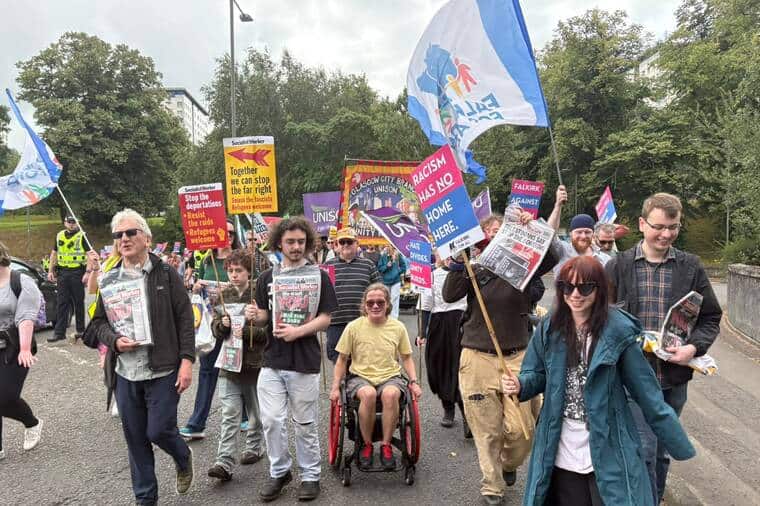
We witnessed this during the Together demonstration on the 28 March. 500,000 people took to the streets, many of them young, to say that we do not stand for racism.
Racism is a tool to divide workers and redirect people’s anger away from capitalism.
When solidarity emerges, racism is intensified to destroy it.
When the political climate is ripe for workers’ unity, the media will churn out racist scapegoating.
It is more crucial than ever that we stand against the far right’s bigotry because workers who cannot stand and fight together are unable to mount effective resistance. The cost of that failure is borne by all workers, no matter their race.
Rimaz Ahmed, east London
With all the hype around the Makerfield by-election one factor has been missed.
Wigan—which makes up part of Makerfield—has a reputation, originally built upon the coal mines, as a working class town.
Along with many other such towns it has lost out as the economic base of Britain moved from industry to finance.
The people of Makerfield at this by-election showed that they have not lost that working class spirit—which puts caring for one’s community at the centre.
Ralph Tebbutt, Medway


Plus: readers on union safebuarding and the Bayeux tapestry
Plus: Readers on the BBC platforming racists, Nathan Cofnas and Dolly Parton's reading programme
Plus: readers on Zionist football chants and the legacy of empire
Plus: readers on the far right in Scotland, The Odyssey and Jason Arday