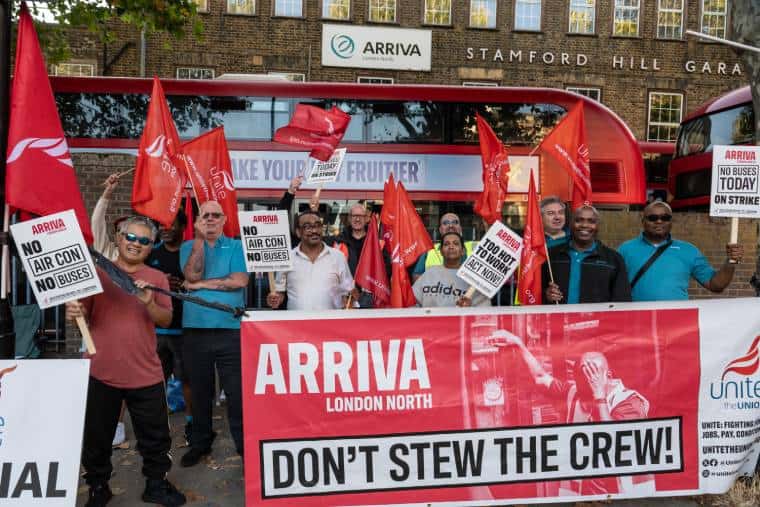
Unison members rally outside Islington town hall on IWD (Picture: Dave Gilchrist)
Workers and students defied Tory intimidation and staged occupations and protests on the Palestine day of action on Friday, International Women’s Day (IWD).
In Leeds, students went into occupation the day before—and remained in the Parkinson Building despite intimidation.
Police visited the occupation on Friday morning to tell the students to not “commit any criminal activity”.
“Campus security has also said it’s issuing a procedural eviction notice that it’s used in previous occupations. We’re expecting that today or tomorrow,” occupier Issy told Socialist Worker.
“We will be here until we think we’ve had sufficient acknowledgement of our demands by management—we’ve set the conditions.”
The students are demanding that the university openly acknowledges the genocide in Gaza, and divests from BAE Systems which it has on £8 million contract with.
Issy said, “It’s taken a few weeks to organise the occupation at this scale and we want it to be successful. We’ve had walkouts every week in support of Palestine. Last week we protested outside management’s building to get it to come down to accept our open letter. It refused—so now we’ve escalated.”
On Friday the students held workshops on the radical tradition of IWD, Islamophobia and racism and held a student meeting.
“On the first night there were 45 of us in here, and it’s an open space for people to come and go,” said Issy. “We organise designated roles for well-being, first aid and other things.
Issy’s advice to other students organising occupations is “go for it—it makes a huge point to universities that our voices cannot be ignored.”
At Goldsmiths university in south London, students put up banners across the front door of the Stuart Hall Building, reading, “Occupied”. Samira told Socialist Worker, “This building has been completely shut down, we’ve now taken the whole building.
“We also planned a big student meeting on Friday evening to discuss our next steps. And we will be discussing how to fight the cuts and 130 redundancies that the university is proposing.”
Students occupied part of the building on 20 February. After the students picketed, security began to lock rooms in the building and closed the café. “One lecture went ahead, but we disrupted it and asked why it was going ahead in an occupied building,” she said.
View this post on Instagram
Samira said it’s “great” that more students are occupying “but we need more action on campuses”. “This is the real tradition of International Women’s Day,” she said.
At Bristol University on Friday, students also took over the Victoria Rooms on campus.
“We had a big march beforehand and announced at the end that we’d be occupying,” student Aimee told Socialist Worker.
“This feels good,” Aimee said. “We’ve seen Goldsmiths and Leeds enter occupation. We attempted this a few weeks ago but we learnt from it and it gave us a confidence boost.
“This time we told people what we were doing and announced it on the march—we were more prepared too. We have a letter of demands and also a code of conduct for occupiers.”
Aimee added, “Bristol university is a top investor in arms companies, and we want it to divest. We’re making it clear that until our demands are met, we’ll be staying here. No one can make us leave.”
In Cambridge, around 100 students and staff attended a lunchtime rally organised by the Cambridge UCU and NEU education union branches.
A Palestinian student spoke powerfully outside the main university admin offices.
She spoke of the struggles of women in Gaza, saying, “Women are forced to use scraps of tent fabric as protection when they have their period.”
School students walked out from Thomas Hardye school in Dorset—the most recent of several walkouts for Palestine.
They marched from their school through Dorchester to Shire Hall, where Martha Brown was tried in 1856 and sentenced to hang by a sexist court. Students chose the rallying point of Shire Hall as a symbol of struggles against social injustice.
Poppy, one of the student organisers, told the rally. “On International Women’s Day, it is important to recognise that women and children in Gaza are bearing the brunt of this conflict. Seventy percent of the thirty thousand people murdered have been women and children. Two mothers in Gaza are killed per hour.”
Naira, a school student from another Dorset school, told the rally she was in touch with Palestinian friends on the West Bank. “They are sending their thank yous and appreciation for what you have done today,” she said. “You have personal thanks from people who are living under occupation.”
Around 70 students in Oxford walked out in rage against Israel’s genocide in Gaza. A member of the Oxford Palestine Society said, “The students of Oxford stand with Palestine. On IWD we stand with tens of thousands of women and girls who have been killed.
“We stand with the pregnant women without health services, without hospitals and without homes. These things are the direct result of Israeli bombardment.”
Around 60 people then participated in a trade union and student rally. The rally was led by women activists who spoke about the experience of women in Gaza.
Julie Simmons from Oxford Stop The War Coalition spoke on the importance of the day of action. “Every segment of our city is standing together on International Women’s Day to stand arm in arm with the women, children and men of Palestine,” she said.
A large school in Hackney, east London, hosted a Palestine solidarity lunch, with 24 people in attendance. Anna, a teacher who attended the lunch, told Socialist Worker, “There was a presentation about the genocide and a seven-minute video made by a Palestine academic about what’s happening in Palestine and the violence women are facing in Gaza.
“It was so powerful. We then discussed what to do. We unanimously voted to walk out at lunchtime if or when Israel invades Rafah.”
Around 50 pro-Palestine activists protested outside Tower Hamlets town hall in east London. Teachers from Swanlea school and health workers from the Royal London and Barts hospitals joined in support.
They protested in solidarity with Palestinian women and leafletted for Saturday’s national demonstration.

Palestine Action spray-painted and slashed a historic painting of Lord Balfour in Trinity College, University of Cambridge. His 1917 Balfour Declaration began the ethnic cleansing of Palestine by promising the land away to the Zionist movement.
Around 30 people campaigned outside of Portsmouth council offices, with adult social care, children service and housing workers. Workers from other central workplaces also joined.
Over 30 joined a protest at Elephant and Castle in south London for Palestinian women. UAL university workers, students and Unite union members all came out.
Around 30 students and staff joined a protest at the main entrance of Imperial College London. The speeches, mainly by women, talked of the need to fight all forms of oppression.
Around 25 activists protested at lunchtime outside St George’s hospital in Tooting, south London, where the mood was positive.
The protest comes after St George’s healthcare workers hosted a talk on the impact of Israel’s war on healthcare on Wednesday. Almost 90 people attended the talk, and two doctors who had spent time in Gaza provided testimonies.
Nearly 20 staff at Merton FE college protested in solidarity with people in Gaza.
Rolf Fruin, a member of UCU, told Socialist Worker, “We won’t be stopped by management’s attempt to hold us back. We’ll approach neighbouring workplaces to make local action bigger on our next national day of action.”
Around 20 people participated in a lunchtime walkout at St Thomas’ hospital, London. There were powerful testimonies read out from women and healthcare workers in Gaza—the mood was reflective but defiant.
And around 20 NHS workers held a vigil outside Warneford Hospital in Oxford in memory of all of the murdered Palestinian health workers.
Some 15 Unison union members protested outside the Hammersmith council building in west London.
Rana Aria told Socialist Worker, “We raised £100 in donation to Gaza and got lots of petitions signed by staff members and the public who support the call for a permanent ceasefire.”
At the Department of Energy Security and Net Zero in central London, 12 PCS union members leafletted their workplace. They stood outside the office in Whitehall in solidarity with Palestinian women to mark IWD.
Lewisham health workers in south east London organised a lunchtime leafleting for the national Palestine march on Saturday. Maggie, who organised the action, said, “I contacted junior doctors I’d met from the strikes from the other NHS trust.”
Health workers at Lewisham hospital building for @PSCupdates big national demonstration for Gaza in London tomorrow as part of @STWuk #IWD2024 day of action for Palestine 🇵🇸 pic.twitter.com/rtDBcQ9YXQ
— Socialist Worker (@socialistworker) March 8, 2024
The junior doctors then “used their WhatsApp group to spread the word”. “We all thought it was a good start to us organizing events as Lewisham Health Workers 4 Gaza,” she said.
A small group at Homerton Hospital, east London, protested on their lunch break. And Manchester health workers successfully ran a solidarity stall at Manchester Royal infirmary as part of the day of action.
Around 40 people over the course of the lunch break came to the solidarity stall.
It’s important to keep deepening the movement on campuses and in workplaces—get onto the streets on Saturday and take action.

Rallying in Bradford
In Bradford, a cross-city day of action began with a lunchtime protest at Bradford College organised by the UCU union and joined by students from Bradford College and Bradford university.
Bell Ribeiro-Addy, Labour MP for Streatham, and local trade unionists addressed the gathering.
In the afternoon hundreds of children left school early to join their parents at their school gates to wave Palestinian flags and lead chanting.
The number of such “school strikes” has rocketed since the first day of action in February, with some 16 schools now involved.
Around 50 people held a vigil in Bradford’s main Centenary Square. The event was organised and led by women, with women speakers marking International Women’s Day with a series of moving and inspiring speeches highlighting the health crisis for women in Gaza.
Speakers told stories of resistance fighters such as Ahed Tamimi, a Palestinian activist known for confronting Israeli soldiers, and Palestinian militant Leila Khaled.
Judy Cox


Bus workers rejected an offer and came back out
New report demolishes fossil fuel industry lies