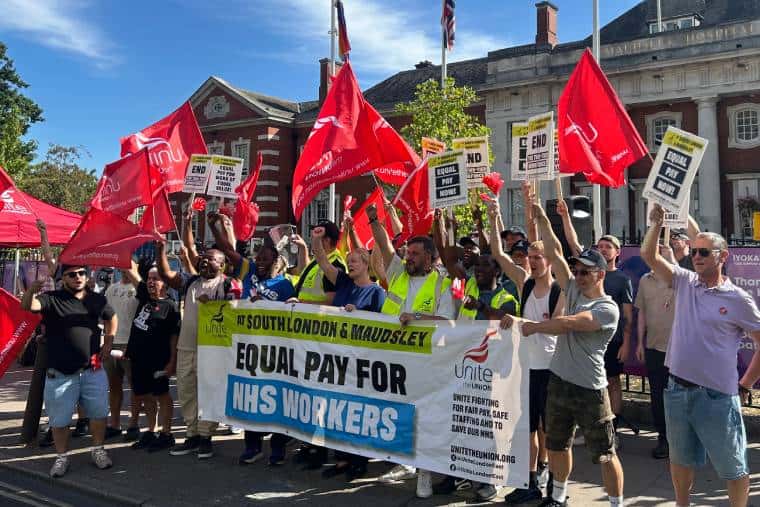
Unison members picketing at Soas in London on Monday. They are striking over pay (Picture: @SOASJ4C on Twitter)
Delegates at the Unison union’s local government conference in Liverpool this week resolved to smash through the hurdles in the Tory anti-union laws. Over 360,000 council and school workers in England and Wales started voting for strikes over pay last month, after rejecting a pay offer of £1,925 a year.
The anti-union laws demand a 50 percent turnout threshold. Liz from Camden in north London said, “The rich are getting richer—there’s more for the billionaires while we’ve lost 25 percent of our pay. Health, education, rail and post workers all managed to beat the ballot thresholds—some yes votes have been huge.
“In our branch traffic wardens reached 86 percent turnout with 99 percent to strike. Local government workers need to be part of the fightback. We need cooperation with other workers—fighting, striking and winning together while the Tories try to divide us with anti-union laws and stopping small boats. We need to give them class war.”
A delegate from Manchester said, “It’s time for action. It’s time to communicate and educate, and to motivate members to get involved. We need more action.” The ballot is disaggregated. This means it’s counted in more than 4,700 individual employers in councils and schools, rather than a single national ballot.
Mark from Portsmouth City explained that his branch has been having in-person and online meetings “to encourage questions and people to get involved”. He said, “We’ve leafletted the main workplace in the city. And we made a local leaflet that tells members how much they will lose with the pay offer because of inflation,” he told conference.
“It’s all about communicating with members. Some are worried about fighting. But we’re only being paid 75 percent of what we were paid when the Tories first came to power.”
Last year local government workers voted in a consultative ballot to accept £1,925 and a day of leave by 63.5 percent on a 34 percent turnout. This year they went straight to a statutory strike vote. Mark told Socialist Worker, “We’re learning from last year’s failures.
“It was the wrong timetable. We could’ve been on strike with the NEU union. But there was no energy from Unison. The offer was made in April and we weren’t balloted until much later in the year. We were slow in last year’s strike wave. Now this year the union bureaucrats have been under pressure from us.”
Claire from Southend told Socialist Worker, “Collective struggle means we can push for better pay, but also push back this weak Tory government.” Care worker Tracy from Sefton branch in the north west of England told conference, “Low paid workers are the great invisible arm of the care sector.
“During the pandemic I was working way beyond my contractual hours—and now my work has quadrupled and income is stagnant. Low paid carers don’t want to strike. We just want a fair wage. But I will take whatever action needed as enough is enough. We need action now.”

The Sunday afternoon session was dominated by motions on education from early to further years. Delegates sent solidarity to the Ashfield school strike in Leicestershire and Orchard Day workers in Knowsley, Merseyside, who voted 78 percent for action on a 100 percent turnout.
Julie, an early education years worker from York said, “We shouldn’t say strikes are the last resort and people don’t want to do it. People on a picket line realise it’s the only place we can fight for real change. It has been inspiring standing on the NEU pickets. I really hope we can officially join the teachers soon and fight together to save our education system.”
Meanwhile, Unison has named 2023 the year of the black worker. Delegates discussed the disproportionate numbers of black women being made redundant, ethnicity pay gaps and the conditions black workers live and work in. And they slammed the anti-Muslim Prevent strategy.
Nimi from Carmarthenshire branch said, “The Tory government is against asylum seekers. In Llanelli we’re battling against people who have picked up on this and describe asylum seekers as invaders. Black people are in fear of that increased racism coming through.
“Branches have to be active in challenging racism against asylum seekers— we have to say clearly that refugees are welcome here. As trade unionists we say that racism is a tool that divides us as black and white workers.”


A staffing crisis in the NHS
Health workers set to strike across four Manchester hospitals
Bus workers rejected an offer and came back out