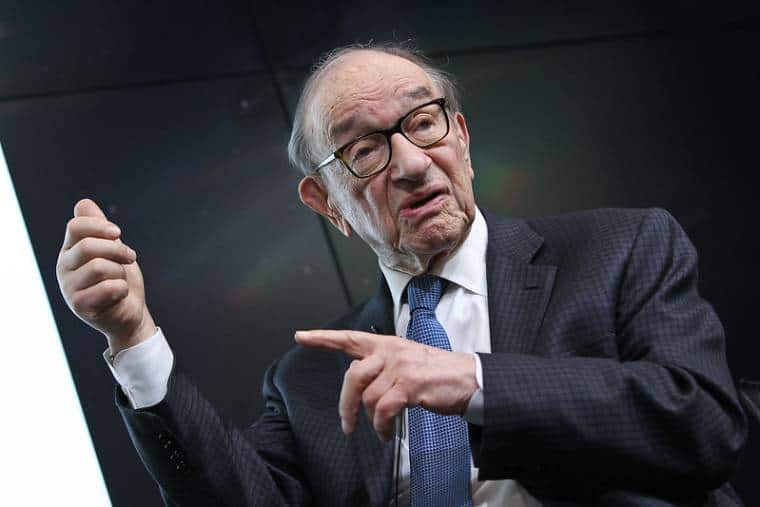
Greenspan built his reputation on manipulating interest rates (Pic: Flickr)
Alan Greenspan, who has died at the age of 100, was chair of the Federal Reserve for eighteen and a half years from 1987 to 2006.
The Fed is the US central bank and the most powerful central bank in the world. And the most powerful figure in the Fed is the chair.
Greenspan was appointed five times by both Republican and Democratic presidents, and he enjoyed a quite extraordinary reputation.
The lack of any actual decline in US economic growth during his tenure was ascribed by some to his apparently amazing ability to judge when interest rates set by the Fed should go up or come down.
However, that reputation was much sullied after his retirement when just two years later the world’s financial system almost collapsed in the face of the sub-prime mortgage crisis.
Greenspan became part of a circle around the right-wing libertarian philosopher Ayn Rand in the 1950s.
They were committed to the idea that, “society functions most efficiently when people actively pursue their own self-interest, to the exclusion of the interests of society as a whole”.
Greenspan once said the “welfare state” was “nothing more than a mechanism by which governments confiscate the wealth of the productive members of a society”.
He also warned that central banks, including the Fed, had allowed markets to think the business cycle had been tamed, breeding complacency and risk-taking by rich investors.
It is ironic therefore that as chairman he moulded the Fed as a bulwark against instability by arranging bail outs when big financial companies and countries went bust.
This became known as the “Greenspan put”, insuring investors against losses–the welfare state but for the rich.
He certainly had to handle a lot of financial instability, exacerbated by the deregulation of the financial markets from the 1980s onwards.
Within months of assuming office in 1987, there was the great Wall Street crash which saw the Dow Jones index fall almost 25 percent in a day, a record drop even to this day.
Greenspan slashed interest rates in response.
In 1994 there was the Mexican debt crisis, brought on by Greenspan raising interest rates to cool a booming US economy.
In 1998 there was the failure of US hedge fund Long Term Capital Management which had borrowed huge sums to make speculative bets in the financial markets and lost $4 billion.
In both cases, Greenspan arranged bail outs to prevent the problems spreading to other parts of the financial system.
Then in 2001 the Dot Com bubble burst and on 9/11 came the attack on the Twin Towers in New York.
Greenspan slashed interest rates again–this time to a record low of 1 percent.
He also urged George Bush to go after Saddam Hussein to guarantee energy supplies.
The US economy once again not only survived the dot-com bubble bursting and the 9/11 shock, but the property market boomed.
Financial speculation also boomed with increasingly complex financial packages created to ensure that “traders” could reap huge fees as well as make speculative gains as the stock market soared.
Greenspan was firmly against increasing regulation to require that lenders and borrowers had insurance against the risks they were increasingly taking.
Bizarrely, he assumed that financial speculators wouldn’t take risks threatening the system itself because that wasn’t in their interests.
He would have done better to read Marx than Ayn Rand.
He would have learned from Marx that capitalist competition is a process where individual actions ultimately produce a crisis in the system as a whole.
And so it was that the sub-prime mortgage bubble burst in 2007/8, with major financial institutions Bear Stearns and Lehman Brothers going to the wall and the whole of the financial system facing collapse.
Of course, once again, the US and other states came to the rescue of the bankers and the rich whilst the working class suffered years of austerity.
That’s Greenspan’s legacy in a nutshell–socialism for the rich, shit for the rest of us.


She was no harmless eccentric