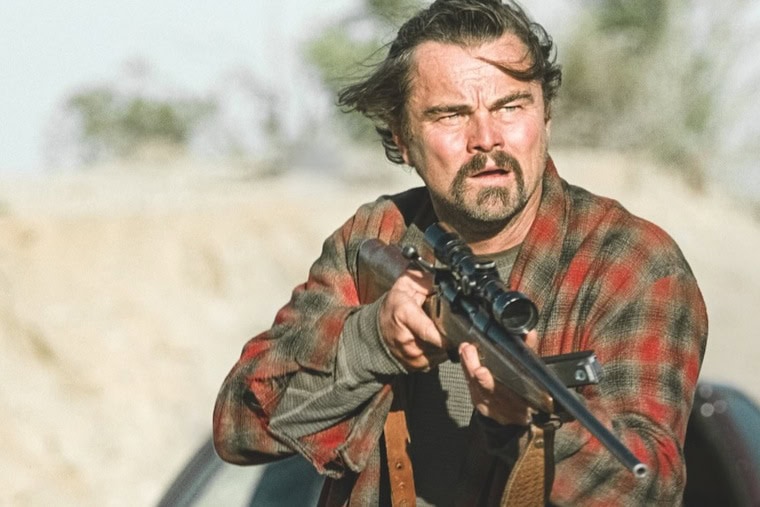
Jeremy Allen White as Bruce Springsteen
Telling the story of Bruce Springsteen’s 1982 album Nebraska, Springsteen—Deliver Me From Nowhere, is more than a simple biopic.
It shows his dedication to storytelling. He finds inspiration in films, poetry and family.
Interspersed with childhood flashbacks, we see Springsteen (Jeremy Allen White) researching, observing and perfecting the narratives with which he wants to express himself.
The film starts with Springsteen fresh off tour, exhausted and deeply alienated with celebrity. He craves quiet and the ability to create without scrutiny. He’s grasping for something beyond his reach.
Springsteen is stringent in his focus on storytelling. He refuses to have what he wants to say reduced or shaped by the market.
He breaks into something and in the process he breaks himself down a little.
Springsteen has to escape the constraints of making art for money in order to heal and to make what is considered his best music.
His mental health is paralleled with that of his father (played by Stephen Graham). If you’re familiar with Springsteen’s music, it’s clear that his father’s mental illness comes from the pressures of working class life. But the film could convey this better.
The film ends with the father and son coming to an understanding. They agree that you can only do the best with what you have and that we all have our battles.
The film is about mental illness, friendship and recovery. Springsteen’s relationship with producer Jon Landau is the focus of this.
Landau understands Springsteen’s vision and fights for it. It’s Landau who is always on the other end of the phone. And it’s Landau who fights the record company and convinces Springsteen to seek help. The portrayal of masculine friendship avoids all the perhaps expected notions of machismo.
The film shirks the cliche of the artistic genius.
And it refuses to make the women in Springsteen’s life into side characters. Faye (Odessa Young), a character created for the film who Springsteen has a relationship with, could easily have been sidelined. But she is the one who calls Springsteen out, refusing to be a prop for his personal development.
It’s a film about having to build something for yourself, from yourself—no one else can take on that responsibility.
I was sceptical at White’s ability to match up to “The Boss”, but I was glad to be proven wrong. He brings the energy and depth needed to take on the icon.
The main drawback is that it does not explicitly explore the working class stories that characterise Springsteen’s music.
Guillermo Del Toro’s Frankenstein is a moving reinterpretation of Mary Shelley’s classic gothic tale. This new film centres its focus towards how we are shaped as humans by our upbringing and environment, alongside the moral dilemmas of “playing God”.
Victor Frankenstein (Oscar Isaac) is portrayed as completely unlikeable—an arrogant genius, who is ultimately disappointed by his own imperfection.
His project is funded by Henrich (Christoph Waltz), who happens to be an arms merchant.
His investment in Victor’s experiment stems from his desire to inhabit this new body. He helps Victor source parts from those dead in war or execution to create the Creature.
Victor seems more than happy to accept funding, turning a blind eye to the suffering.
Henrich’s niece Elizabeth (Mia Goth) says of this, “Men sit and control war and benefit from it, whilst the soldiers dying miles from home have no choice.”
When Victor confines his creation to a cellar almost immediately after “birth”, Elizabeth questions his cruelty. “The creature doesn’t know any better,” he says. Elizabeth replies, “But you do.”
It is telling that only the oppressed characters—a woman or a blind older man—show the Creature compassion.
Jacob Elordi portrays the Creature as a child of neglect, shaped by grief and rage as Victor inflicts his own shame upon him. The creature ponders his purpose and identity, haunted by fragmented dreams of the bodies stitched together to form him.
Are we not all shaped by those who came before us? This adaptation captures the tragedy of human ambition and the yearning to be loved simply for existing.
Vic Hoover


Interviews with RAR organisers 50 years on
Hadestown is a damning condemnation of capitalism
Exhibition seems to revel in making histories and events obscure
Artist Mike warns, 'This is what you’ll lose'