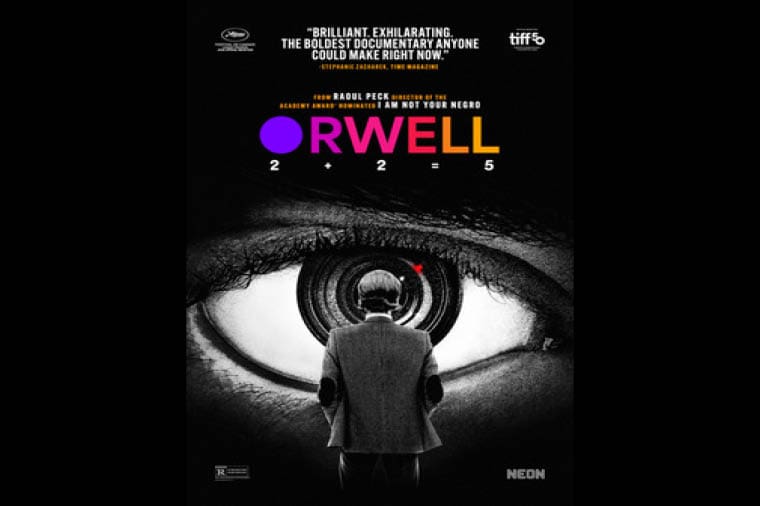
Orwell 2+2=5 refuses to turn away from reality
“Do you begin to see what kind of world we are creating?”
This is the question Raoul Peck’s Orwell 2+2=5 asks.
The film pieces together George Orwell’s life and works and parallels it with the disasters, revolts and violence of the last century. It is a damning assessment of politics today.
Uncovering double-speak and mirages, Peck urges the viewer to reconsider the politics and histories that make up our everyday lives.
The film starts with Orwell’s upbringing in India and his time in the colonial army, “part of the actual machinery of despotism”.
Analysing his place in these apparatuses of power, we are immediately made to think of hierarchies, armies and the violence that power and money so easily inflicts.
Using archival footage, news coverage, infamous photographs and speeches, the film unfurls Orwell’s analysis of authoritarianism.
Peck covers a phenomenal amount of ground. The film jumps between events such as the fall of the Soviet Union, Donald Trump’s rise to power and Israel’s genocide in Palestine.
Many critics have accused Peck of overloading the film with themes, events and information. But the bombardment serves a function.
By inundating the viewer with these catastrophic images and words, the film refuses to turn away from the reality we face.
It also refuses to see these events as disconnected. Instead, it uses Orwell’s words and understanding of the world to expose the dark underbelly of capitalism and its structures of power.
This gives the film a sense of immense urgency. It gives the viewer impetus to fight back—and shows shining examples of this
From Black Lives Matter, mass protests in France, the Arab Spring and the Spanish Revolution, the film does not leave us feeling powerless.
Very subtly, Peck also parallels Orwell’s declining health with political downfall. Orwell suffered from chronic tuberculosis, spending much of his later life in inpatient care facilities.
Throughout it all he continued to write and diagnose the world.
A slight death wheeze throughout the film becomes a final gasp, forcing the viewer to face up to the pressing issue—it’s now or never.
The failing British prison system is the backdrop for two show-stopping performances from Tom Blyth and David Jonsson in Wasteman.
The film follows Taylor, a long-time inmate on the brink of release, as he’s paired with Dee, his new cellmate.
He introduces chaos into Taylor’s previously well‑behaved routine. Charmed by Dee’s initial charisma, Taylor finds himself being dragged further afield by Dee’s antics.
What starts as the sharing of contraband spirals into drug smuggling, violent altercations and a threat to Taylor’s freedom.
More so than anything else, Wasteman highlights the consequences of a lack in resources and funding in the prison systems.
What should be a rehabilitation system has devolved through overcrowding and lack of communication.
The prison system has become the perfect breeding pit for escalated drug use and smuggling, increasing the vulnerability of inmates.
Jonsson shines as Taylor. You can sense his trepidation throughout the film as his almost completed sentence is threatened by Dee.
In stark contrast to Taylor, Dee, played by Blyth, finds himself thriving in prison.
He is able to operate and maintain a drug dealing business under the noses of inattentive guards.
In one scene, a guard finds a pill packet left behind by Taylor, who has been secretly maintaining his own drug habit under the nose of Dee.
With a few vague threats and brazen confidence, Dee is able to intimidate the guard into throwing the packet out.
What follows is a descent into coercion and manipulation as Taylor finds himself indebted to Dee whilst trying to maintain good behaviour in an effort to secure his release.
The film gives two powerhouse performances that shine a light into the shortcomings of the prison system.
Vic Hoover


Interviews with RAR organisers 50 years on
Hadestown is a damning condemnation of capitalism
Exhibition seems to revel in making histories and events obscure
Artist Mike warns, 'This is what you’ll lose'