A Unite the union members’ picket line on Wednesday (Photo: UniteSharon/X)
Over 300,000 public sector workers in Ireland struck on Wednesday over pay.
The strike, called by the ICTU union federation, involves the whole public sector, including teachers, nurses, doctors, other health workers and civil servants.
Almost one in ten people in the south of Ireland struck, in the largest strike in the republic since the financial crisis of 2008.
Patricia is a clinical nurse manager working in disability services and a rep of the Cork branch of the INMO nurses’ and midwives’ union. She spoke to Socialist Worker from the picket line.
“The trade unions have been trying to sit down with the government, to have a proper negotiation about pay, about the cost of living,” she said. “But they haven’t listened and we’ve had enough.
“Our nurses are working around the clock, working longer hours, coming in earlier, going home later. We’re constantly short of staff.
“And the basic cost of living—we can’t afford it! The rents have gone through the roof. We can’t even afford a reasonable amount of groceries because the price of everything has skyrocketed.
“We have to keep going. What we want today is fair pay that matches the cost of living in Ireland. That’s not too much to ask.”
In the new budget, the right wing coalition of Fianna Fáil and Fine Gael has set aside €1.2 billion for pay increases for these public sector workers. But at least €2 billion is needed to match inflation and allow workers to stay ahead.
People Before Profit (PBP), a socialist party in Ireland, say they need at least a 10 percent pay rise.
There is currently an unallocated €1.6 billion in the budget and workers are demanding this goes to their pay.
Workers will strike again next Wednesday if their demands are not met.
“The whole public service sector is on strike today, so we are hoping the government does feel the impact,” Patricia continued. “We’re willing to have a discussion, as long as it is meaningful and can reflect the suffering the cost of living crisis is causing us. But if not, we’re out again on 21 October.
“Everyone is getting the brunt of this. We’re all out here together, saying the same thing—what do we want? For pay to reflect the cost of living. And we need it now.”
The Irish government and media are painting the strike as an act of cruelty by the workers—the same workers who look after children, and sick and elderly people across the country.
It is only because the government has refused to pay them properly that they are on strike. They have spent the summer balloting after an insufficient pay deal expired in June.
Mass strike action has the power to get results. Almost every school in Ireland closed due to the strike. Hospitals were covering emergency work only. And court proceedings ground to a halt as workers picketed the steps of the Criminal Courts of Justice.
A statement from PBP said, “The prospect of an all-out strike that would close down the country would force the government to take the demands of the unions seriously.
“We must guard against any attempt to deescalate the action.”
The Irish strike shows the power of workers—and escalating action has the power to force the government to cough up.
On the night of Saturday 26 September, the parades commission—the body which regulates “sensitive” marches in the north of Ireland—ruled that the Orange Order was allowed to march down the Garvaghy Road.
The last time the Orange Order marched along this route was in 1998.
Residents of the Catholic majority area were terrorised by loyalist riots. Twenty one Catholics were killed, including three young brothers.
As soon as permission for the parade was granted, residents from the area began to gather on the Garvaghy Road to blockade the route of the march.
Tens of thousands gathered on the road in a massive rally of solidarity on 4 October.
Despite the attempts of unionist politicians to paint the dispute as sectarian, many Protestants who do not want to see a return to the violence of the Troubles joined the blockade.
This re-ignition of the Drumcree dispute from the 1990s has proved that sectarianism can be overcome when people take a stand against the dregs of the Orange Order.
They repeatedly tried to muster loyalist supporters to the Garvaghy Road, but failed to materialise anyone.
The stand-off has deepened the crisis of the Northern Irish state-let.
First minister, Michelle O’Neill, of Republican party Sinn Fein, is to face a vote of no confidence.
Unionist politicians are fearful since Sinn Féin is now the largest party for the first time.
But working class people have the power to challenge these rotten institutions across the sectarian divide.
Tags: Ireland Posted in International |
Comments Off on Victory for people on Garvaghy Road
Activists across London are gearing up for a March Against Austerity on Tuesday 27 October—the evening before the budget.
The march organisers are demanding funding for public services, welfare not warfare, no to racism and that the rich pay more tax.
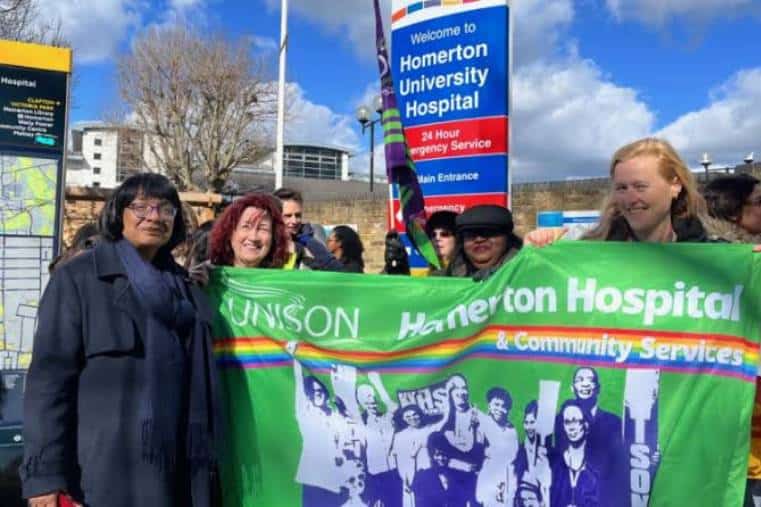
Jordan Rivera is the secretary of Homerton hospital Unison, in Hackney, east London. She has been centrally involved in organising the demonstration.
She told Socialist Worker, “Andy Burnham says he will be better that Keir Starmer, but he has to actually be better. It can’t just be words. He has to act”.
“Our march was initiated in Hackney because we had the Summit Against Austerity here, organised by the Green Party-led council. And we wanted to make sure something came out of that summit.
“So Homerton Unison, Hackney National Education Union and Hackney Stand Up To Racism (SUTR) were the first groups to support the march.
“The summit did decide to support the march. But they said it was too soon to organise it for budget day. We were able to say, ‘We’re already doing it’.
“Lots of other union groups have since backed the march.”
Press reports say Burnham rejected a call from the health secretary Yvette Cooper for extra funding for the NHS.
That means any pay rise for health workers will come from hospitals’ budgets—which are already being cut.
A Whitehall source said the NHS must “live within its means”.
Jordan said, “Health workers are talking about the story.
“I know workers in the NHS are worried about their jobs. Hospitals face millions of pounds of cuts. It beggars belief that they can say we should pay for our own pay rise when our hospital alone is facing £26 million of cuts.
“On what planet can they say that is okay? The teachers’ pay rise is now being funded, which must be a relief for them, although it’s still not a good pay rise.
“The NHS agreed 3.3 percent for health workers and were negotiating over the pay structure. There should be extra money to pay for that. We need a pay rise and we need it to be fully funded, we don’t want it to come from them closing down departments.
“We have an open organising meeting for the protest every week and more are people coming on board.
“We are trying to make sure those groups that have pledged support mobilise their members too,” she said.
“SUTR was included from the start. That’s crucial, because we know not being able to access from services makes some people turn to Reform UK and fall for the lies that refugees are to blame.
“Fighting racism and fighting austerity must go hand in hand.
“We are finding there is a lot of enthusiasm for the march. We want people to spread the word in their workplaces, in any networks they relate to and on social media.”
Eve of Budget protest against Austerity, Tuesday 27 October, 6pm, Rally at Victoria Embankment for march to Downing Street, London
Sponsors include Hackney Trade Union Council, Camden Trade Union Council, Redbridge NEU, Daniel Kebede, NEU general secretary, Tower Hamlets Unison, East London NHS Foundation Trust Unite, London Region UCU
Tags: Austerity, Budget Posted in News |
Comments Off on ‘We’re protesting against austerity on the eve of Budget Day’
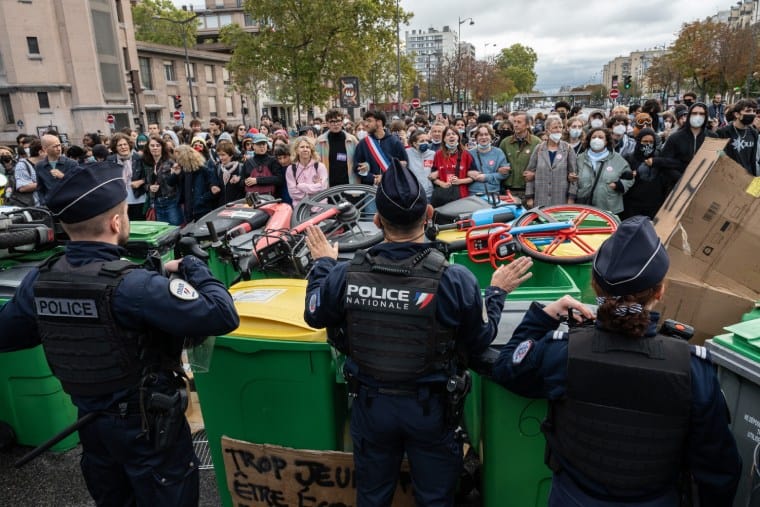
On the streets of Paris ahead of the march on Tuesday (Picture: Guy Smallman)
Young protesters rocked France on Tuesday in another round of militant protests.
The movement of blockades that started in secondary schools in the poorer suburbs of Paris has spread across the country, pulling in university students and workers.
School blockades took place on Tuesday ahead of mass marches across the country that were joined by union members. At Hélène Boucher school in Paris, hundreds gathered at the entrance to the building, blocking it with green plastic wheelie bins.
When the signal was given, they took their barricade into the road to block Cours de Vincennes, one of the main routes through the city. The students outnumbered police, who were forced to direct traffic around the main junction in all four directions as they awaited reinforcements—which eventually arrived in the form of several van loads of CRS riot cops.
“We hope for the resignation of Emmanuel Macron and his government,” one school student in Paris told Socialist Worker, “As well as apologies to the families of the injured children.
“If I am optimistic, I hope for a revolution, and if we are dreaming, Macron to the guillotine.
“Because we are too pacifist and we are waiting for change from a state that does not listen to us, treats us like criminals and is violent towards us.”
Basile, another secondary school student, told Socialist Worker, “The movement was formed around the blockades. That’s our method of action, and we’re going to continue like that. We know we can’t keep this up forever, but we’ll think about what to do next later.
“Right now, at least until the holidays, we have to stay here. Some people are saying that the unions shouldn’t join us because the movement is student-led, and they’re afraid the unions will co-opt it.
“I also understand that we need everyone to win and that we’re also fighting for public services. I don’t know what I think about it. Because it’s true that to have the strength to continue, it would be good if teachers went on strike a lot and we weren’t all alone in carrying the burden.”
The movement has faced fierce repression from the police and some young people have been left with horrific injuries. They include a 15 year old whose hand was blown off and a 14 year old with a fractured jaw after being hit in the head by a tear gas grenade. There have been over 6,000 arrests since the movement began last month, mostly of under 18 year olds.
Late on Thursday last week, the state pledged to send 3,000 more teachers to the schools as an emergency measure to fill staffing gaps. But the government’s measures have done little to quell people’s anger.
They mean little when prime minister Sébastien Lecornu is trying to push a budget through in parliament that promises £46 billion worth of cuts.
“We need all the workers to join the students,” student Hélia told Socialist Worker on the Tuesday morning blockade. “We need everyone to converge in our fights. And we need to go as far as we need to get what we want.
“I want to see all the union federations, the left parties join. We want their help. We desperately need them because we are students and it’s been two and a half weeks already of us blocking everything.”
Students, parents and workers link arms outside the school on Tuesday (Pic: Guy Smallman)
Hélia explained that police have targeted certain neighbourhoods more than others. He said, “We don’t see a lot of police brutality. It’s only when we block the whole road. But in the poorer suburbs they do what they want. They hit everyone, they shoot with flash balls. The police are racist, homophobic, transphobic.”
Emily, a young worker for a not for profit organisation said, “It’s important when you are an adult to come to these things and to support them, because I know it can get a bit rough. Even apart from the physical violence I know a lot of students are getting tired.”
“I’m also part of an anti-fascist group from this neighbourhood. Being here is a way to talk about this with them, talk about the upcoming presidential election with a far right party in the lead. That’s also something we have to fight collectively.”
Danielle Simonnet, a member of the French parliament in the left wing party L’Après, was also at the school to show her support for the students.
She told Socialist Worker that students’ demands go beyond wanting more funding and teachers in schools. “It’s like ‘68. It’s a historic movement. In every country around the world young people are for Palestine. In every country young people are for the climate. And on every demonstration we are against the Rassemblement National, against the extreme right, against racism and against antisemitism. We are for equality.”
CGT general secretary Sophie Binet has raged against the state repression of students whose futures are being stolen.
She said, “Rarely have the living and studying conditions of young people been so degraded. This generation has grown up with the climate crisis, terrorism, Covid, wars, and now the prospect of a world of work disrupted by artificial intelligence.”
Olivier Clément from the CFDT union federation in Paris told Socialist Worker, “It’s important for trade unions to be in solidarity with the high school students’ demands.
“We are there to protect the young people. And, their demands cross ours with some of the same concerns. So, we’ll be in the Parisian streets with young protesters.”
The movement has shown how action by young people can be a lightning rod for wider anger at the system.
Last Thursday huge crowds gathered at the Bastille in Paris where they faced police baton charges.
University students blockaded their campuses and held mass assemblies, including one in Nantes with thousands of people. And some 10,000 people gathered for a rally led by left wing presidential candidate Jean-Luc Mélenchon in the city of Clermont-Ferrand on Sunday.
In Vitrolles, near Marseille in the south of the country, truck drivers have restarted go slow protests bringing traffic to a standstill over rising fuel prices.
This Saturday there are calls for protests over the cost of living, which are drawing comparisons with the Yellow Vest movement that exploded across France in 2018, where tens of thousands of people in high-vis yellow vests took part in road blockades.
Students got to the school to set up blockades from early in the morning on Tuesday (Pic: Guy Smallman)
Some figures on the left have condemned violence from the school students. So Binet says, “We can debate their methods, and we must of course condemn the violence committed against staff or institutions.”
But university students and workers overwhelmingly recognise that the violence comes from the police and want to show their solidarity with the school students.
There are questions about where the movement goes next. After Friday this week, schools will break up for two weeks of holiday. Can the movement of blockades sustain itself?
Will workers join in larger numbers that could really shut down sections of industry and force the government to roll back its budget plans?
And can the movement stop the threat of the fascist RN. School students are chanting against the fascists. But will they march and disrupt their conference on 24 October and stop them from building a base?
All that is possible—but it requires the movement to deepen and develop into a confrontation with the French state and the system it defends.
Zack Polanski speaking at the We Demand Change summit last spring before he became Green Party leader (Picture: Guy Smallman)
Zack Polanski should take it as a compliment that he and the Green Party are getting the Jeremy Corbyn treatment. It means that the British establishment sees them as a threat. He needs not to buckle in the face of this pressure.
The assault takes the same form as the campaign mounted against Corbyn during his leadership of the Labour Party between 2015 and 2020—on the one hand, a frenzied media assault, on the other, attacks from within by the right wing of the party, all centring on the libel that their target is an antisemite.
The moral quality of the media campaign has been beneath contempt. Tony Blair, butcher of Iraq and pensioner of billionaire Donald Trump crony Larry Ellison, is leading the charge. He declaims the Greens “have crossed a line” by having the effrontery to declare that Zionism is racist. The Telegraph newspaper has managed to hit a new low by publishing a revolting anti‑Green cartoon insulting both Jews and Muslims.
Meanwhile, Green ex-leaders, headed by Caroline Lucas— never a reliable friend of the Palestinian cause—have taken advantage of Polanski’s failure to win the Holborn and St Pancras by-election. Uncomfortable with how he has been turning the Greens into a dynamic, mass “eco-populist” party, they want to push him out of the leadership.
It is of course nonsense to deny that, however the Zionist movement started in the 19th century, it now exists to sustain and defend a genocidal racist apartheid state. The fact that the Green Party conference passed a motion to this effect is a result of the gigantic learning process that has hammered this truth home to hundreds of millions of people globally in the three years since 7 October 2023.
Polanski’s achievements are closely bound up with this process. He spotted that the emergence of the huge Palestine solidarity movement and the failure of the Labour government under Keir Starmer to begin to address the cost‑of-living crisis offered an opening for the Greens.
Hannah Spencer’s thumping victory for the Greens in the Gorton and Denton by-election in February and their advances in the local 3elections in May were successes for this strategy. Undoubtedly, they helped to precipitate Starmer’s removal by Andy Burnham, who has tried with a degree of success to rebrand Labour as a more conventional social‑democratic party.
The resulting “Burnham bounce” is the main reason why Polanski lost in Holborn and St Pancras. The Zionism is racism vote was too close to the by-election to have had much effect. But the media campaign that has been running for months to brand Polanski—himself a Jew—as antisemitic probably did.
What he has to do now is keep his nerve and hold firm.
One factor in Corbyn’s demise was the tendency of his leadership team to respond to the attacks with concessions and manoeuvres. These left Corbyn on the defensive and demoralised his supporters.
Polanski must understand that time is on his side. Burnham is very unlikely to deliver on his promises of substantial social change. Moreover, the Palestine movement represents something that didn’t exist when Corbyn led Labour—a vast, sustained and increasingly radicalised effort at solidarity that reaches deep into British society.
That’s a source of strength. Polanski’s biggest weakness is his own party—historically a niche, predominantly middle class electoral project. The Greens’ record in local councils isn’t much better than that of the mainstream parties. And in the rest of Europe, a degree of electoral success has helped to transform Green parties into rotten pro-imperialist parties—witness their denunciation of the Zionism is racism vote.
So far, Polanski has ducked, dived and hedged over what he calls in Monday’s Guardian newspaper “this imperfect motion”. But he hasn’t capitulated, writing that “its substance chimes with my understanding of Zionism as the ideology that underpins the displacement and genocide of Palestinians”.
Nevertheless, he will have to fight to change the Greens so that the party becomes a genuine reflection of the movement that has made their successes possible. And that movement also needs a strong and independent revolutionary left that can fight for the real transformation of society.
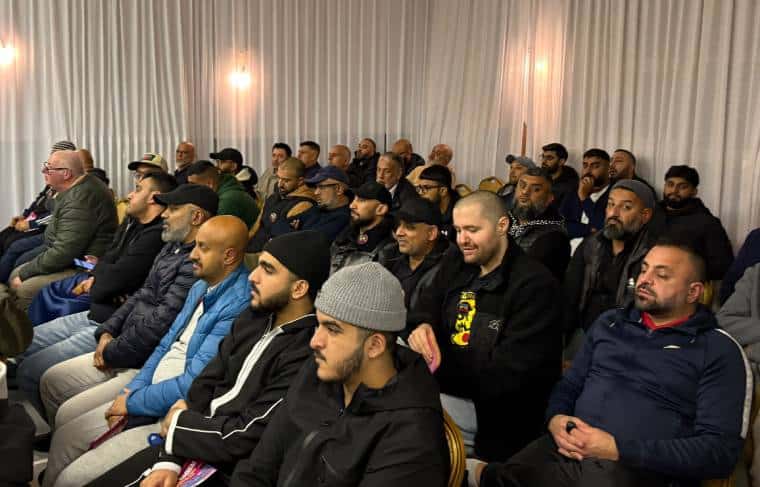
Over 300 anti-racists joined an emergency meeting in Darnall, Sheffield, on Monday night after Patriot Platform showed up in town the day before.
A gang of masked men, dressed all in black, gathered outside Linburg Coach yard in the Sheffield suburb.
The fascists claim that this coach company has been involved in transporting asylum seekers. They threatened that it was a “warning to other coach companies assisting in the facilitation of this illegal invasion”.
Stand Up To Racism (SUTR) organised the packed out meeting of 300 people in Darnall on Monday.
Maxine from SUTR spoke to Socialist Worker about the emergency meeting. “It was a big, angry meeting with standing room only,” she said.
“We talked about Islamophobia. It’s not just about refugees—it’s about demonising all Muslims and saying they are a danger.”
Maxine said she spoke about the parallels with the Battle of Cable Street in 1936, when anti-fascists stopped the Blackshirts marching through a mainly Jewish area in east London. “They marched through the centre of the Muslim community this week,” she said.
“We need to say now that they shall not pass. They won’t be coming back to Darnall again.
“If the police won’t defend us, we have to defend ourselves. Our unity is incredibly important.”
Daniel “Tommo” Thomas launched Patriot Platform in Dover in an attempt to build a new fascist street movement.
SUTR activists in Sheffield are organising a unity march on 24 October.
Meanwhile, teenagers chased the far right out of Brighton last Saturday. Grifter Montgomery Toms of Freedom Watch GB goes from town to town to “debate” people on the street with his travelling gazebo.
When he tried to set up in Churchill Square in the centre of Brighton, school students surrounded him and tore down his gazebo.
The gazebo was decorated with the challenge “Prove me wrong”—and this is precisely what teenagers in Brighton did.
On the same day, over 500 people joined a unity demonstration in Leeds.
Despite lashing rain and a small far right counter-protest, the SUTR march was loud and lively.
It was led by Women Against The Far Right, and was full of trade unions, a Green Party bloc and Palestine activists.
Before setting off, anti-racists heard performances from Love Music Hate Racism.
And around 120 anti-racists in Yeovil, Somerset, came out last Saturday to challenge the far right in their south west town. The far right only managed a small rally of 50 people.
Tags: Anti-racism Posted in Anti-racism, News |
Comments Off on Sheffield anti-fascists organise after Patriot Platform rallies in Darnall
Imperialist competition is increasing at all levels of the global system (Credit: rawpixel.com / U.S. Department of Defense)
World leaders marched us closer to war this week.
But if you follow the mainstream media, it presents what’s taking place in Yemen, Ukraine, Iran and Palestine as isolated snapshots.
At best, we’re told that “authoritarian” forces are trying to undermine “us”—whether it’s the Houthis, Vladimir Putin or the Islamic Republic in Iran.
In reality, the snapshots are all part of a much deeper crisis of imperialism and the system.
First, imperialist competition is increasing at all levels of the global system. At the international level, we see the return of “great power competition”, which reflects the long-term decline of the US and the rise of China.
But we’ve also seen the rise of regional imperialist powers outside the historic core of capitalism. Israel, Saudi Arabia, the UAE, Iran and Turkey are all vying for regional dominance in the Middle East.
The flashpoint over Saudi Arabia and Yemen is a reminder of how US decline has opened up space for such powers.
Second, the liberal capitalist order built by US imperialism after 1945 is disintegrating. And neoliberalism, the dominant way of managing global capitalism for over 40 years, is breaking down.
Ruling classes are looking to forms of “state capitalism” to help them compete internationally.
This sees the state take on a much more active role in directing investment and organising production as it faces a world of intensified competition.
Third, these two shifts are intertwined with how the rise of China as a manufacturing powerhouse has reshaped global capitalism.
All these changes are increasing competition across the world.
What’s the way out? The Marxist theory of imperialism understands that the drive to war is rooted in the profit system.
But it does not simply see the world as a chess board where “great powers” play out their rivalries and the rest are passive victims.
Our understanding of imperialism reasserts the agency of the overwhelming majority of people.
If the drive to war is rooted in the profit system, what’s the social force that has the power to disrupt that system? Here, we point to the potential power of workers when they strike.
Today, social struggles are raging on the streets of France and the Spanish state, and the Palestine movement has fed into them.
In Britain, such struggles haven’t broken out—yet. But we can try to bring together the radicalism of “Generation Palestine”, social struggles and our generational battle against the far right.
And, in every battle, we have to find ways to infuse it with the social power of workers to disrupt the system. Such a force can stop the drive to war and defeat the horrors of imperialism.
The international day of action in solidarity with dock workers in the Mediterranean on 30 October is a good opportunity. They are taking action over Palestine and arms being sent to warzones.
A general strike is taking place in Italy on the day and it comes amid the revolt in France and the Spanish state.
What can you do in your union branch, workplace or campus?
30 October: International day of action in support of dock and port workers. See Stop The War for more info. What can you do in your union branch, workplace or campus?
War drive comes at a cost to us all
Andy Burnham’s first budget day approaches on 28 October.
The consistent line from the government is that it can’t afford big spending commitments this autumn. But the drive to war continues. Spending on “defence” is set to rise £73.5 billion by 2028-29.
The money for war will be siphoned directly from the pot for healthcare, education and other public services.
While working class families are crying out across the country (see page 16), pension security is being undermined and energy bills are rising.
Workers are being squeezed more and more. Any pay rises they win come straight from another pot.
The national care service that Burnham has promised will be funded by scrapping the pension triple lock—meaning poorer elderly people will end up funding this care anyway.
It is not just older people who require social care, but there has been no mention of social care for adults or young people.
If the government has money for warmongering and slaughter abroad, it has money to save the public services that it has left to crumble. People should not be left freezing, hungry or waiting months for healthcare to fund more death and destruction.
Tags: Imperialism, war Posted in The SW View |
Comments Off on A force capable of defeating imperialism
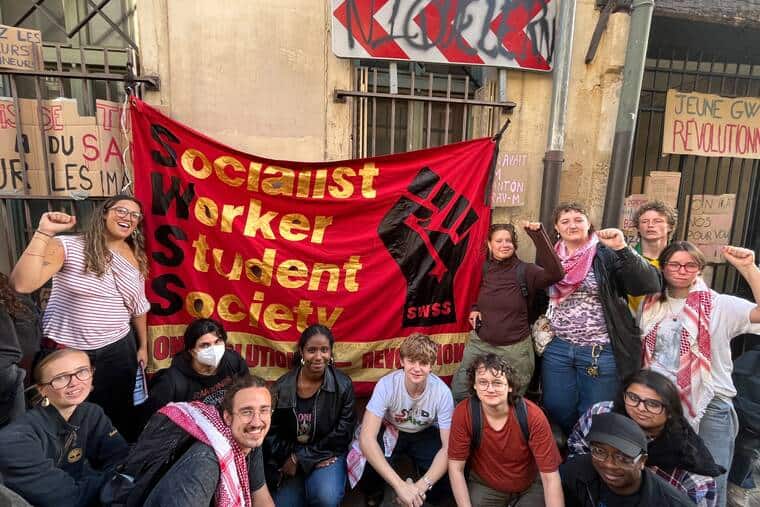
The Socialist Workers Student Society delegation on the streets of Paris
I was part of the Socialist Workers Student Society (SWSS) delegation to France last week.
After learning from the students leading the blockades, I have never been more sure that I will never stop fighting against the capitalist system.
I was reminded that struggle comes from below. It came from students in the poor suburbs of Paris, creating networks of solidarity and organisation.
I was so impressed with their organisation, seeing the students pass around water and use anything they could get their hands on to blockade their schools.
We must develop these networks in Britain.
Seeing students and workers stand together, united, was extremely powerful. The brutality of the repression is proof that when young, diverse, working class people stand together against the ruling class, it scares the fuck out of the state.
It also illustrates the importance of solidarity in the face of repression.
Two young students heard us speaking and asked where we had come from. When we explained that we were a part of a SWSS delegation from Britain, they were overwhelmed with gratitude. They thanked us repeatedly for simply standing with them, a testament to the power of solidarity that will stick with me for a long time.
Workers and students around the world should follow the example set in Paris, rise up and smash the ruling class.
The final and most vital lesson is that militant anti-fascism is the most important movement of our time.
The fascist National Rally still tops the polls and the fascist street movement in Britain is getting more organised.
If we don’t start taking this threat seriously, countering fascists in every way possible, then we might not get a chance to rebel like the French.
Get organised. And let’s build a revolution.
Fergus, Bristol
Anti-racism in Gosport
I welcome Camilla Royle’s piece on “Gosport—Is Fascism taking hold on England’s South Coast?” (Socialist Worker 7 October).
There is no doubt the south coast is under relentless pressure at the moment.
But it needs to be pointed out that there is organised, defiant opposition to far right and fascists both in Gosport and the nearby Portsmouth.
Gosport Together has been at the centre of anti-far right counter‑demonstrations, substantially out numbering local organised fascists.
Gosport and Portsmouth anti-fascists stood firm against a 500-strong mobilisation of south coast fascists.
More recently, we have stood in opposition to a Reform UK motion attacking the emergency lifeboat services. We passed a motion in an emergency meeting of Portsmouth City Council, and Women Against The Far Right organised a very successful counter demo within 24 hours, which attracted 70 noisy protesters.
It helps enormously that we have many comrades active in this endeavour.
Alan Burgess, Portsmouth
Driving far right Young Bob out of York
Last week far right “auditor” Young Bob—real name Gregory Moffitt—came to York to hold debates titled “All abortion should be banned” and “We need to deport millions”.
York Stand Up To Racism (SUTR) called a protest to oppose him.
People had chalked messages on the pavement where he was, writing things such as “Women’s bodies are not up for debate” and “York against bigotry”.
I drowned him out by chanting “Nazi scum off our streets” and “Refugees are welcome here”.
Moffitt hated this—he wanted to provoke us into a debate.
The police took me aside to try and make me stop chanting, but I refused and the rest of the protesters started chanting with me.
Moffitt ended up packing up as the police created a cordon around him. We chased him out of the city.
We knew it was important to confront him on the ground rather than engage in things that are not up for “debate”.
Julie Forgan, York
Pensioners in poverty
Andy Burnham has announced he will scrap the state pension triple lock in 2030 to fund a new National Care Service.
Nearly 2 million older people in Britain already live in relative poverty. And without the triple lock, it would be drastically higher.
Burnham doesn’t have to scrap the triple lock on pensions to fund his National Care Service.
A 2 percent tax on individual wealth over £10 million—affecting 0.04 percent of the population—would raise up to £24 billion.
Sasha Simic, east London
Tags: France, Students Posted in Letters |
Comments Off on Letters: What British students can learn from the French








Alex Callinicos: Zack Polanski must hold not fold over Zionism is racism motion
Zack Polanski speaking at the We Demand Change summit last spring before he became Green Party leader (Picture: Guy Smallman)
Zack Polanski should take it as a compliment that he and the Green Party are getting the Jeremy Corbyn treatment. It means that the British establishment sees them as a threat. He needs not to buckle in the face of this pressure.
The assault takes the same form as the campaign mounted against Corbyn during his leadership of the Labour Party between 2015 and 2020—on the one hand, a frenzied media assault, on the other, attacks from within by the right wing of the party, all centring on the libel that their target is an antisemite.
The moral quality of the media campaign has been beneath contempt. Tony Blair, butcher of Iraq and pensioner of billionaire Donald Trump crony Larry Ellison, is leading the charge. He declaims the Greens “have crossed a line” by having the effrontery to declare that Zionism is racist. The Telegraph newspaper has managed to hit a new low by publishing a revolting anti‑Green cartoon insulting both Jews and Muslims.
Meanwhile, Green ex-leaders, headed by Caroline Lucas— never a reliable friend of the Palestinian cause—have taken advantage of Polanski’s failure to win the Holborn and St Pancras by-election. Uncomfortable with how he has been turning the Greens into a dynamic, mass “eco-populist” party, they want to push him out of the leadership.
It is of course nonsense to deny that, however the Zionist movement started in the 19th century, it now exists to sustain and defend a genocidal racist apartheid state. The fact that the Green Party conference passed a motion to this effect is a result of the gigantic learning process that has hammered this truth home to hundreds of millions of people globally in the three years since 7 October 2023.
Polanski’s achievements are closely bound up with this process. He spotted that the emergence of the huge Palestine solidarity movement and the failure of the Labour government under Keir Starmer to begin to address the cost‑of-living crisis offered an opening for the Greens.
Hannah Spencer’s thumping victory for the Greens in the Gorton and Denton by-election in February and their advances in the local 3elections in May were successes for this strategy. Undoubtedly, they helped to precipitate Starmer’s removal by Andy Burnham, who has tried with a degree of success to rebrand Labour as a more conventional social‑democratic party.
The resulting “Burnham bounce” is the main reason why Polanski lost in Holborn and St Pancras. The Zionism is racism vote was too close to the by-election to have had much effect. But the media campaign that has been running for months to brand Polanski—himself a Jew—as antisemitic probably did.
What he has to do now is keep his nerve and hold firm.
One factor in Corbyn’s demise was the tendency of his leadership team to respond to the attacks with concessions and manoeuvres. These left Corbyn on the defensive and demoralised his supporters.
Polanski must understand that time is on his side. Burnham is very unlikely to deliver on his promises of substantial social change. Moreover, the Palestine movement represents something that didn’t exist when Corbyn led Labour—a vast, sustained and increasingly radicalised effort at solidarity that reaches deep into British society.
That’s a source of strength. Polanski’s biggest weakness is his own party—historically a niche, predominantly middle class electoral project. The Greens’ record in local councils isn’t much better than that of the mainstream parties. And in the rest of Europe, a degree of electoral success has helped to transform Green parties into rotten pro-imperialist parties—witness their denunciation of the Zionism is racism vote.
So far, Polanski has ducked, dived and hedged over what he calls in Monday’s Guardian newspaper “this imperfect motion”. But he hasn’t capitulated, writing that “its substance chimes with my understanding of Zionism as the ideology that underpins the displacement and genocide of Palestinians”.
Nevertheless, he will have to fight to change the Greens so that the party becomes a genuine reflection of the movement that has made their successes possible. And that movement also needs a strong and independent revolutionary left that can fight for the real transformation of society.
Posted in Alex Callinicos, Comment, Palestine & Middle East | Comments Off on Alex Callinicos: Zack Polanski must hold not fold over Zionism is racism motion