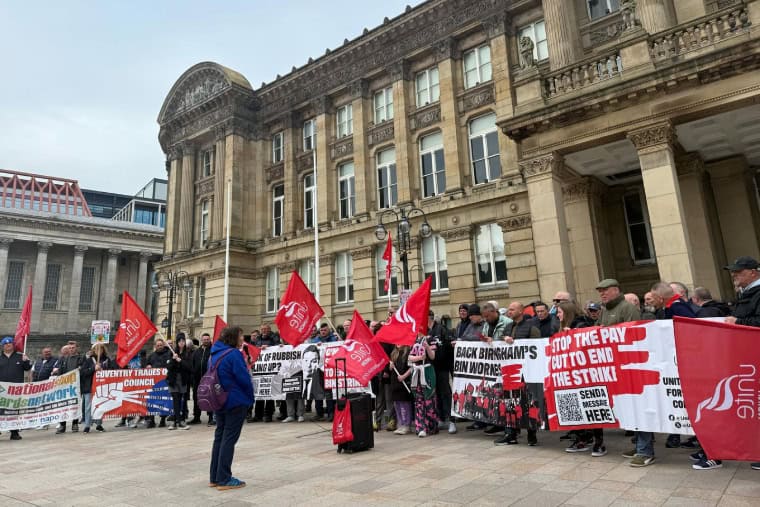
Striking bin workers rally at Birmingham Birmingham City Council House (Pic: @unitetheunion on X)
Trade unionists are building solidarity with Birmingham bin workers on indefinite strike.
The Labour-run council—which wants to slash workers’ pay—is doing all it can to break the strike.
But the mood on the picket line is rock solid. Last week, the Unite union members rejected a pay deal by an overwhelming 97 percent.
“On the pickets, morale hasn’t taken a hit,” striking worker Steeven told Socialist Worker. “We want to get back to work, but no one is looking to go back and take a massive loss—some of us are losing a quarter of our income. It is people’s livelihoods that will be affected.”
Birmingham council—with the backing of Labour—has used police to break apart picket lines. And it is using scab labour and army planners to clean up the rubbish. It’s a vicious declaration of class war—but strikes can win.
Unite should call mass pickets—a militant combination of workers and supporters to cause sustained, large-scale disruption outside depots. And there must be a wider fightback from the trade union movement.
But trade unionists don’t have to wait for Unite’s lead to organise solidarity. Steeven has been speaking at trades councils hoping to make links with other workers. And he went to the NEU union national conference last week to build solidarity.
Huw, an activist in Bristol, has been working with Steeven to raise wider solidarity to build the strength of the Birmingham strike.
“In terms of why it’s important, it’s about understanding the commonality of fighting back, to learn from struggle and take inspiration,” Huw told Socialist Worker. “I think in the political context and the current crisis, it will be felt very sharply by local government workers, so it’s a bit of a test case.”
Huw also explained that bringing trade unionists together “builds class confidence” and can raise “practical solidarity”, with other unionists donating and supporting the strike.
Next Thursday, Steeven will be meeting up with other striking workers and trade union branches to raise the profile of the Birmingham struggle and build a network of solidarity. Part of the programme is a meet and greet, which is open to all and provides the opportunity to link with political activists even outside of trade unions.
“Really, it’s about building politics through economic struggle,” Huw explained. “The core is trade unions, but I think it does go wider—with Palestine activists and potentially students, all of which is good for the wider movement.”
“At the end of the day, if they can come for government workers, then everyone is fair game for them,” Steeven said. “Lecturers, nurses, teachers—so this strike isn’t just for us, it’s for everyone. For me it shows that these battles we’re all fighting, we are not fighting them alone. We’re fighting them together.”
Steeven also explained that it’s important “to shed light on what’s happening and fight the misinformation. You’d expect Labour to back the working class, but they’re backing anyone but—so we aren’t going anywhere.”
After six weeks of strikes, with around 22,000 tons of rubbish lining Birmingham’s streets, workers are leading the fight against a Labour council pushing savage austerity.
It’s the sharpest industrial dispute Keir Starmer has faced so far. Building wider solidarity and the level of political struggle can raise workers’ combativity and lead to victory.


Health workers set to strike across four Manchester hospitals
Bus workers rejected an offer and came back out
Deadline to accept new conditions approaches