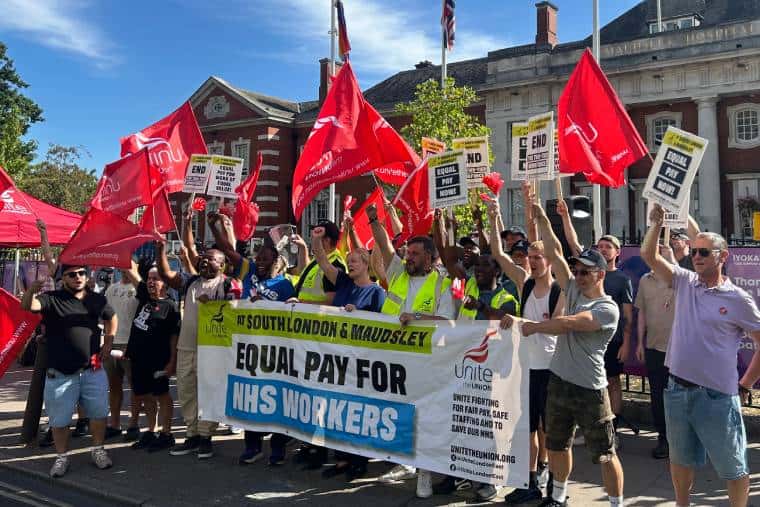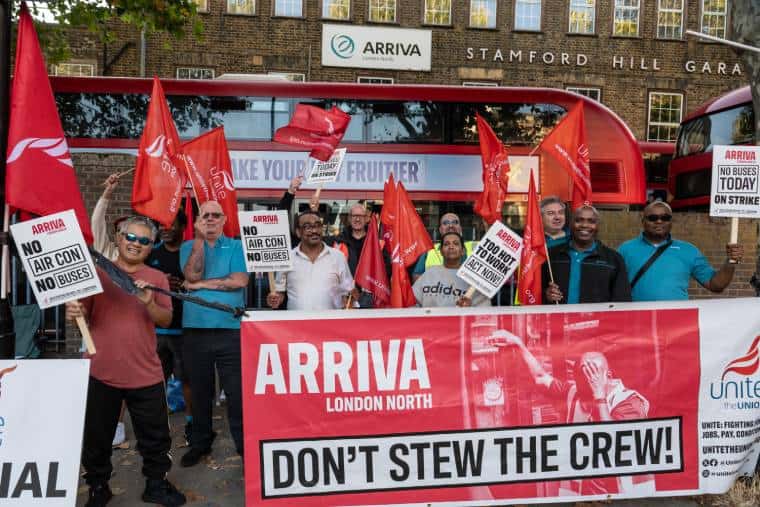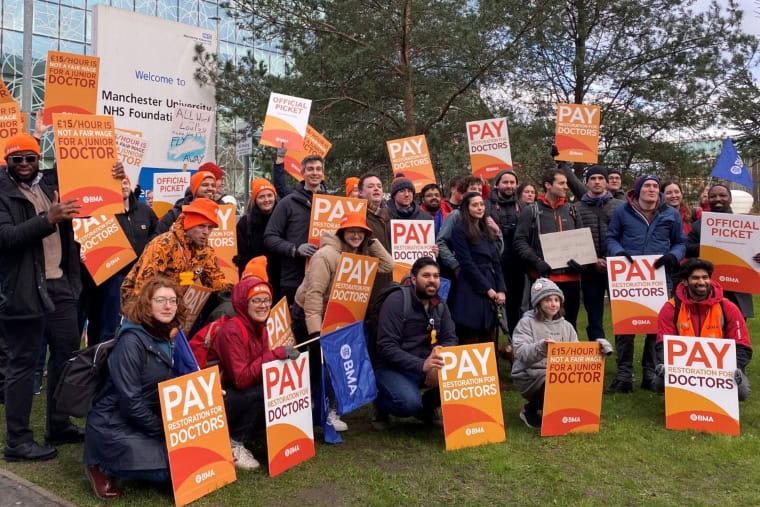
Striking junior doctors on the picket line earlier this year forced the new deal from Labour (Picture: @theBMA on twitter)
Junior doctors’ leaders have agreed a new pay deal with the government to end their strikes based on a settlement far short of the full pay restoration they were demanding.
The proposed deal could lead to their wages rising by around 20 percent—but over two years. It’s always misleading when union leaders talk about big rises over several years because it leaves aside the multi-year effect of inflation.
It’s true that action has moved the government beyond its initial demands—strikes work. The latest offer follows 44 days of strikes since junior doctors first took action in March 2023 in pursuit of a 35 percent pay rise.
The British Medical Association’s (BMA) junior doctors’ committee says it will put the new offer to its members. Tens of thousands of them will now vote on the deal. But they should reject it and continue to insist on the full demand.
One junior doctor wrote in a BMA members’ WhatsApp group, “We were right to say 35 percent was needed to stop disastrous loss of staff and to keep patients safe. That’s still true. I won’t be voting for a deal that has no long-term strategy for full pay restoration.”
Another said, “We have a new government and the BMA seems to want to show it will cooperate with health secretary Wes Streeting.
“I understand the desire to turn the page after Conservative rule. But that doesn’t mean we should take an inadequate deal.”
The offer is for a backdated pay rise of 4.05 per cent for 2023-24, on top of an existing increase of between 8.8 percent and 10.3 percent, depending on grades.
Junior doctors will be given a further pay rise of 6 percent for 2024-25, which will be topped up by a consolidated £1,000 payment. This is equivalent to a pay rise of between 7 percent and 9 percent.
If junior doctors reject the deal and restart strikes they can win more. And they can also give a fighting lead to hundreds of thousands of other NHS workers who can battle for pay justice and to win the funding needed for the health service.
Charlie Kimber
Workers are speaking out after the government’s punitive benefit measures are pushing them out of work, and further into poverty. People who claim the carer’s allowance are only permitted to earn just £151 a week before their benefit is stopped.
Nearly a million unpaid carers claim the £81.90 weekly allowance. If they earn just a few pence over that limit, their entire allowance is scrapped and they must pay it back.
For instance, a carer who earned £1 more than the £151 threshold for 52 weeks would pay back not £52 but £4,258.80. The Department for Work and Pensions (DWP), which administers the benefit, can spot when claimants go over the earnings threshold.
Yet DWP workers haven’t been notifying claimants, instead letting them rack up life-changing sums of debt, then clawing the money back. Workers are forced to turn down promotions, overtime, pay rises and cost of living payments.
Some are even forced to work for free so they don’t fall foul of the rules. It’s landing them with huge debts—some up to £18,000—and others have been prosecuted for fraud.
A “devastating” report by the Carers UK charity, released on Monday this week, called for urgent changes to the benefit. Helen Walker, the CEO of Carers UK, said, “It is heart breaking to hear of instances where thousands of pounds of debts have been accumulated.”
The Labour government must act now fast on resolving the carer’s allowance scandal. But the real deeper injustice is how unpaid carers—mostly women—are expected to survive on such measly amounts at all given the crucial tasks that they do.
Sarah Bates
GPs have threatened to bring the NHS to a “standstill” with unprecedented walkouts. Family doctors across England are being balloted by the British Medical Association (BMA).
They’re voting on whether to be in favour of staging collective action amid a row over the new contract for GP services in England. This collective action could potentially mean GPs limit the number of patients they will see each day to 25.
They may choose to stop performing work they are not formally contracted to do. They could also potentially ignore “rationing” restrictions by “prescribing whatever is in the patient’s best interest”.
GPs have not staged action since 1964 when family doctors collectively handed in undated resignations to the Harold Wilson government. They are not NHS employees, but independent GPs who contract with the NHS.
Unlike other NHS employees and junior doctors and consultants, GP contractors are not subject to anti-union law restrictions. If they vote for action it could start this week.
The GP method of operation is broken and outdated. They ought to be fully part of the NHS.
Surgery theatre nurses at Guys and St Thomas’ hospital in south London are to step up strikes over safe staffing. The dispute is over an increase in shift lengths.
The nurses were already working under unsustainable workloads before bosses imposed the hour-long extension from 8pm to 9pm to their shifts. Management had already increased the nurses’ shifts from 7pm to 8pm and introduced Saturday working.
The nurses previously struck on 27 June and 2 and 9 July. The next round of strikes was set for Tuesday and Wednesday this week.
Hundreds of Medirest workers at Northwick Park hospital in Harrow, north London, have been striking over pay. Staff are fighting over pay, conditions, disparities in contracts and a missing £1,300.
GMB union members—including caterers, ward hosts and porters—voted 97 percent for action. Medirest bosses have not paid their workers £1,300 from last year’s NHS pay deal.
The cash was paid to directly employed and some outsourced staff. Workers also face worse terms and conditions than other NHS staff.


Health workers set to strike across four Manchester hospitals
Bus workers rejected an offer and came back out
Deadline to accept new conditions approaches