Union members struck in defiance of the law
The Conservative government in Ontario, Canada, has been forced to rescind anti-union legislation after tens of thousands of education workers struck in defiance of the law.
More than 80 percent of the 55,000 members of the Ontario School Board Council of Unions (OSBCU-CUPE) voted 96 percent in favour of a strike to begin on 4 November.
The Tory premier of Ontario, Doug Ford, responded to the strike threat by introducing Bill 28. It made the strike illegal by suspending and overriding the Canadian Charter of Rights and Freedoms and the Ontario Human rights code both of which guarantee the right to collective bargaining.
It imposed a contract on the workers and included colossal fines of $500,000 (£320,000) on the union for each day of the strike and $4,000 (£2,580) on each individual worker if they struck.
The response was swift. OSBCU announced that its members would still walk off the job and the union began planning rallies and pickets. Other unions in the province from both the private sector and other public sector workers vowed to join them.
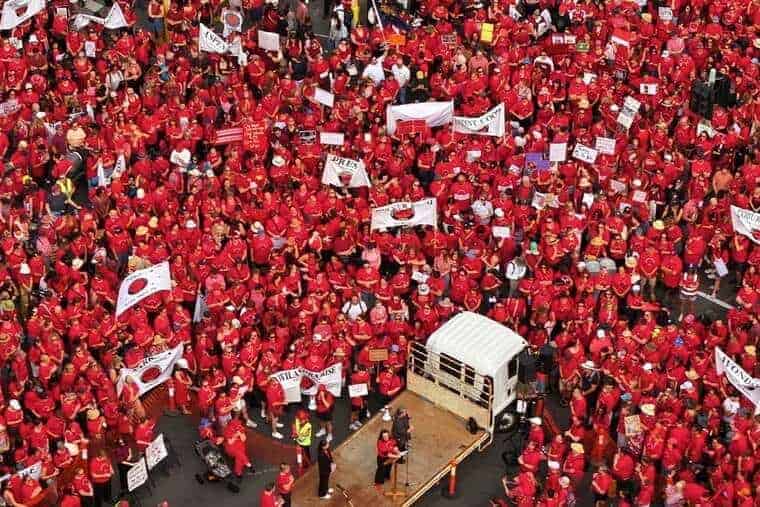
The new law was seen as an attack on the whole trade union movement. On 4 November strikes shut down most schools in the province. Tens of thousands of workers rallied and picketed at the provincial legislature in Toronto, and strikers set up large pickets in both cities and small towns.
Other trade unionists—transit workers, steelworkers, construction workers, and other public sector workers—joined education workers. Parents and students joined in and supported the actions.
In Peterborough, a small city of roughly 80,000 people, the picket at Tory Member of Provincial Parliament Dave Smith’s office stretched for more than a kilometre. The anger was palpable and the workers had lit a fuse.
The following day a mass rally shut down the core of Toronto and showed that it was not simply a one-day event.
Polling showed that 60 percent of the people supported the workers and 68 percent of parents with children in school believed that the Tories were responsible for the strike.
The Ontario Federation of Labour—the largest union federation in the province—led an emergency meeting and prepared for an even broader response. A meeting of heads of all the major unions agreed that a general strike would be called for 14 November.
On Monday morning the government grudgingly declared it would cancel Bill 28 and return to the bargaining table. The union announced it would take down pickets and go back to talks if they received that commitment to end the law in writing.
Thousands on the streets at rallies and pickets across the province celebrated as the news spread The workers had forced the government to back down on the imposed contract.
But the fight is not over. OSBCU workers are still without a contract and their demands have not been met. These workers—librarians, educational assistants, caretakers and clerical staff—have been given negligible wage increases for more than a decade meaning that many have fallen well below the salary required to live in the province.
More than half of them have had to take on a second job to make ends meet.
Other workers, including bus drivers are still on strike. Teachers’ unions are still in negotiation. The Tories are still going ahead with their plans to cut healthcare and privatise some hospitals.
Their agenda has not been defeated and millions are still suffering hardship from the skyrocketing cost of living while the corporations rake in billions in profits.
What the events showed is that a mass workers’ strike can provide a pole of attraction for the millions who are struggling to survive and can broaden the horizons for those who want to find a way to fight back. Workers have felt their collective power. It has changed the terrain and showed that the Tories can be beaten.
The next few weeks will be crucial. The union leaders will not automatically decide to continue this fight. They have capitulated many times in the past and can’t be trusted to carry this struggle forward.
The need for a rank and file movement to keep the pressure on their own leaders is essential if we are to push for the kind of mass fights that are required to bring the Tories down.


Fascist Tommy Robinson didn’t receive the same treatment
Russia has threatened revenge after British-made drones targeted its oil refineries and transport networks
Progressive candidate has won primary in Republican dominated state
Rank-and-file rebellion secures pay rise