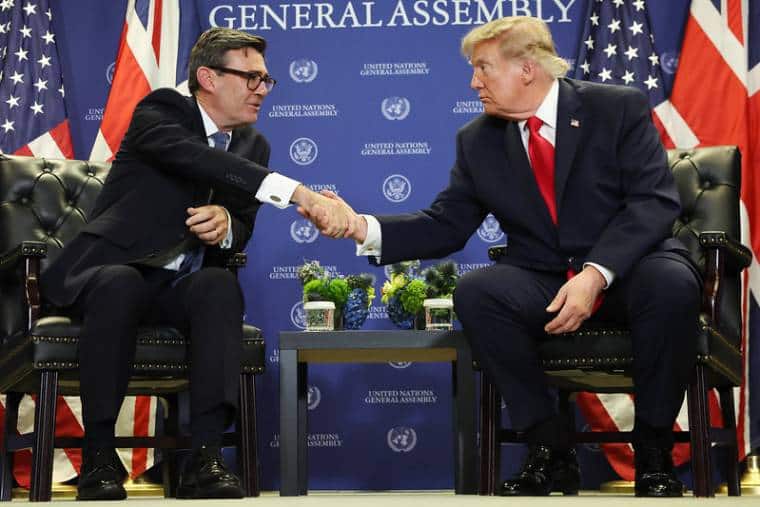
Imperialist rivals—Donald Trump and Vladimir Putin (Picture: Flickr/Trump White House)
The Donald Trump administration has been on a charm offensive ahead of talks between the United States and Russia over the Ukraine war.
“I don’t regard Vladimir Putin as a bad guy,” says Steve Witkoff, the US president’s special envoy for Russia. Witkoff said he “liked” the Russian president and thought he was “super smart” after meeting him in Moscow.
The mainstream press is full of claims that the Trump administration is “pro-Putin” and betraying “Western democracy”.That isn’t true. What’s really behind such comments?
First, Trump is finding out that Russia isn’t going to roll over in the negotiations, which are taking place in Saudi Arabia. For instance, Russia didn’t agree to a full ceasefire. It only promised to stop targeting Ukrainian energy infrastructure for 30 days.
Second, Trump isn’t negotiating with Putin because he’s “pro-Russian”. He isn’t the first Western leader to do deals with Putin in the interests of Western imperialism.
In 1999-2000, missiles, bombs and shells rained down on Grozny, the capital of the break-away republic of Chechnya in southern Russia.
But there was no outcry from European politicians demanding weapons for Chechnya—far from it in fact. Britain’s Labour prime minister Tony Blair flew to Russia to congratulate Putin on his action against “terrorism”.
US Democratic secretary of state Madeleine Albright had already praised Putin as a “problem solving patriot” with a “candid approach”.
Why did the West back Putin then? In the 1990s the US was the one military superpower in the world, but was determined to stop the rise of potential rivals.
It feared that a victory for the Chechen resistance would be an inspiration for other movements taking on imperialist powers such as itself. It backed Putin’s war on Chechnya. And some US officials, including then president Bill Clinton, toyed with the idea of Russia joining Nato.
However, US and Russian cooperation go hand in hand with competition. The US still tried to pull some of Russia’s neighbours into its sphere of influence in the 1990s.
From the 2000s, competition between the West and Russia increased in the region. This flowed from the dynamics of imperialism, a global system of competition among capitalist states.
Ukraine’s rulers had balanced between the West and Russia, but this became harder as the imperialist rivalry increased. When Ukraine seemed like it would pivot to the West, Russia stepped in. It annexed Crimea and backed separatist insurgencies in the Donetsk and Luhansk regions in the south east in 2014.
The US and Russia poured in weapons and support for their proxies. And, despite peace agreements in 2015, competition increased and culminated in Russia’s brutal invasion in 2022.
The Biden administration saw Ukraine as an opportunity to overcome US defeats in the Middle East and put it on a war footing with China. As one US official said back in 2021, “Ukraine’s strategic value to Nato can enable US and Euro-Atlantic aspirations for competition with Russia and with China.”
Trump’s moves hammer home that Ukraine is a proxy war between US imperialism and Russian imperialism.
After billions of dollars’ worth of aid, Ukraine has turned into a stalemate. The Trump administration has made the calculation that the Ukraine war now hinders rather than helps the US in its competition with China.
As US secretary of state Marco Rubio recently said, “The big story of the 21st century is going to be US-Chinese relations.
“A situation where the Russians are permanently a junior partner to China” is “not a good outcome for America”.
For the West, the war in Ukraine was never about freedom or democracy—it was always about a ruthless asserting of its own interests. And for the left, the lesson is don’t line up behind imperialist powers when they clash.


What did Burnham do?
Learn from mistakes of Corbynism
Build for the Palestine national demonstration on 10 October