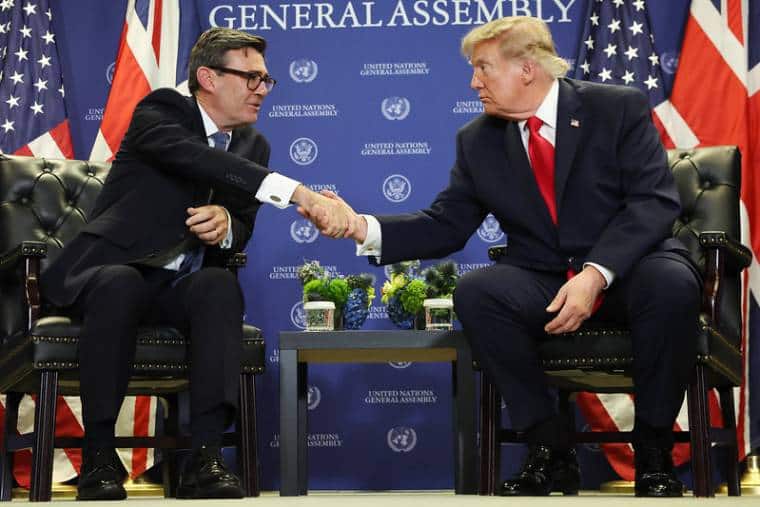
Andy Burnham shakes hands with Donald Trump (Picture by Simon Dawson / No 10 Downing Street on Flickr)
Andy Burnham turned out the Irish Guards in full regalia—bearskins, scarlet tunics, and all—to greet Ukrainian president Volodymyr Zelensky at Downing Street on Wednesday last week. But, for all this show and Burnham’s pledges of “unwavering” support for Ukraine, he was careful not to take sides in the latest row between Zelensky and Donald Trump.
This balancing act sums up the precarious position of European capitalism. Its rulers talk up war with Russia under Vladimir Putin to justify higher military spending, but remain dependent on president Trump and US power. They are feeling the disruptive effects as competition among imperialist states—themselves included—heats up.
Trump is open in his hostility to Zelensky. He posted last Sunday, “with all of the money that Europe is famously giving him… he doesn’t want to end this war and probably never did.” But, despite the two presidents’ celebrated clash in the White House Oval Office in February 2025, the conflict isn’t about personalities.
There are two main reasons for Trump’s attitude—one strategic, the other short-term. First, his administration wants to end the growing antagonism that has developed between US and Russian imperialism over the past 20 years.
Though White House strategy isn’t exactly coherent or consistent, the Trumpists have a vision of the world carved up into regional spheres of influence for the most powerful imperialisms —the US, China and Russia. As far as the administration is concerned, if Washington’s European allies feel threatened by Russia, it’s up to them to step up military spending to deter Moscow. The war in Ukraine has become an obstacle to a settlement with Putin, which might open up business deals profiting the Trump family and their cronies.
Second, one way in which this strategy isn’t coherently pursued is that Trump, like all his predecessors since 1945, still sees the world as his oyster. Hence the war against Iran that he started alongside Israel’s Benjamin Netanyahu back in February. Of course, this war has gone very badly for them. The Iranian regime held together, using its mastery of the precision-strike technology of drones and missiles to hit back.
Now Iran’s allies, the Houthis in Yemen, are deploying that same technology to threaten the Saudi dynasty’s domination of the Arabian Peninsula. This is to keep the price of oil and refined petroleum products, such as diesel, high. This pushes up inflation and makes governing parties unpopular, like Trump’s Republicans who face mid-term elections next month.
Meanwhile, with the fighting on the ground in Ukraine more or less stalemated, both sides are increasingly reliant on precision-strike technology. The Ukrainians have been hitting Russian infrastructure, including refineries and data centres. Russia is attacking civilian and military targets in Ukraine.
Trump is relaxing or not implementing sanctions against Russia in exchange for diesel oil. He’s also pushing Zelenskyy to stop hitting Russian refineries. He hopes these moves will cut diesel prices before the mid-terms. Any fall in prices would probably be short-lived, because the source of the energy crisis is in the Middle East.
The Europeans, including Britain, have taken over funding Ukraine’s war effort. But the US retains what a Ukrainian official called a “triple American monopoly” of intelligence, ballistic missile interceptors and the Starlink satellite network and its military component Starshield. You can’t fight a missile and drone war without this kind of network. Starshield has mysteriously slowed down for Ukrainians these past few days. Of course, Starlink owner Elon Musk protests his innocence.
This conflict leaves the European imperialisms high and dry. They want Ukraine to continue fighting in the belief this will keep the terrible Russian bear at bay. In fact, given that they are encouraging Ukraine to be more indiscriminate in its attacks on Russian territory, the effect could be the opposite—escalation towards nuclear war.
But this terrifying prospect simply underlines European capitalism’s dependence on US imperialism for its security. Europe remains politically fragmented, with its leading states grappling with domestic paralysis and, in France and Britain, bond markets nervously eyeing their debts. So they will continue to tug their forelocks in deference to Trump, however much he bullies and insults them.


Why is Labour increasing repression?
Looking at the magnificent mass eruptions in France, one is tempted to ask—'Why not here?'
Learn from mistakes of Corbynism