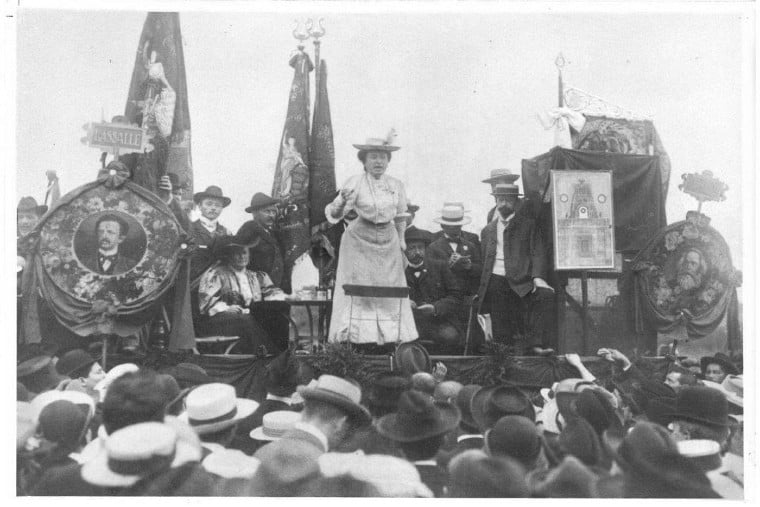
Rosa Luxemburg addresses a crowd
Rosa Luxemburg was murdered during the German Revolution in 1919 on orders from the Social Democrats. She suffered a second murder at the hands of a social democrat last week in the pages of the left wing Morning Star newspaper.
With breathtaking irony, Claudia Webbe used Luxemburg to defend the Your Party leadership’s decision to exclude the revolutionary left.
“There is a theoretical question at the heart of Your Party’s April 2026 decision on membership eligibility, and it deserves a serious answer—not a bureaucratic one,” Webbe writes.
She asks what kind of party the working class needs in Britain today. “A disciplined vanguard, or a broad democratic mass party? An organisation built around the co-ordination of professional revolutionaries, or one built around the self‑activity and democratic participation of the widest possible cross-section of the working class itself?”
No one was suggesting that Your Party should be organised as a “vanguard party”. The question was whether socialists already organised in such parties should be able to join Your Party on the basis of “dual membership”.
So, how much truth is there in the claims that Webbe makes for Luxemburg? And why would someone who died over a century ago have anything to tell us about how we organise today?
Webbe presents the argument as one between Luxemburg and Russian revolutionary Vladimir Lenin about how socialists organise.
She calls this “one of the deepest debates in the socialist tradition” and claims Luxemburg “spent much of her life engaged in precisely this debate with Lenin.”
Webbe conflates two different debates—and presents us with a third, false one.
Luxemburg—born in 1871 in Poland, then part of the Russian Empire—was a leading revolutionary socialist from her teens until her death at the age of 47.
In 1898 she moved to Germany, the heart of the socialist movement. The Social Democratic Party of Germany (SPD) was the biggest Marxist organisation in the world.
But as soon as Luxemburg arrived in Berlin, she saw that it was beginning to change. Activists were becoming administrators and elections were taking precedence over workers’ struggles.
Sections of the leadership, led by Eduard Bernstein, argued that revolution was no longer necessary in an age of economic growth and democratic reform. A mass socialist party could focus on winning reforms through parliament.
She rejected Bernstein’s blinkered view of capitalism. A few years without an economic crisis did not mean that the underlying anarchy of the system had been fixed.
This was the debate that actually took up much of Luxemburg’s life—captured in her pamphlet, Reform or Revolution. Fundamentally, she defended the central Marxist principle that the “emancipation of the working class must be the act of the working class”.
Socialism cannot be brought about by electing socialists to a parliament built to defend ruling class interests or using the structures of the capitalist state.
Instead, working class people have to take power and run society from below. Luxemburg saw the fight for reforms as part of the bigger struggle for revolution, not a replacement for it.
She understood immediately that the SPD’s direction was not “a more tranquil, calmer and slower road to the same goal, but a different goal.”
Over a century of experience has taught us that she was right to say that capitalism cannot be peacefully reformed away. She argued so confidently inside the SPD that one leading member referred to her, with a subtle hint of racism, as “a guest who comes to us and spits in our parlour”.
Claudia Webbe conflates two debates and presents a third, false one
Luxemburg battled the conservatism of the SPD leadership. When unofficial strikes periodically broke out in the industrial regions of Germany, Luxemburg looked to the ingenuity of the workers themselves.
The SPD leadership looked to the trade union bureaucrats, who often condemned workers for not going through “the proper channels”.
Webbe is not wrong when quotes Luxemburg saying workers “would come to political consciousness not through the transmission of a correct party line from above”. They would do so “through their own collective experience of struggle, of solidarity, of discovering their power through using it.”
What Webbe fails to note is that most of the time, the party Luxemburg was criticising was the SPD.
Luxemburg did engage in tactical debates with Lenin about organisation. But it is important to state that Lenin and Luxemburg were comrades.
The idea that they were fundamentally opposed was invented after they were both dead. It was first done by Joseph Stalin’s state capitalist regime in Russia, which buried all the gains of the Russian Revolution of 1917. He was building a cult of Lenin from the ashes of the revolution.
The new, anti-Stalinist left that came out of the struggles of the 1960s rightly praised Luxemburg, but also accepted the Stalinist caricature of Lenin.

Before 1914 Luxemburg—along with everyone else in the socialist movement—thought the SPD was the model for socialist organisation.
The tighter organisation Lenin was building in Russia, the Bolsheviks, was a result of the special conditions of organising under the tsarist dictatorship.
Luxemburg was concerned that the centralised leadership advocated by Lenin could lead to the party “going astray” from the masses.

Lenin’s position on the relationship between party and class changed over time, as did Luxemburg’s. Both were shaped by the different conditions they were battling. Luxemburg against the conservatism of the SPD and Lenin against the relative immaturity and lack of organisation in the Russian socialist movement.
The start of the First World War was a key turning point. It exposed the trajectory of the SPD and similar organisations. In August 1914, the SPD MPs voted to support the imperialist war. The party’s commitment to the nation state outweighed its commitment to peace.
Luxemburg spent much of the war in prison, but she continued to write. When news of the Russian Revolution reached her in 1917, she praised the Bolsheviks for grasping the moment.
Her 1918 essay, The Russian Revolution, criticises the suppression of some democratic rights to put down counter revolutionary forces in the immediate aftermath of the October revolution. But that’s in the context of an overall vigorous defence of the revolution.
Webbe’s article counterposes the “vanguard party” and the “broad democratic mass party” and attributes the two forms to Lenin and Luxemburg.
The vanguard party, Webbe asserts, “was theorised for conditions of revolution and repression, for moments when rapid centralised decision‑making was essential to survival.”
By contrast, “The mass democratic party—broad, plural, democratically accountable—is theorised for the conditions of advanced capitalist democracy.”
The Bolshevik party did form in circumstances of repression, but it became a mass democratic party. It grew from 4,000 members in 1914 to 250,000 in the summer of 1917.
By October, it had led a revolution from below to victory when workers’ council (soviets) took power.
The Bolsheviks remained a vanguard party throughout. It grew by immersing itself in the workers’ movement and showing that it had a strategy to win.
The way a revolutionary party organises depends on the political circumstances. But the need for one remains whether it’s in a parliamentary democracy or authoritarian state.
This flows from how working class people’s ideas are uneven. Some want to tear the head off the system, while others are reactionaries who buy into the system. The majority sit somewhere in between, with progressive and backward ideas.

A reformist party reflects all of those contradictions and panders to backward ideas. A revolutionary one organises together the most militant fighters to shape the broader struggles.
Luxemburg supported the idea of a vanguard—a party of revolutionary socialists who are already convinced of the need to overthrow the system.
The problem was that she was in a party that was rapidly moving away from that role—and, even after the disaster of 1914, she remained inside. She and her supporters only left to form a separate party during the revolution in 1918.
The SPD model failed the test of the First World War and the German Revolution. During it, the SPD formed the government and did everything it could to stifle workers’ revolution.
Revolutionaries today also have a role in calling out the disastrous effects of capitalism—and more importantly, arguing for a strategy to take our side forward.
Luxemburg was one of the greatest revolutionaries of a generation. She saw the birth of mass workers’ movements, colonialism, the First World War and the only successful—albeit brief—workers’ revolution.
It is a shame to see her legacy twisted again. I recommend you read her works yourself.


Thousands of residents in London have been without water for months
The climate crisis is impossible to ignore
The human cost of the heatwaves are higher than the temperature
Divide and rule was used to undermine struggle