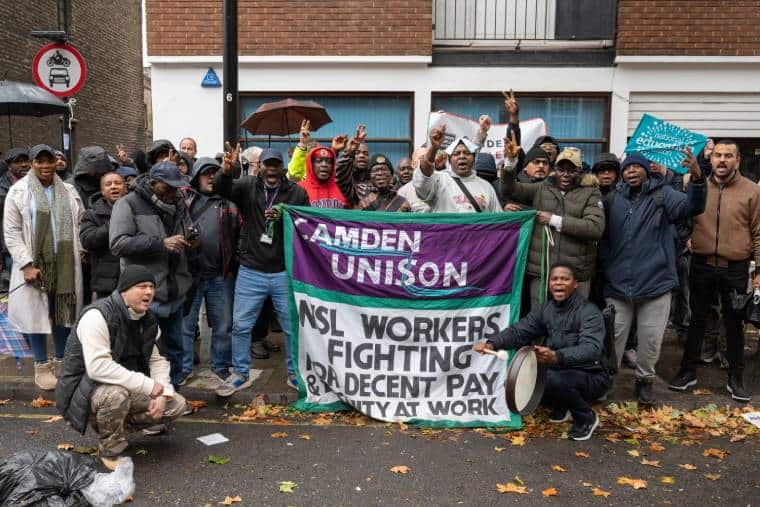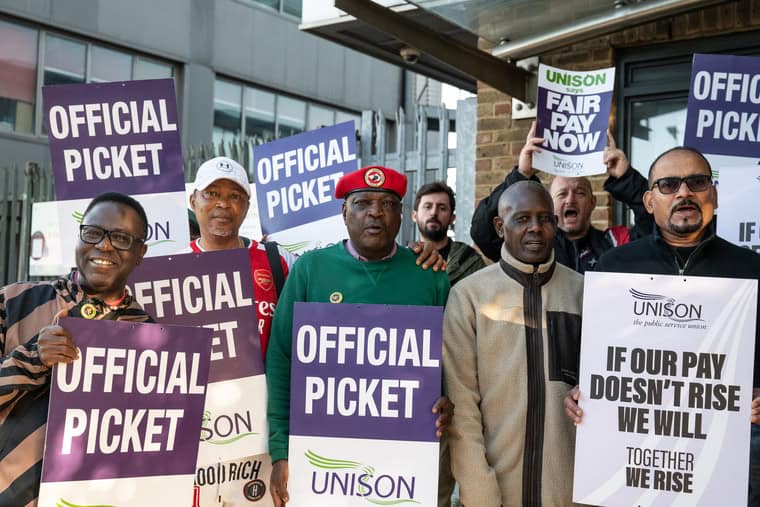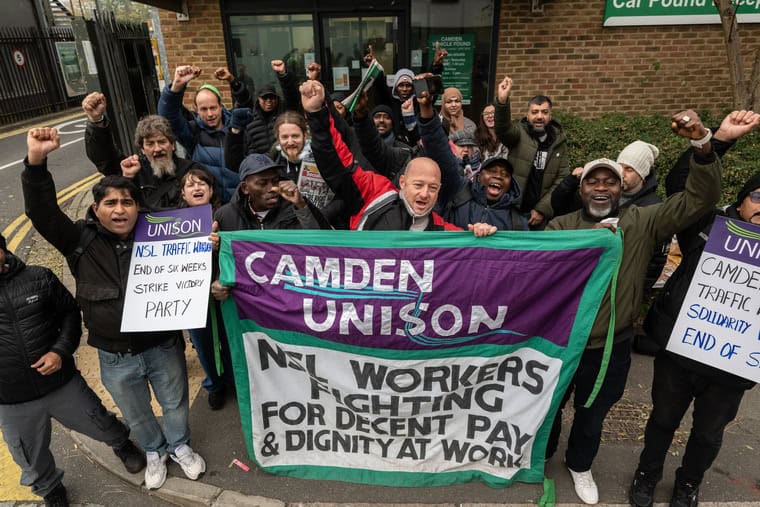
Meet the migrants driving wages up (Photo: Guy Smallman)
Migrant workers are blamed for “driving down wages” day after day in the mainstream media.
It is the same pernicious lie touted by the bosses and politicians seeking to blame migrants for the lack of housing or for crumbling public services.
But in Camden, north London, traffic wardens have smashed these racist myths apart.
The predominantly black and migrant workforce has shown how workers can push up wages when they stand together. The Unison union members scored their fifth consecutive win against their bosses on Tuesday after six weeks of continuous strikes.
These workers, who keep traffic moving in one of the busiest boroughs in London, have just won a huge pay rise after a fierce battle with their employer, private contractor NSL.
This week they voted overwhelmingly to accept a two-year deal that will see their hourly rate increase by 9 percent in this financial year, more than twice the RPI rate of inflation.
Pay will go up again in April next year to £19.10, a further increase of 6.1 percent.
One worker told Socialist Worker after the victory was declared, “This is a very good win.”
“We already have our eyes set on next year’s claim to secure the rest of what we want.
“We didn’t get the seven days of annual leave or sick pay from day one that we put in for.
“Sick pay and more annual leave—NSL knows that will be our next target. We’re already getting ready.”
When the dispute started, NSL bosses said that they could only afford a pay increase of 55p an hour.
But workers were confident that they could push for far more—and together, that’s exactly what they did.
However, the strike was never just about pay. Workers will also see an improvement in their terms and conditions as part of the deal. As of April next year, all workers will have an additional three days of annual leave.
Initially, NSL said that an increase in annual leave was “impossible” as it was part of their national terms and conditions.
Another worker explained that with every strike, members are aiming to bring pay—and terms and conditions—closer to those of Camden council workers.
“At the moment, Camden council is outsourcing the workforce to NSL because it saves money by not paying into pension pots or for sick or annual leave,” he said.
But the closer the traffic wardens’ terms and conditions align with workers at Camden council, outsourcing makes less sense even on its own term.
“We want to be brought back in house,” he said. “That’s what all of us are fighting for.”
Unity in the face of the bosses’ divide and rule tactics is one of the most inspiring stories of the strike.
In a previous offer, NSL bosses had wanted only to concede annual leave to those who had worked for more than five years for the company. But the strikers made it clear that no-one was being left out of the deal.
One worker said, “We wouldn’t have got this deal for every worker without striking.
“What we have learned in previous strikes is that you have to be prepared to stick it out for as long as it takes.
“But as long as you are all together you are strong.
“We wanted to stand our ground until we had an agreement that benefited every worker.”
He added, “We always said if we got to six weeks and we still didn’t have an acceptable offer, we were going to put in for an indefinite strike.
“It was always, we’re all staying out until we get this done.”
For weeks, workers have come together on picket lines for mass meetings where they rejected unfair proposals and stood solid.
A delegation of striking workers even made it to Paris for last week’s mammoth general strike.
A Unison rep at one of the sites celebrated the “carnival atmosphere” on the day despite police kettling them and confiscating their banner poles.
She said that strikers felt it was important to join the general strike because “as members of a union, we know how important it is to support fellow trade unionists”.
“We visited the natural history museum to meet with French workers on the picket line and gave solidarity,” she said.
“We have a lot of things in common, we’re all getting paid a pittance and then it all gets taken back any way it can through bills and taxes and whatever else they can hit you with,” she said.
“I admire the French for standing up for their rights. I wish we were doing more of that in this country. That’s what we did with our strike—stood up for ourselves.”
The traffic wardens in Camden have taught the trade union movement a lesson. If you want a pay rise, strikes are just the ticket.
The victory is a reminder that bosses don’t hand out better wages because workers deserve them. They do it just because workers get organised and fight for more.
The real power to push wages down lies with employers who use insecure work, low pay and divisions between workers to try to drive up their own profits.
The answer isn’t to turn on migrant workers. It is to organise alongside them. When workers stand together, bosses face a much harder job of playing one group off against another.
And a better paid workforce can help raise expectations for everyone.
The Camden traffic wardens’ dispute also shows that workers don’t need to wait for politicians to improve their lives. They got organised and went out and fought for it themselves.
As the Labour government increasingly seeks ways to make workers pay for their crises or for scapegoats to blame, examples like Camden are important.
The working class is made up of people from many countries, backgrounds and communities.
These workers have proven in practice that we all have a common interest in winning higher pay, better conditions and more control over our working lives.
The bosses want workers divided. But the Camden traffic wardens showed the opposite—when workers stick together, they can force their employers to pay up.


Higher education battle plus further education strike ballot and round-up
Health workers want Palantir out of the NHS
PM Lecornu offers only crumbs
Plus: How socialists can mobilise large numbers of people