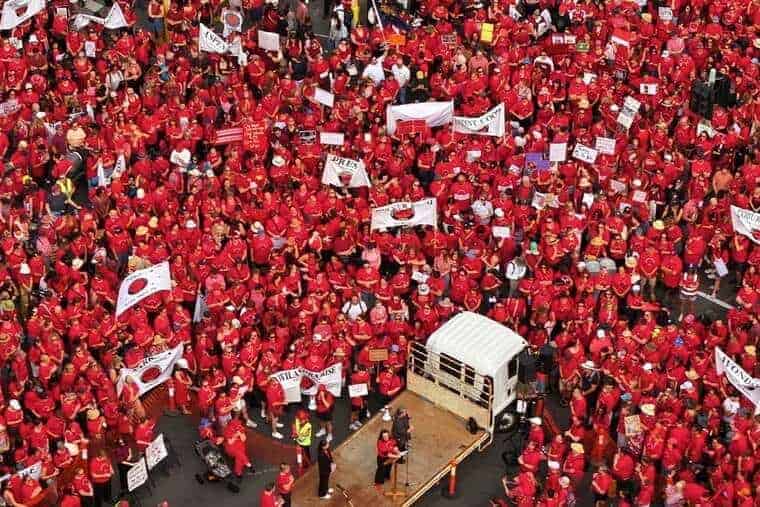
The biggest popular mobilisation in South Korean history brought the country to a standstill last Saturday.
Around 1.7 million people took to the streets in the capital Seoul alone. A further 200,000 protested in Busan, the traditional heartland of the ruling Saenuri party.
Rail, metal and public sector workers’ unions mobilised in large numbers.
This growing movement forced president Park Geun-hye to announce that MPs would decide her fate last week. It was a dirty tactic to avoid impeachment by appeasing rebel MPs within her own party.
The rebel MPs soon declared they will not vote for impeachment.
This immediately divided the opposition parties. One of them argued that it didn’t have enough MPs to push through the impeachment.
But Saturday’s protests forced the rebel MPs within the ruling party to flip again.
Now it is more likely that Park will be impeached on Friday of this week, but the constitutional court will need to ratify the decision.
That may take up to six months, which leaves plenty of room for political uncertainty.
But the demand for immediate resignation has been taken up across the working class movement.
For weeks the opposition parties have been distancing themselves from the movement, relying on negotiations with the ruling party.
Fierce
Only a fierce backlash from protesters moved them to impeach the president—but they backed down after Park’s announcement.
But the left wing KCTU trade union federation’s one-day protest strike last Wednesday acted as bridge to the mass demonstration.
Many ordinary people were outraged to see Park refuse to step down. They also criticised the opposition parties for their opportunistic behaviour.
As a result, last Saturday’s protest had a more ferocious atmosphere than previous ones. Many shouted, “Arrest Park Geun-hye,” along with, “Step down immediately.”
One retail worker said, “I work from 7am and now my back is aching terribly.
“Yet I couldn’t help coming to this protest after seeing Park’s announcement. They are monsters.”
On Saturday many trade unions put forward demands about wages and working conditions.
Rail workers have been on strike for more than two months. Shipbuilding workers face
large-scale “restructuring” due to the crisis. Migrant workers are suffering discrimination.
They all brought their demands onto the protests.
Protesters also demanded the arrest of Samsung and Hyundai Motors’ bosses for bribery. They had insisted in front of a parliamentary hearing that they did not bribe Park.
But people do not trust them and will not stop protesting until they are held to account.
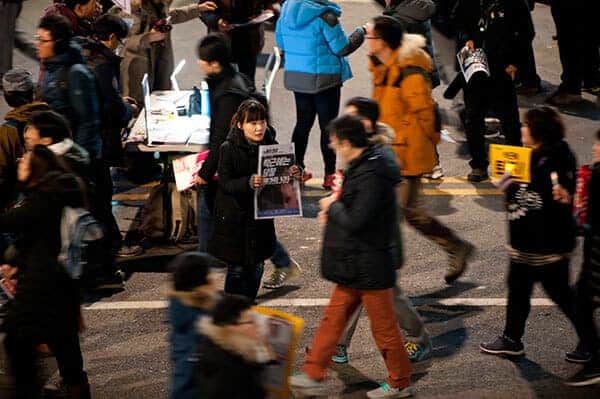
More than 8,000 copies of Socialist Workers’ sister newspaper Workers’ Solidarity were sold on last Saturday’s protest (Pic: Workers’ Solidarity)
Many forces within the movement acknowledge that workers have played an important role.
Workers have launched political strikes against the government and have been the backbone of the street protests.
However, organised workers do not lead the movement because their union leaders are holding them back.
And the right wing forces within the movement—NGOs and the Stalinists—are constantly attempting to limit the movement to supporting parliamentary activities.
They are doing everything they can to push the left wing trade unions and the radical left to the margins of the movement.
One of their arguments is that protests should take place in front of parliament, instead of their current site near the presidential residence.
This reflects the right wing of the movement’s intention to transform people’s direct action against the president into support for MPs in parliament.
For weeks, the police have been forced little by little to allow protesters to come within 100 metres of the presidential residence.
To argue that we need to pull back and instead head towards parliament, more than six miles away, is ridiculous.


Fascist Tommy Robinson didn’t receive the same treatment
Russia has threatened revenge after British-made drones targeted its oil refineries and transport networks
Progressive candidate has won primary in Republican dominated state
Rank-and-file rebellion secures pay rise