
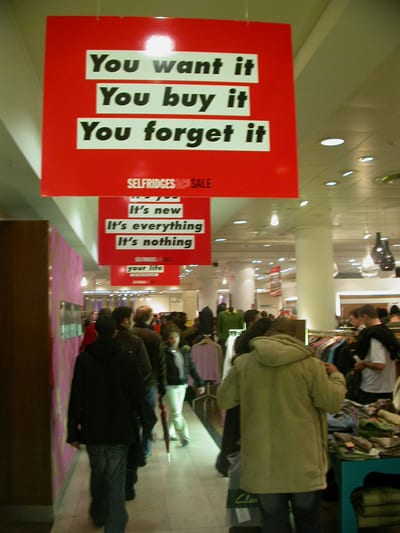
Bold red, black and white signs incorporating phrases extolling the distortion of desire that comes with commodity fetishism were everywhere. It was as if a bunch of Marxist subvertisers had crept in late at night and hijacked the space. Critiques of consumerism sourced from Malcolm X, Charles Baudelaire and Edgar Allen Poe, among others, were everywhere – as part of a collaboration between New York artist Barbara Kruger and the store.
Barbara became famous in the 1980s for her strong graphic social commentary and straplines such as “I shop therefore I am”. These were often displayed in public spaces on billboards, and critiqued the rightward drift of culture. Some 20 years later, rampant privatisation and its corollary, the foreclosing of cultural subsidies by the state, has had the damaging and ironic effect of creating a bastardised version of the avant-garde dream of bringing art into everyday life. This example shows that this has been achieved but with one small proviso – public art must have a company logo and a sponsorship deal attached. In this corporate-friendly climate, Selfridges, like many companies aiming at a cultured middle class consumer, has positioned itself as both patron and site for the arts. It regularly commissions work for its window displays – and this is a small part of the blurring of the concerns of commerce, fashion and fine art.
The Selfridges campaign has been part of a three-year collaboration between Kruger and the retailer, which was developed by Mother – an “edgy” advertising agency who specialise in “anti-advertising”. Mother’s campaigns tend to reverse the standard cliches of advertising in an attempt to reach jaded audiences. They are responsible for the Orange mobile phone ads you may have seen at the cinema, which play on the idea that you don’t want corporate culture ruining your movie – as a way of reminding you to turn off your phone.
Kruger has not commented on her involvement with Selfridges. Maybe she thinks that this is the perfect venue for her work. But the recuperation by corporate capitalism of her ideas and signature style seems a heavy price to pay for someone who has built their reputation on being critical of the way corporate images control and limit human consciousness and potential.
Whatever she may think, James Bidwell, Selfridges’ marketing director, is under no illusions. Discussing the campaign, he said, “There seems to be a standard template for sale advertising among retailers, but we wanted to do something completely different. Kruger’s work engages on several levels and will add to the overall Selfridges sale experience.”


In November of last year, there was a brief moment of light amid the darkness that was 2020. Scotland became the first country in the world to make period products free for all. Just as the weekend and the eight-hour-day are now regarded by many as a given, future generations may be in disbelief that...
On 4 November last year, when many of us were watching the aftermath of the American presidential election, the US formally left the Paris Climate Agreement. Written in 2015 at the United Nations’ COP21 climate conference in Paris, the agreement is often considered to be the most significant document of international climate cooperation. Back then,...
To say 2020 was dramatic would be an understatement. The world situation has been completely transformed by the Covid-19 pandemic and the inadequacy of governmental and state responses. As we head into 2021 it feels like we are entering uncharted territory. To make specific predictions would be unwise. But the Covid-19 crisis raises fundamental questions...
The 2020 crisis we’ve endured isn’t an aberration of the system but, as Alex Callinicos argues, an aspect of its permanent crisis.

