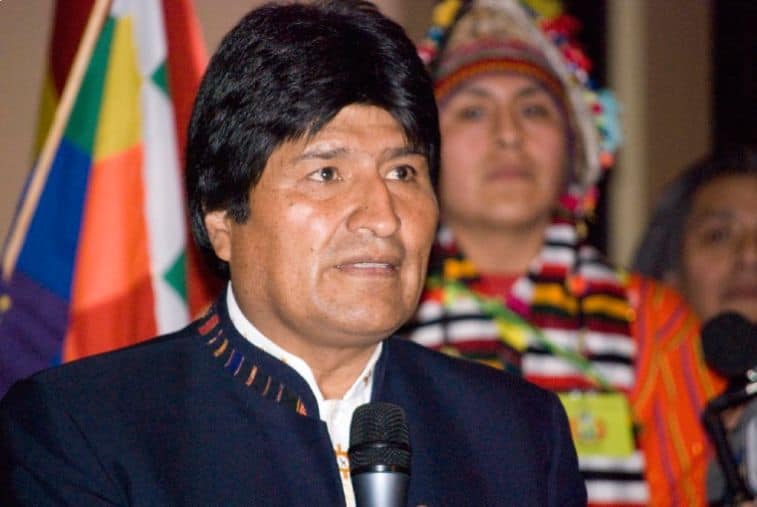
Morales was Bolivia’s first indigenous president (Pic: Sebastian Baryli on flickr)
Bolivia’s Movement for Socialism (Mas), a party that has led the country since 2005 and survived two coup attempts, has just been all but eradicated in this month’s election.
The presidential election will go to a second round on 19 October. It’s a run-off between two right wing candidates, Rodrigo Paz Pereira and Jorge Quiroga.
Official results of the vote count aren’t out yet, but America Elects predicts that Mas won only one seat in the chamber of deputies and no seats in the senate, leaving the country governed by parties of the neoliberal right.
In 2005, Mas leader Evo Morales was elected as Bolivia’s first ever indigenous president. Bolivia is mostly indigenous, but its ruling class is almost entirely white. Morales’ election gave hope for indigenous working class people.
Morales was seen as a leader of mass struggles against privatisation in Bolivia, and his election took place during the “pink tide”, a wave of left wing victories across Latin America.
As president, he introduced some pro-indigenous reforms, turning the country into a “plurinational state” with indigenous nations gaining equal rights under the law.
However, Morales was no revolutionary. He wanted to compromise with the ruling class. He gave concessions to social movements that took them off the streets and defended the capitalist state.
In 2019, amid declining popularity and attempts by Morales to stay in power, a coup supported by Donald Trump and the United States installed a far-right government led by Jeanine Anez. This government was deeply unpopular and killed dozens of protesters. In 2020 Mas was elected back in.
Voters expected a break from neoliberalism and real change, but the new centre-left president and former banker Luis Arce had other plans. Arce focused on reassuring banks and imperialists that Mas could be friendly to them.
Arce was massively unpopular, but left-wing opposition wasn’t channelled to the streets. Instead, it was channelled towards reformism and Morales, who tried to run for president again this year despite being ineligible.
During Arce’s term, Morales faced credible accusations of sexual assault that his supporters dismissed as political persecution. In a video published by the Guardian newspaper, Morales was seen being defended from arrest by his supporters inside a makeshift fortress.
Going into the election, Mas was seen as corrupt, divided and ineffective. Tired of betrayal from reformists, Bolivians turned to the right, hoping for change.
But the right will only help the rich, Neoliberal governments across Latin America have attacked indigenous people and the working class.
Reformism led to this election result, the left needs to take to the streets not the ballot box if it wants to secure real change.


Strikers are demanding an unallocated €1.6 billion go towards workers' pay rise
Another day of mass resistance